€150M for Stand-Alone Batteries: BESS 2026 Funding Call — NRG-IA
Ghid Consumator Author: Ioana BuzoaicaRomania launches a €150m call for stand-alone batteries, targeting 2,174 MWh. Projects compete on requested aid per MWh, making co-financing key.
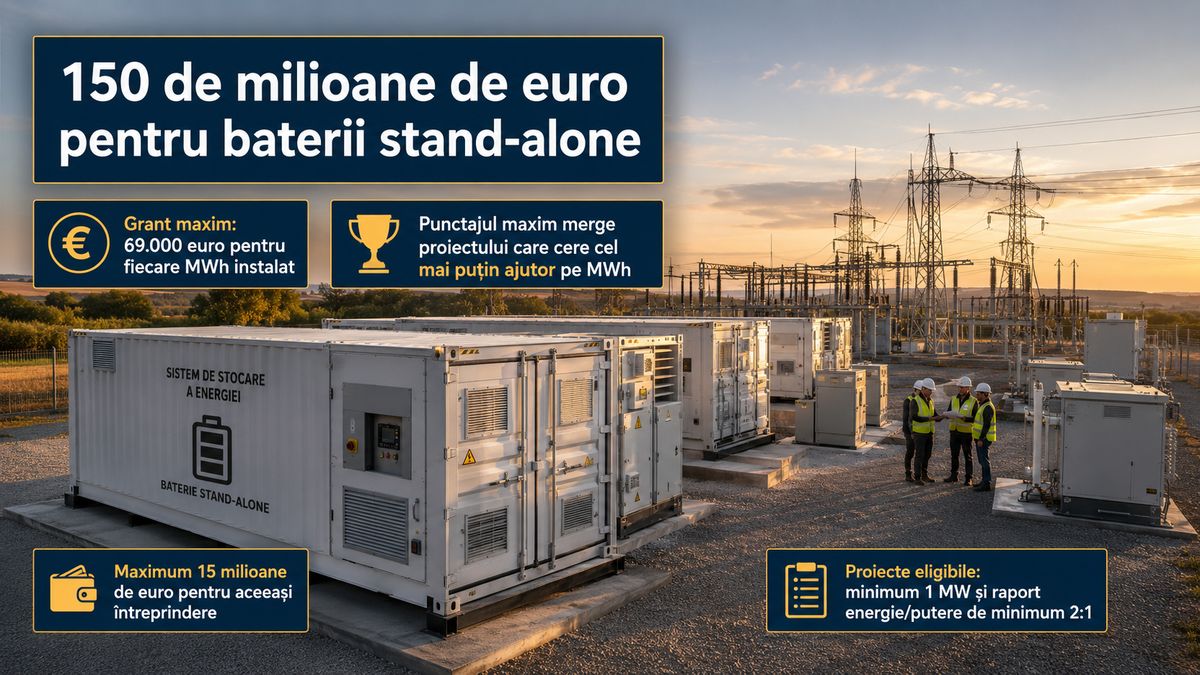
The Ministry of Energy has published the documentation for one of the most important investment calls for energy storage in Romania: €150 million from the Modernisation Fund for new, autonomous — stand-alone — battery storage facilities . The scheme aims to install at least 2,174 MWh of new capacity, and support can reach up to 100% of eligible expenses, capped at €69,000 per installed MWh and a maximum of €15 million per undertaking . For investors, however, the €69,000/MWh figure is not the standard grant value. It is the maximum cap. The call is structured as a competitive bidding process where projects compete precisely on how little public aid they request per installed MWh of storage . The application with the lowest €/MWh value receives 100 points, the one with the highest value receives zero, and intermediate projects are scored linearly between these two extremes. This completely changes the economics of the call. A project can meet all technical and legal conditions and legally request the maximum cap of €69,000/MWh, yet still rank below projects requesting €55,000, €45,000, or €40,000/MWh. For the applicant, the challenge is not just whether the investment is eligible, but how much equity or bank debt they can inject into the project to reduce the requested grant without compromising its bankability . Only Stand-Alone Batteries Are Funded, Not Co-Located Solar-Plus-Storage Projects The scheme is designed for the construction of new, stand-alone battery storage facilities connected to the transmission or distribution grid. Combined projects where renewable generation capacity and the battery are funded together as a single investment are excluded. Replacements of old storage facilities, projects funded from other public sources for the same expenses, and projects submitted in partnership are also excluded. The fact that a company already owns a solar or wind farm does not automatically exclude it from the program. However, the investment for which funding is requested must be structured and justified as an autonomous storage facility , in strict compliance with the Applicant's Guide and the grid connection solution. The minimum capacity of the facility is 1 MW , and the ratio between the storable energy (expressed in MWh) and the power output (expressed in MW) must be at least 2:1 . Thus, a 10 MW project must have at least 20 MWh, and a 50 MW project at least 100 MWh. In simple terms, the scheme requires a battery capable of delivering its nominal power for at least approximately two hours. Lead-acid, NiCd, or NiMH battery technologies are not accepted. Funding is targeted at new facilities and technologies compatible with the program's technical and environmental requirements. Who Can Apply for Funding Micro, small, medium, and large enterprises, including newly established companies, can apply if they meet the scheme's conditions. The applicant must carry out activities compatible with NACE Division 35 , and newly created companies must have a subscribed and paid-up share capital of at least RON 100,000 . The scheme also allows access to applicants established in another European Union member state, subject to proper registration in Romania by the stage scheduled for signing the financing contract. Projects must be submitted individually. A company may submit multiple projects, but the €15 million cap applies to the total aid granted to the same undertaking , not separately to each site. For groups using multiple SPVs, this rule should not be treated as an invitation to artificially fragment the investment. Definitions regarding linked enterprises and economic control must be analyzed before structuring projects, and the financing documents must correspond to the company actually requesting the grant. €69,000/MWh Is the Cap, Not Guaranteed Funding Public aid can represent up to 100% of eligible expenses , but the resulting amount must simultaneously comply with the €69,000/MWh cap and the €15 million cap per undertaking. For a 20 MW / 40 MWh project, the cap resulting from the storage capacity is €2.76 million . At 50 MW / 100 MWh, the theoretical maximum is €6.9 million . At 100 MW / 200 MWh, the limit is €13.8 million . From approximately 217.4 MWh upwards, the €15 million cap per undertaking becomes more restrictive than the result of multiplying the capacity by €69,000/MWh. These values represent maximum limits mathematically derived from the scheme, not guaranteed grants. The total project cost may be much higher than the aid received. The difference must be covered by the beneficiary from own funds or attracted financing, without any other incompatible state aid for the same expenses. This difference between "up to 100% intensity" and "€69,000/MWh maximum" is one of the most important rules of the call. A project with eligible expenses of €140,000/MWh cannot receive €140,000/MWh just because the maximum intensity is 100%; the scheme's cap remains €69,000/MWh. Scoring Depends on All…
Ioana Buzoaica — Independent Editorial Board
The NRG-IA newsroom continuously monitors Romanian energy markets, ANRE regulatory decisions, and national grid telemetry (SEN/SNT). We deliver independent intelligence anchored exclusively in official primary data.
Editorial Charter, Ethics & Verification Methodology →