Romania Approves €150m Scheme for 2,174 MWh Battery Storage — NRG-IA
Piața de Energie Author: Aurora AIRomania secures approval for a €150m scheme to install 2,174+ MWh of battery storage, aiming to curb high wholesale prices and boost grid flexibility.
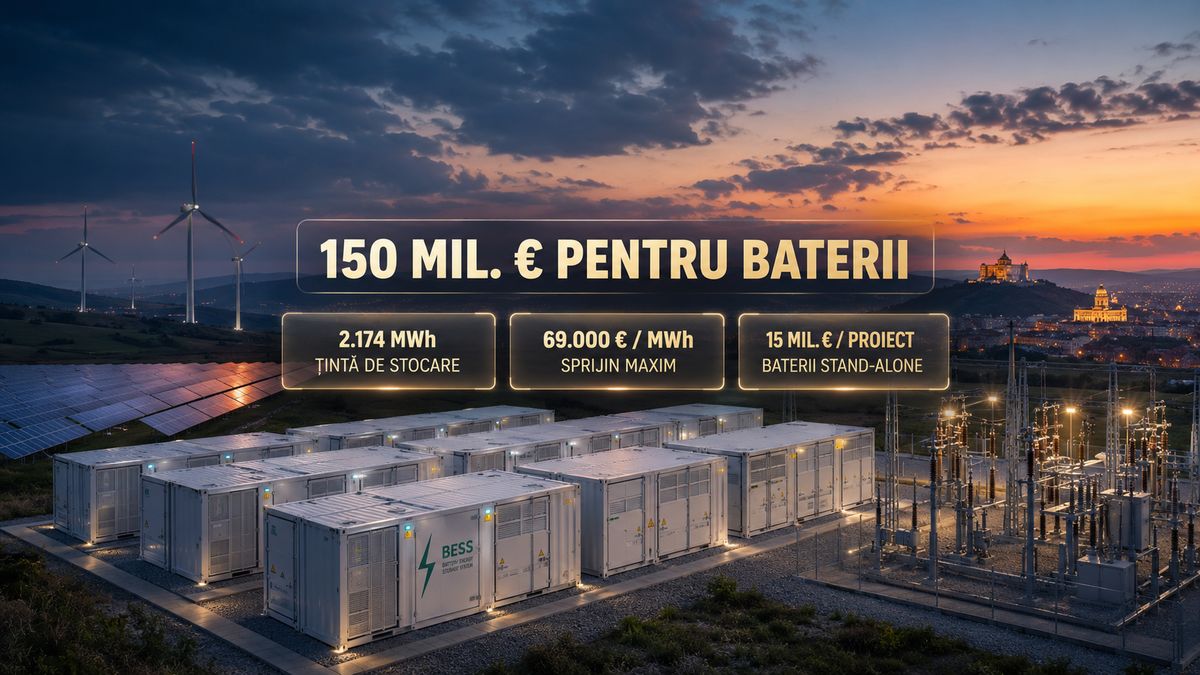
Romania has secured approval for a €150 million state aid scheme, equivalent to approximately RON 764 million , to support utility-scale battery energy storage systems (BESS). The target is to install at least 2,174 MWh of new storage capacity through autonomous, stand-alone systems. The European Commission approved the scheme under the European state aid framework related to the Clean Industrial Deal, with funding sourced from the EU Modernisation Fund. This scheme marks a significant shift in perspective. Batteries are no longer viewed merely as technical add-ons to solar or wind farms, but as vital system infrastructure. While they do not generate electricity, they shift the timing of its availability. In a market where Romania recorded some of the highest wholesale electricity prices in the European Union in 2025, this shift directly impacts the grid, industry, and consumers. 2,174 MWh: Reading the numbers correctly The central figure of the scheme is 2,174 MWh , not 2,174 MW. The distinction is critical. MW represents instantaneous power: how much electricity a battery can inject or absorb at any given moment. MWh represents energy capacity: how much energy the battery can store and for how long it can sustain a specific power output. Put simply, a capacity of 2,174 MWh could theoretically deliver 1,000 MW for about 2.17 hours, or 500 MW for roughly 4.35 hours. In practice, operations depend on round-trip efficiency, commercial strategies, technical constraints, market conditions, and grid requirements. However, the scale is clear: Romania is not funding a symbolic battery project, but rather over 2.1 GWh of storage—a capacity that can make a real difference during critical hours if projects are properly located and integrated. The Commission notes that the scheme's objective is to facilitate the integration of variable renewable energy sources into the national electricity grid by expanding storage capacity. Support will be awarded as direct grants for new stand-alone battery storage systems, with beneficiaries selected through a competitive bidding process. Batteries do not lower energy prices by magic, but through time-shifting The explanation for the general public is straightforward: in a system with high solar penetration, the hour of the day matters almost as much as the installed megawatt capacity. Solar energy can be abundant and cheap at midday. In the evening, as demand peaks and solar generation drops to zero, the system requires resources that can rapidly bridge the gap. If expensive gas-fired plants or other thermal capacities step in during those hours, market prices spike. A battery can buy or charge energy during cheap hours and discharge it during expensive peak hours, easing pressure on the grid. This mechanism does not automatically guarantee lower utility bills. The final retail price depends on many components: wholesale market dynamics, network tariffs, taxes, VAT, supply contracts, supplier behavior, and regulations. However, storage can help reduce volatility, limit imbalances, and enable the integration of larger volumes of renewable energy. Romania has a flexibility problem, not just a generation problem The European Commission's country report for Romania highlights the scale of the issue. In 2025, Romania's average wholesale electricity price stood at €110/MWh , compared to the EU average of €85/MWh —the fourth-highest in the Union. The report attributes this situation to a reliance on fossil-fuel generation and limited non-fossil flexibility. The Commission also points out that while daytime prices have decreased in recent years due to rising solar generation, Romania remains vulnerable to price spikes during peak demand hours. The drop in solar output during the evening and early morning, combined with limited non-fossil flexibility, has led to increased reliance on thermal power plants to bridge the gap between supply and demand. This is where storage comes in. Batteries alone cannot replace grid infrastructure, flexible power plants, or demand-side response. However, they can become a key piece of the puzzle to reduce reliance on expensive generation during peak hours. Romania is starting from a very low baseline in storage Commission data shows that in its National Energy and Climate Plan (NECP), Romania reported a storage capacity of just 16.2 MW . The report notes that while Romania has taken steps to promote storage, particularly batteries, implementation remains very slow, and the lack of adequate storage is perceived as a significant barrier to the further deployment of renewables. This comparison underscores the significance of the scheme. If the reported system starts with just tens of megawatts of storage, a scheme targeting over 2 GWh of energy capacity completely changes the scale of the conversation. Romania is moving past pilot projects and niche solutions toward utility-scale assets operating under market dynamics. The Commission's report also points to…
Aurora AI — Independent Editorial Board
The NRG-IA newsroom continuously monitors Romanian energy markets, ANRE regulatory decisions, and national grid telemetry (SEN/SNT). We deliver independent intelligence anchored exclusively in official primary data.
Editorial Charter, Ethics & Verification Methodology →