Romania: €150M Battery Storage Modernisation Fund — NRG-IA
Ghid Consumator Author: Aurora AIRomania approved a €150m state aid scheme for battery storage. The call targets BESS projects to directly boost power market flexibility.
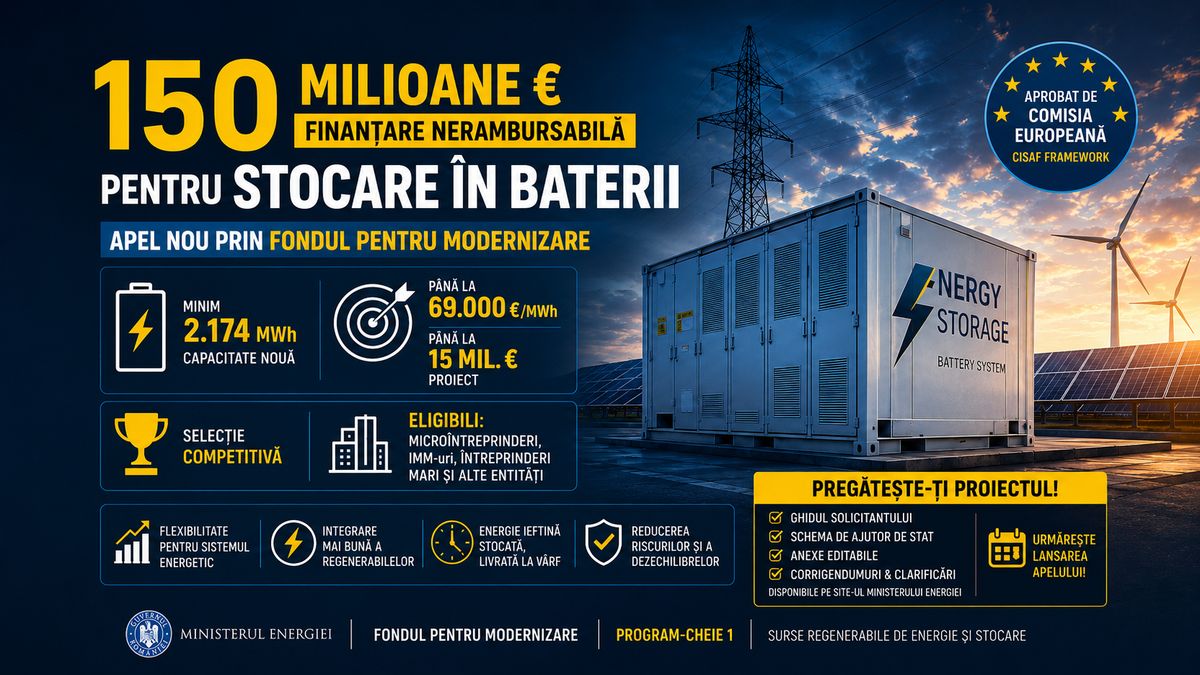
Romania is entering a critical phase for electricity storage: the European Commission has approved a €150 million state aid scheme to install at least 2,174 MWh of new battery storage capacity. Funded through the Modernisation Fund , the initiative targets the development of stand-alone battery energy storage systems (BESS) selected via a competitive bidding process. This scheme is more than just technical funding for batteries. It marks the transition of storage into key energy infrastructure essential for balancing, flexibility, renewable integration, and easing grid pressure during peak hours. Approved Funding: €150 Million for Utility-Scale Storage The European Commission-approved scheme aims to deploy new electricity storage capacities, targeting a minimum of 2,174 MWh . Support will be granted as direct investment grants , with beneficiaries selected through a competitive bidding process. The aid is funded by the Modernisation Fund , an EU mechanism designed for lower-income member states to accelerate the energy transition, modernise energy systems, and reduce emissions. According to European communications, this scheme is Romania's first measure approved under the Clean Industrial Deal State Aid Framework — CISAF , the EU framework enabling targeted support for decarbonisation, clean technologies, and infrastructure vital to a net-zero economy. Targeted Project Types The funding targets new stand-alone battery storage systems . This is a crucial distinction: this call must be differentiated from previous schemes that targeted behind-the-meter batteries directly co-located with existing renewable energy generation capacities. Under this newly approved scheme, the focus is on batteries operating as independent market and grid assets. Depending on their technical, commercial, and regulatory integration, these systems can help absorb surplus energy during high-generation periods, discharge power during peak hours, mitigate imbalances, and enhance the flexibility of the National Power Grid (SEN). Who Should Monitor This Call The call is highly relevant for economic operators and entities capable of developing storage projects backed by robust technical design, financial capacity, and mature documentation. Key interested parties include: micro-enterprises; small and medium-sized enterprises (SMEs); large enterprises; start-ups, provided they meet the guidelines' criteria; autonomous administrations or other entities explicitly mentioned in the final documentation; energy infrastructure investors, BESS project developers, power producers, and players interested in flexibility services. Final eligibility must be verified in the Applicant's Guide and the State Aid Scheme published by the Ministry of Energy. The final official call document is the sole decisive authority, rather than press releases or commercial summaries. Support Value and Selection Logic Publicly available data indicates support of up to €69,000/MWh installed, capped at €15 million per project . Selection will be competitive, meaning projects will not be evaluated merely on investment intent, but on their ability to deliver cost-effective storage under the aid scheme. For investors, the critical criterion will be the ratio between proposed capacity, eligible costs, requested aid, and project maturity. Projects lacking clarity on land rights, grid connection, permits, technical solutions, operating models, and financial structures will struggle to compete. Official Documents to Review Before Project Preparation For any entity interested in funding, the correct starting point is the Ministry of Energy's official page dedicated to the call “Supporting investments in the development of electricity storage capacities — batteries” , as well as the general section Modernisation Fund — Key Programme 1 . This is where the final call documents, editable annexes, corrigenda, and subsequent clarifications must be tracked. The essential documents for analysis are: The Applicant's Guide — the primary document establishing eligible beneficiaries, fundable project types, evaluation criteria, eligible and non-eligible expenses, required documentation, and the submission procedure. The State Aid Scheme — the document setting out the legal framework for funding, the form of support, aid limits, cumulation rules, and the conditions under which the grant can be awarded. The Editable Annexes of the Call — the forms that must be completed by the applicant to form part of the funding application file. Corrigenda published on oportunitati-ue.gov.ro — documents that may modify deadlines, criteria, forms, eligibility conditions, or other relevant elements of the call. Clarification Summaries and Updates in Key Programme 1 — crucial for interpreting guide requirements, particularly when the Ministry of Energy responds to queries raised by potential applicants. For any applicant, analyzing these documents is essential before the official opening of the submission…
Aurora AI — Independent Editorial Board
The NRG-IA newsroom continuously monitors Romanian energy markets, ANRE regulatory decisions, and national grid telemetry (SEN/SNT). We deliver independent intelligence anchored exclusively in official primary data.
Editorial Charter, Ethics & Verification Methodology →