Romania Solar Record: 3,453 MW Peak Output on Aug 20, 2026 — NRG-IA
Energie Regenerabilă Author: Ioana BuzoaicaRomania's dispatchable solar output hit a record 3,453 MW on Aug 20. The rapid growth highlights the urgent need to shift midday surplus to evening peak.
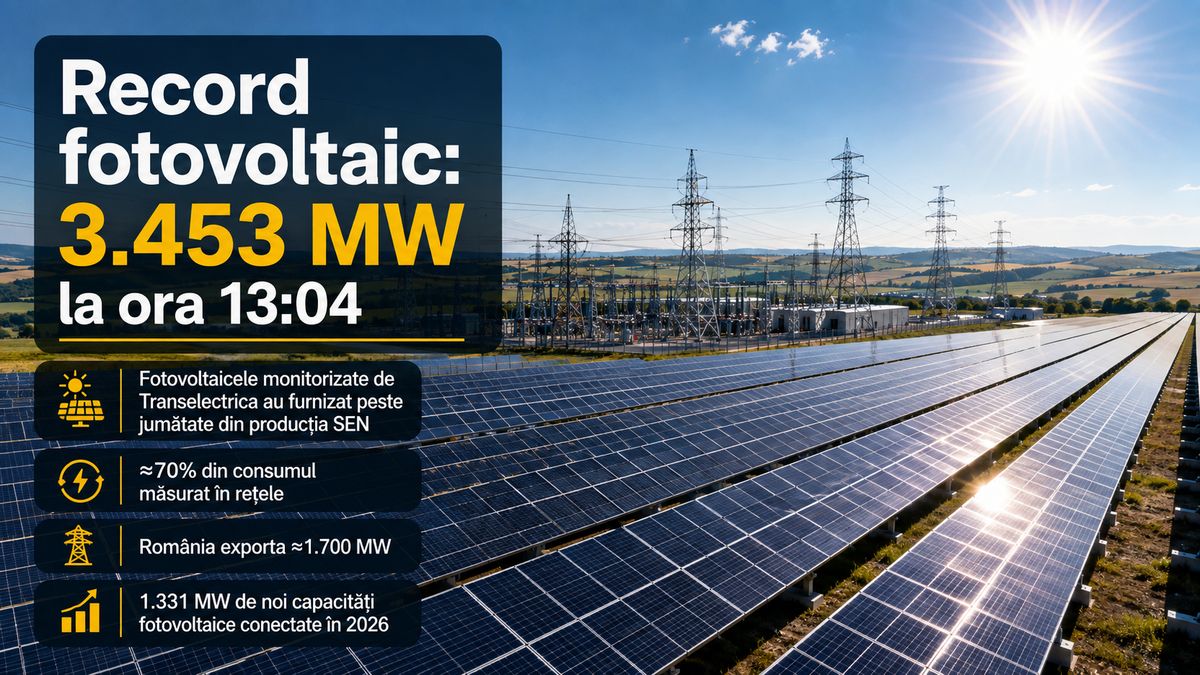
Dispatchable photovoltaic parks monitored by Transelectrica reached an instantaneous output of 3,453 MW on August 20, 2026, at 1:04 PM , setting a new record for solar generation visible in the National Power System (SEN). At that moment, grid-measured consumption stood at approximately 4,800 MW, solar PV accounted for around 52% of the SEN's total generation, and Romania was exporting about 1,700 MW. The 3,453 MW figure represents the instantaneous power output of the utility-scale parks monitored by Transelectrica, rather than the energy generated over a specific timeframe or the country's total solar output. Energy is measured in MWh, and prosumer generation is not fully captured in this figure. Compared to the grid-measured consumption of approximately 4,800 MW at the same hour, dispatchable solar generation was equivalent to roughly 72% of the system's visible demand . However, this percentage does not reflect Romania's total actual consumption, as many prosumers cover their demand directly from their own generation—energy that does not fully register in grid-level consumption measurements. The previous record lasted only three days The speed at which these peaks are being broken is just as significant as the record itself. On August 17, dispatchable solar generation had reached 3,301 MW at 12:51 PM , the peak at the time. Just three days later, that record was broken by another 152 MW, reaching 3,453 MW. This growth is not merely the result of a favorable sunny day. Behind these successive peaks lies a rapid expansion of installed capacity. On August 20, Transelectrica announced that 1,331 MW of new solar capacity had been grid-connected since the beginning of the year, representing the largest share of the 2,514 MW of new generation and storage capacity commissioned in 2026. Another 496 MW came from wind power, and 663 MW from energy storage facilities. By August 1, the installed capacity of dispatchable solar parks had reached approximately 4,163 MW , following a 323 MW increase compared to the beginning of July. The peak of 3,453 MW means that, at the moment of the record, instantaneous generation was equivalent to roughly 83% of this installed capacity. Romania already has over 8 GW of solar capacity when including prosumers The overall solar landscape is much larger than the 4.16 GW tracked under the dispatchable power plant category. As of June 30, 2026, the Romanian Energy Regulatory Authority (ANRE) reported 359,378 prosumers , with a cumulative installed capacity of 4,019.17 MW . Residential prosumers accounted for 2,067.47 MW, while commercial and industrial prosumers made up 1,951.69 MW. Combining the approximately 4.16 GW of dispatchable solar parks reported on August 1 with the 4.02 GW of prosumer capacity installed as of late June puts Romania's total known solar capacity at over 8 GW . While these two figures correspond to different dates and do not represent a synchronized single-day inventory, their scale highlights how rapidly the system has transformed: distributed solar capacity at the consumer level is now comparable to the capacity installed in utility-scale parks monitored by the transmission system operator. On the day of the record, Economica.net estimated that prosumers were generating around 2,200 MW . If this estimate is close to reality, total solar generation at that moment could have reached around 5.65 GW. However, this is not an official aggregated measurement: it is not known in real time how much of the prosumers' energy was self-consumed, how much was charging local batteries, and how much was injected into the public grid. At the hour of the record, Romania was exporting approximately 1,700 MW The system balance around 1:04 PM demonstrates the sheer power that solar has achieved during certain times of the day. While monitored solar plants were producing 3,453 MW, Romania had a net export balance of approximately 1,700 MW . These exports cannot be attributed solely to solar. Hydroelectric, nuclear, wind, and thermal power plants were all operating simultaneously in the SEN, and cross-border flows reflect the balance of the entire system. However, the coincidence of peak solar generation, relatively low visible grid demand, and high exports highlights just how much power becomes available during peak solar production hours. This transformation is gradually shifting the nature of the energy challenge. Romania is no longer just discussing how to build more generation capacity. At certain hours, the challenge is becoming how to utilize the energy that is already available. The midday record shifts the challenge to the evening Solar power has a predictable profile: generation rises in the morning, peaks around midday, and drops off as evening approaches. Demand does not follow the same curve. The result can be a system with abundant energy at noon, high exports, and reduced pressure on conventional generation, followed just a few hours later by the need to rapidly…
Ioana Buzoaica — Independent Editorial Board
The NRG-IA newsroom continuously monitors Romanian energy markets, ANRE regulatory decisions, and national grid telemetry (SEN/SNT). We deliver independent intelligence anchored exclusively in official primary data.
Editorial Charter, Ethics & Verification Methodology →