Lower Olt: €400M, 200 MW Unused Pumped Hydro & New BESS — NRG-IA
Ghid Consumator Author: Ioana BuzoaicaRomania spent €400M on 200 MW of pumped hydro on the Lower Olt, but never used its storage. Now, Hidroelectrica plans a 200 MW BESS on the same sector.
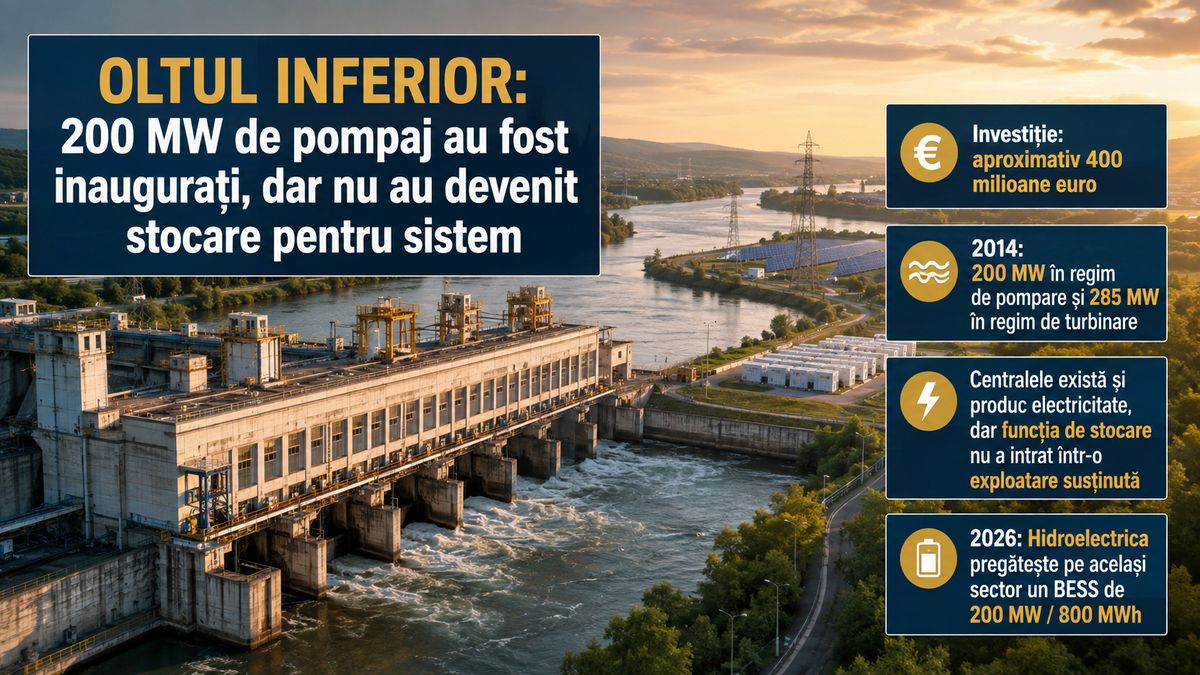
Romania built a 200 MW pumped storage capacity on the Lower Olt River, officially commissioning it in 2014 and testing its reversible operation after a modernization project costing approximately €400 million . Within less than a year, however, the pumping mode was abandoned in daily operations, with Hidroelectrica citing a lack of economic viability. The five plants continued to generate electricity as conventional hydropower plants. In 2026, the contrast becomes much sharper. On the exact same Lower Olt sector, Hidroelectrica is preparing a project featuring 200 MW / 800 MWh of battery storage , integrated with a 100 MWp floating solar PV plant. The feasibility study has received internal approval, and the investment decision is currently undergoing authorization. Romania does not, therefore, have a multi-million euro infrastructure that "exists only on paper." It faces a more complex paradox: it physically built 200 MW of pumped storage but failed to turn this capacity into a systematically utilized storage asset, precisely in a power system that now increasingly demands flexibility. The €400 million modernized real plants and created 200 MW of pumping capacity The project targeted five hydropower plants on the Lower Olt—Ipotești, Drăgănești, Frunzaru, Rusănești, and Izbiceni—equipped with a total of 20 reversible hydro-aggregates. Documents from Hidroelectrica’s judicial administrator show that, prior to the upgrades, the equipment suffered from major technical issues and required high maintenance costs. Therefore, the modernization was not solely intended to create pumped storage. The technical results recorded at the time were substantial. Available capacity in generation (turbining) mode increased from 185 MW to 285 MW , while available capacity in pumping mode rose from zero to 200 MW . The projected average annual generation was estimated to rise from 512 GWh to 944 GWh. The plants exist and are operational. Hidroelectrica still includes them in the Lower Olt development scheme today, with the reversible units installed. The issue with the investment is therefore not the absence of infrastructure, but rather that one of its strategic functions—using grid electricity to pump water and later recovering it through turbining—never became a sustained activity. This distinction is essential. A pumped storage plant can function as a hydraulic battery: it consumes electricity during hours when it is abundant or cheap, pumps water to an upper reservoir, and later uses it for generation when the grid needs energy most. The €123 million figure was not the initial contract value The financial history of the project is also more complex than the simple claim that a €123 million contract ballooned to €400 million. The figure of approximately €123.8 million originated from a 2001 study by the Institute for Hydroelectric Studies and Designs (ISPH) and represented an estimated investment budget. The contract actually signed in April 2004 was already valued at approximately €356.7 million and was awarded to a consortium led by Voith Siemens Hydro Power Generation. In the subsequent evolution of the project, including corporate reorganizations of the suppliers, Voith Hydro and Andritz Hydro appear in Hidroelectrica's documents. The final settled cost of the works eventually reached approximately €400 million . This timeline changes the nature of the issue. It is not a case of a €123 million contract tripling during execution. The major discrepancy had already emerged between the 2001 estimate and the contract signed in 2004. The profitability of pumped storage was questioned even at commissioning On May 9, 2014, Hidroelectrica inaugurated at Frunzaru what the company describes in its own history as Romania's first pumped storage hydropower development. The system then featured 285 MW in turbining mode and 200 MW in pumping mode . A trial period for reversible operation was planned, during which energy would be used for pumping at certain intervals and later recovered through turbining. However, the economic challenge was already known at that very moment. Hidroelectrica’s judicial administrator at the time, Remus Borza, stated at the inauguration that, under 2014 market conditions, utilizing pumped storage was not profitable according to the company's calculations. The high investment cost and the ratio between the cost of electricity consumed for pumping and the value of the energy recovered later made the business model difficult to sustain. By May 2015, the five plants were already being operated as conventional hydropower plants, without regular use of the pumping cycle. Thus, Romania found itself in a rare situation: the technical capacity had been built and proven, but the economic mechanism required to sustain its utilization was non-functional. Islaz was considered a necessary link since 2007 and remains unfinished today Another key piece of the puzzle appears in Romania's Energy Strategy approved in 2007.…
Ioana Buzoaica — Independent Editorial Board
The NRG-IA newsroom continuously monitors Romanian energy markets, ANRE regulatory decisions, and national grid telemetry (SEN/SNT). We deliver independent intelligence anchored exclusively in official primary data.
Editorial Charter, Ethics & Verification Methodology →