AFM: RON 400m for prosumer batteries, up to RON 15,000 — NRG-IA
Ghid Consumator Author: Ioana BuzoaicaRomania launches a RON 400m prosumer battery subsidy. The AFM scoring system favors larger solar systems and higher co-financing, up to RON 15,000.
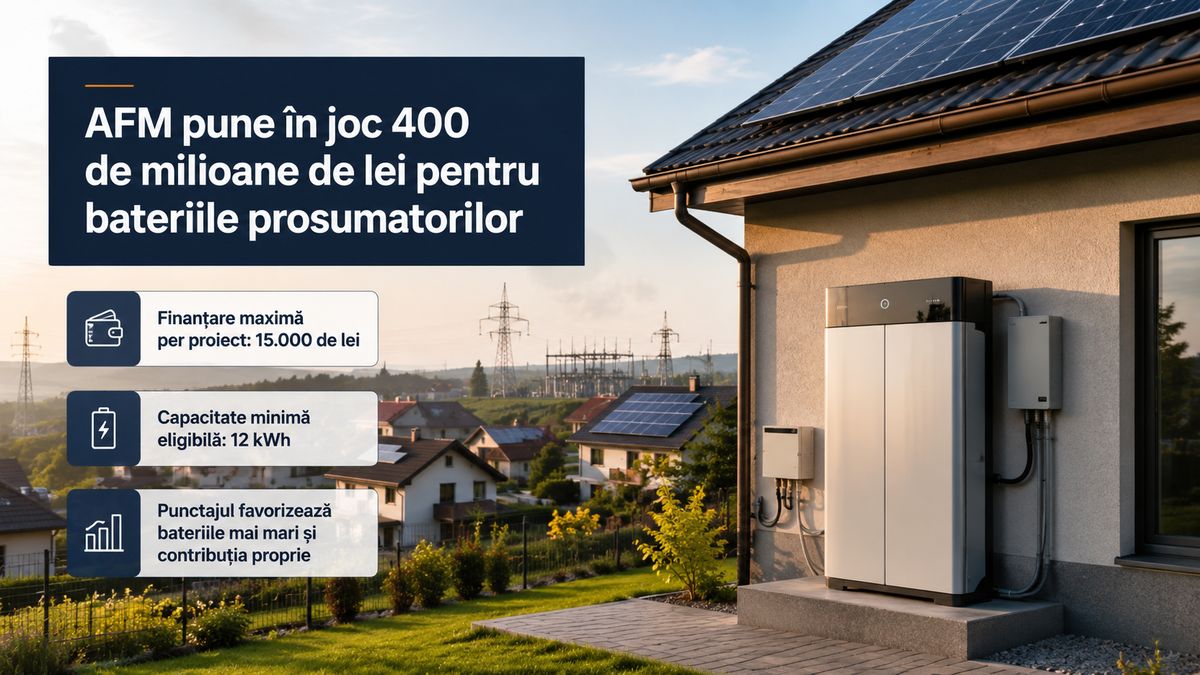
Romania is starting to fund energy storage at both ends of the electricity system. Just days after finalizing the €150 million scheme for stand-alone batteries , the Ministry of Environment launched a public consultation on a RON 400 million program for prosumer batteries . Funding can reach up to RON 15,000 per household, and the battery must have a minimum capacity of 12 kWh. However, the major novelty is not just the budget. The Environment Fund Administration (AFM) project changes the mechanism for allocating funds. The speed of application submission is no longer the primary criterion: requests will be ranked by a scoring system, with the greatest advantages awarded to prosumers who provide a higher self-contribution, install larger batteries, and already own more powerful photovoltaic systems. Thus, two public programs launched almost simultaneously attempt to solve the same problem at completely different scales. The Ministry of Energy's scheme funds grid-connected industrial batteries and rewards projects that request less public aid per installed MWh. The AFM program shifts storage to households, but in turn creates competition for a limited budget. Up to RON 15,000, but the beneficiary must already be a prosumer The program targets individuals who already have prosumer status and own grid-connected renewable installations. The Ministry explicitly states that it does not matter how the existing panels were funded: both beneficiaries of previous AFM programs and those who purchased their PV systems with their own funds are eligible. This provision resolves one of the controversies that arose in the spring, when preliminary documents regarding the AFM budget raised the issue of potentially excluding self-funded prosumers. However, the current draft requires prosumer status at the time of registration. The program is not designed for individuals who only intend to install panels or who are in a preliminary licensing stage. The battery must have a minimum capacity of 12 kWh , and funding can reach a maximum of RON 15,000, VAT included . The Ministry of Environment additionally indicates a cap of RON 1,250 per kWh of storage capacity and a self-contribution of at least 25%. This mechanism means that the RON 15,000 sum is the funding cap, not the amount automatically granted to each beneficiary. Self-funding can yield 40% of the score The draft abandons the classic 'first-come, first-served' mechanism. Eligible applications will be ranked based on a maximum score of 100 points. The largest individual weight is assigned to the beneficiary's contribution: a maximum of 40 points . The minimum 25% contribution yields 10 points, and the score increases as the beneficiary funds a larger share of the investment. The threshold for the full 40 points is reached with a self-contribution of at least 62.5% of the project value , according to the formula provided in the draft Guidelines. Another maximum of 40 points is awarded based on battery capacity. A 12 kWh system receives 12 points, a 20 kWh system receives 20, and a battery of 40 kWh or larger reaches the maximum score for this criterion. The final 20 points depend on the capacity of the existing PV installation. A 5 kW system receives 5 points, a 10 kW system receives 10, and systems of 20 kW or more receive the full 20 points. In the event of a tie, the tie-breaking criteria follow the same logic: the absolute value of the self-contribution is considered first, followed by battery capacity and PV system power. The registration timestamp only comes into play afterward. A small system can start at 27 points, while a large one can reach 100 The effect of this formula is mathematically straightforward. A prosumer with a 5 kW PV installation, choosing the minimum 12 kWh battery and the minimum 25% self-contribution, would obtain 10 points for co-financing, 12 for the battery, and 5 for the panels: 27 points out of 100 . At the other end, a prosumer with a PV installation of at least 20 kW , a battery of at least 40 kWh , and a self-contribution of at least 62.5% can reach 100 points . These are mathematical outcomes of the proposed formula, not examples published by the AFM. However, they clearly demonstrate the effect of the criteria: the current draft offers a structural advantage to households that already have larger PV installations, want to purchase high-capacity batteries, and can afford to fund a larger share of the investment. This choice can be justified by the goal of securing more storage capacity from a limited public budget. At the same time, it has an obvious social consequence: a household with lower financial resources and a small PV system enters the competition with a much lower initial score. The Ministry calls for consumption-sized batteries, but the ranking rewards size The Ministry of Environment states that systems must be sized in relation to production and the household's actual consumption needs, so that energy generated during the day…
Ioana Buzoaica — Independent Editorial Board
The NRG-IA newsroom continuously monitors Romanian energy markets, ANRE regulatory decisions, and national grid telemetry (SEN/SNT). We deliver independent intelligence anchored exclusively in official primary data.
Editorial Charter, Ethics & Verification Methodology →