Antora Energy: 5 GWh Carbon Battery & Turbine-Free TPV — NRG-IA
Tehnologie & Inovație Author: Ioana BuzoaicaAntora's 5 GWh Big Stone thermal battery is delivering industrial steam. Next, TPV cells will convert carbon heat to electricity without turbines.
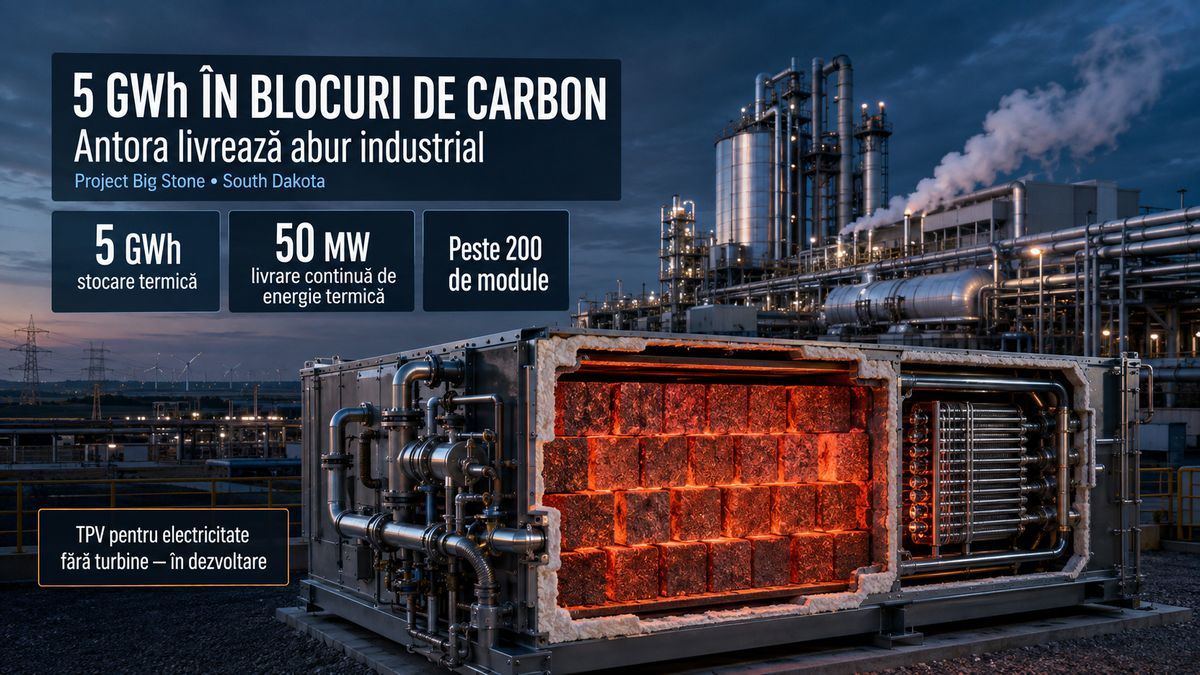
In May 2026, Antora Energy began commissioning one of the largest industrial thermal batteries announced to date: Project Big Stone, with a storage capacity of 5 GWh , built next to the POET plant in South Dakota. The system comprises over 200 modules and is designed to continuously deliver 50 MW of thermal energy to generate steam for the plant's operations. Instead of storing electricity in lithium-ion cells, Antora converts it into heat, raising the temperature of solid carbon blocks to extreme levels. Carbon acts as a thermal mass: energy remains stored in the material's temperature and can be extracted later for industrial processes. The company's technology platform is designed for temperatures up to 2,400°C , and a previous full-scale demonstration by Antora exceeded 1,800°C. Big Stone moves this concept from the demonstration phase into industrial infrastructure. The project began delivering energy less than 12 months after construction started, and Antora and POET expect to complete commissioning and enter full commercial operation later this year. The most immediate application is already clear: in industries with continuous steam and heat consumption, a thermal battery can convert electricity available during specific hours into a continuously usable thermal resource. But Antora's plan goes further. The company is developing a version that could convert the stored heat back into electricity without a conventional heat engine , using thermophotovoltaic (TPV) cells. Big Stone Converts Flexible Electricity into Continuous Industrial Heat The current architecture is relatively straightforward. Electricity heats the carbon blocks, heat is transferred to water, and the resulting steam enters POET's industrial process. The fundamental advantage comes from decoupling the time energy is purchased from the time the plant actually needs it. Documents from the South Dakota Public Utilities Commission indicate a partially dispatchable electrical demand of up to 155 MW for the project. This allows the facility to absorb large amounts of electricity when grid and contract conditions favor charging, while the industrial process receives the heat it needs independently of that timing. This flexibility redefines a factory's role in the energy system. A process that would otherwise require continuous power supply can become, on the electrical side, a load capable of shifting to periods of abundant generation. For a power grid with growing shares of solar and wind energy, this makes a major difference. Surplus electricity during certain hours no longer needs to be consumed simultaneously with steam production. It can be fed into the thermal battery and used later. The electric service agreement associated with the Big Stone project has a 20-year term, demonstrating that the facility is designed as long-term industrial infrastructure, not a temporary technology demonstration. Carbon Stores Energy, and Heat Can Avoid Unnecessary Conversion Direct thermal storage offers a structural advantage when the industry's desired end product is heat itself. An electrochemical battery would receive electricity, store it, discharge electricity, which would then have to be converted into heat. Antora shortens this chain: electricity directly heats the storage medium, and the thermal energy is then dispatched to the industrial process. This difference opens up a much larger market than the classic image of a grid-connected battery suggests. According to the International Energy Agency, industries dominated by low- and medium-temperature heat and steam processes account for approximately 70% of global industrial energy consumption . For Antora, the primary market is therefore not replacing lithium-ion batteries in the power grid, but rather electrifying a portion of factories' thermal consumption, where grid availability, hourly pricing, and the industrial process profile make the economic case. The Next Technology Can Convert Incandescent Carbon Directly into Electricity At very high temperatures, carbon blocks emit intense electromagnetic radiation, predominantly in the infrared spectrum. Antora is developing thermophotovoltaic (TPV) cells—semiconductors that convert this radiation directly into electricity. The principle is similar to that of a photovoltaic panel, but the source of photons is no longer the Sun, but the incandescent material inside the storage system. In this architecture, the chain becomes: electricity → heat in carbon → thermal radiation → electricity. The final conversion requires no turbine, piston, or alternator. Photons with sufficient energy are absorbed by the semiconductor, generating electric current, while a portion of the radiation that cannot be converted can be reflected back to the emitter to minimize losses. The scientific foundation of this conversion has already surpassed the modest efficiencies historically associated with TPV technology. A study by researchers from Antora, the National…
Ioana Buzoaica — Independent Editorial Board
The NRG-IA newsroom continuously monitors Romanian energy markets, ANRE regulatory decisions, and national grid telemetry (SEN/SNT). We deliver independent intelligence anchored exclusively in official primary data.
Editorial Charter, Ethics & Verification Methodology →