AFIR Launches €650m for Solar and Storage — NRG-IA
Ghid Consumator Author: Ioana BuzoaicaRomania launches a €650m fund for public solar & storage projects. Funding covers up to 100% (max €10m/project) on a first-come, first-served basis.
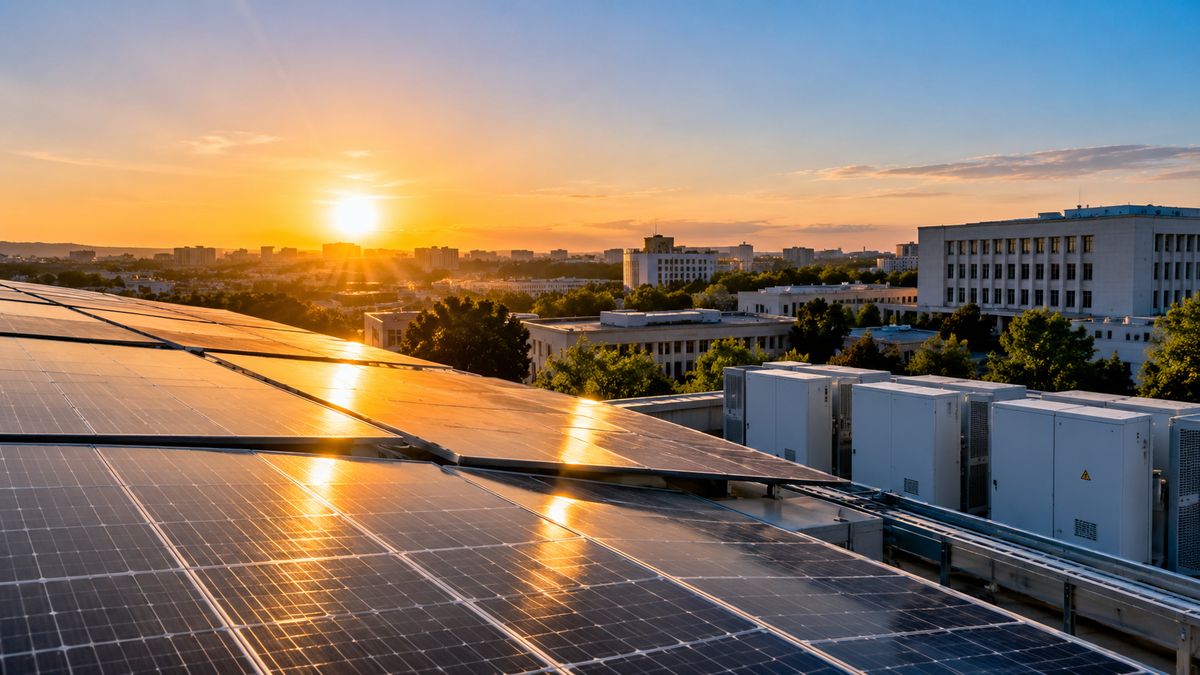
Romania is launching today one of its largest funding lines dedicated to local energy production and storage in the public sector. Starting at 10:00 AM, eligible institutions can submit projects for two calls with a combined budget of €650 million , funded through the Modernisation Fund. Out of this total, €500 million is reserved for building new photovoltaic capacities with integrated storage for self-consumption, while another €150 million is earmarked for installing batteries alongside existing renewable energy generation capacities. The funding can cover up to 100% of eligible expenses , within the limits established by the program guidelines. However, the selection mechanism makes the timing of submission critical: projects are evaluated in the order of registration, subject to eligibility conditions, until the available budgets are exhausted. AFIR (the Agency for Financing Rural Investments) notes that, depending on the number of compliant projects, an increase in the allocation may be considered, subject to the availability of the Modernisation Fund and based on the decision of the Ministry of Energy. Submissions remain open until November 20, 2026, at 23:59 . €500 Million for Solar Panels, but Storage is Mandatory The largest component of the program shifts the paradigm of publicly funded photovoltaic investments. The €500 million is not intended for simple solar plants, but for systems where generation and storage are integrated from the outset . Projects must include new solar power generation capacities and batteries. Heat pumps can also be integrated. The generated energy must be 100% dedicated to self-consumption , and the energy stored in the battery system must come entirely from the funded solar installation. Thus, the program is not designed to develop public power plants aimed at selling electricity on the market, but rather to reduce grid consumption and lower energy costs for beneficiaries. Non-repayable funding can reach up to €10 million per beneficiary , and this cumulative value includes both individually submitted projects and potential partnership participations. The funding cap is set at €900,000/MW installed, excluding VAT , for projects without heat pumps, and €1.1 million/MW for those that include such equipment. For Every Photovoltaic MW, 2–4 MWh of Battery Capacity Must Be Installed One of the most important technical conditions concerns the sizing of the storage system. For every 1 kW of photovoltaic capacity , the project must provide between 2 and 4 kWh of storage . Equivalently, a 1 MW solar installation must be paired, within the limits set by the guidelines, with a storage capacity of 2–4 MWh . The nominal charging and discharging power of the storage system must be at least equal to the eligible photovoltaic capacity. The guidelines exclude lead-acid, nickel-cadmium, and nickel-metal-hydride batteries. This configuration aims to shift a portion of solar generation from peak solar hours to periods when the institution actually needs energy, rather than immediately feeding the entire surplus into the grid. Grid Injection is Limited to 400 kW The program also introduces an explicit limit on the energy that can be fed into the public grid. The approved grid injection capacity cannot exceed 400 kW per production site , regardless of the total installed capacity of the panels or inverters. Projects must feature a dynamic power management system capable of tracking generation, consumption, and battery status in real time, and automatically limiting grid injection when generation simultaneously exceeds local consumption and available storage capacity. This condition clearly highlights the scheme's objective: energy must be generated as close as possible to where it is consumed, and the battery must absorb a significant portion of the mismatch between generation and consumption times. Another €150 Million Earmarked Directly for Storage The second call targets institutions that already have renewable energy generation capacities and want to add behind-the-meter storage systems. The budget is €150 million , and funding here can also cover up to 100% of eligible expenses, up to a maximum of €10 million per beneficiary. The specific funding cap is set at €200,000 per MWh of installed storage capacity , excluding VAT. Batteries must be sized for an equivalent storage duration of a minimum of two and a maximum of four hours relative to the capacity of the existing renewable installation. The two calls thus cover two different scenarios: institutions launching a new investment can build solar and battery storage simultaneously, while those already generating renewable energy can fund storage separately. From Municipalities and Hospitals to Universities and Research Institutions The program has a broad scope of public beneficiaries. Eligible applicants, subject to the guidelines, include administrative-territorial units and their subdivisions, public institutions, fully publicly…
Ioana Buzoaica — Independent Editorial Board
The NRG-IA newsroom continuously monitors Romanian energy markets, ANRE regulatory decisions, and national grid telemetry (SEN/SNT). We deliver independent intelligence anchored exclusively in official primary data.
Editorial Charter, Ethics & Verification Methodology →