Smoke at Abqaiq: Saudi oil production impact unconfirmed — NRG-IA
Geopolitică & Energie Author: Ioana BuzoaicaA thick smoke plume is visible at Saudi Arabia's Abqaiq oil complex after drone attacks. Smoke is confirmed, but claims of major damage remain unverified.
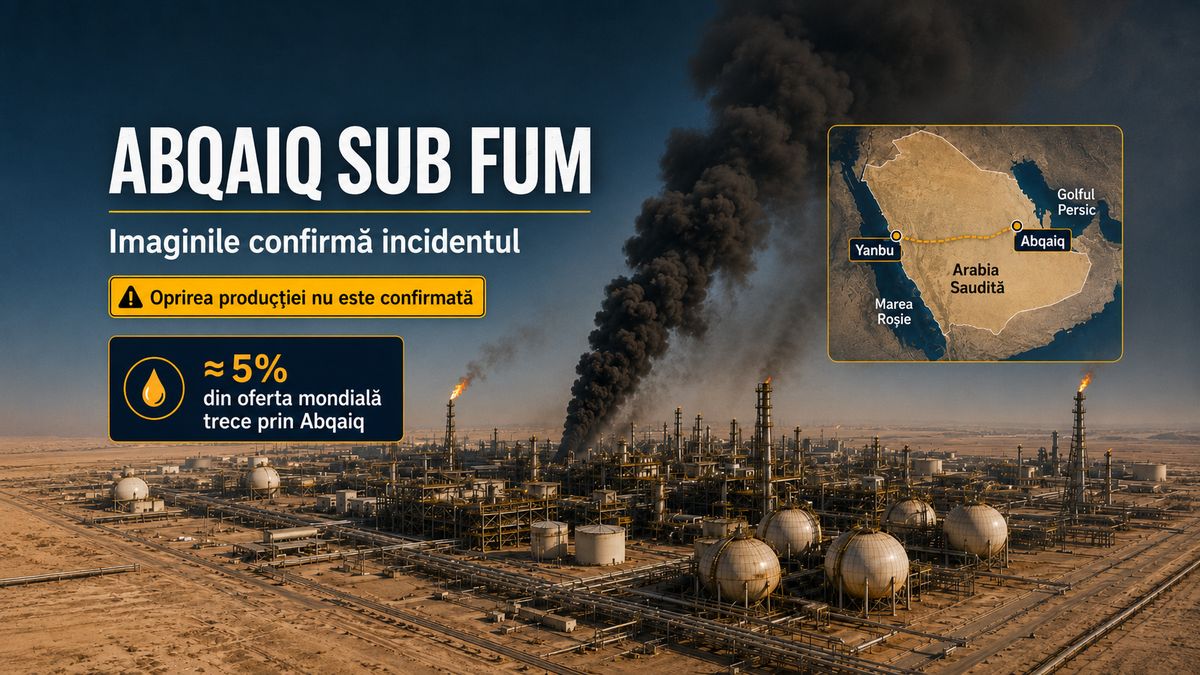
Saudi Arabia's most sensitive oil facility is once again under a large plume of smoke. Images captured on July 27 by European Sentinel-2 satellites locate the source in the area of the Abqaiq complex, through which a significant portion of Saudi production passes before the crude is transported to export terminals. The images confirm a significant flaring or burning event inside or in the immediate vicinity of the complex. However, they do not show how many barrels have been affected, whether the main units were hit, or if Saudi Aramco has suspended oil processing. Saudi authorities confirmed drone attacks on oil targets in the Eastern Province and the capital area. Air defenses claim to have intercepted and destroyed several UAVs launched from the direction of Iraq by Iran-backed groups. Official statements do not confirm successful strikes on Abqaiq and offer no explanation for the smoke plume observed from space. At the time of writing, Saudi Aramco had not published an assessment of damages, available capacity, or potential delivery delays. In the absence of this information, the incident must be treated as a major risk still under evaluation, rather than a confirmed disruption to global supply. The smoke is certain, but the nature of the fire remains unclear The two images distributed from the Copernicus Sentinel-2 program show a dark cloud rising from the facility area and extending over a considerable distance, carried by the wind. Its size indicates intense burning, but does not on its own establish the cause. In an oil processing complex, such a plume can result from direct equipment fires, the burning of crude or associated products, or the heavy use of safety flares. These flares are used for the controlled disposal of gases when pressure builds up, a unit is rapidly shut down, or the industrial process becomes unstable. A safety flaring event of this scale would itself indicate a major operational disruption. However, it would not prove the destruction of the facility or the loss of its entire capacity. The resolution of Sentinel-2 satellites is sufficient to identify smoke, large fires, and significant surface changes. It does not allow for a reliable assessment of individual tanks, separators, compressors, or piping systems in a complex of Abqaiq's scale. Some accounts specializing in open-source intelligence (OSINT) imagery analysis claim that several spherical processing vessels were affected and that two of them may have been destroyed. Other interpretations suggest the smoke originates primarily from an industrial flare stack and that the images do not provide sufficient evidence of a production loss. Both scenarios remain preliminary assessments. Confirming structural damage requires higher-resolution commercial imagery, clear before-and-after comparisons, thermal data, and information from the operator or from inside the facility. Confirmed attacks lack full attribution Saudi Arabia stated that the intercepted drones were launched from Iraqi territory by groups close to Iran. Riyadh urged Iraqi authorities to prevent the use of their national territory to attack neighboring states and reserved the right to respond. The Iraqi government ordered an investigation and stated it would not allow the country to be used as a launchpad for such operations. No Iraqi group had publicly claimed responsibility for the specific attack on Saudi targets at the time of writing. Separately, Houthi forces in Yemen announced strikes on oil processing and transport facilities along the pipeline linking eastern Saudi Arabia to the Red Sea port of Yanbu. The group framed the operation as retaliation for alleged Saudi violations of Yemeni airspace. The two accounts cannot be automatically linked into a single operation. There is insufficient public information to determine whether the smoke at Abqaiq was caused by a drone launched from Iraq, an action claimed by the Houthis, an interception near the complex, or a preventive measure taken during the attacks. Definitive attribution must await further information from Saudi authorities, the operator, and independent sources. Abqaiq prepares crude oil for export Abqaiq is no ordinary refinery. The complex receives crude extracted from some of the largest Saudi oil fields and processes it for transport, storage, and export. The stabilization process removes gases and highly volatile components from the crude oil so it can be safely transported via pipelines and tankers. Without this step, a significant portion of production from the connected fields cannot enter commercial channels normally. Saudi Aramco states that oil equivalent to approximately 5% of global supply passes through Abqaiq. The US Energy Information Administration (EIA) has estimated the complex's maximum capacity at around seven million barrels per day. The two figures describe different metrics. The roughly 5% share refers to the actual volume associated with global supply, while the seven million…