Cernavodă și rețelele inteligente atrag 3,5 miliarde euro sub presiunea șocului din Golf — NRG-IA
Geopolitică & Energie Author: Gheorghe RăzușThe Middle East price shock forces a rapid transition to Energy TECH in Romania, marked by €3.5 billion investments in smart grids and nuclear energy.
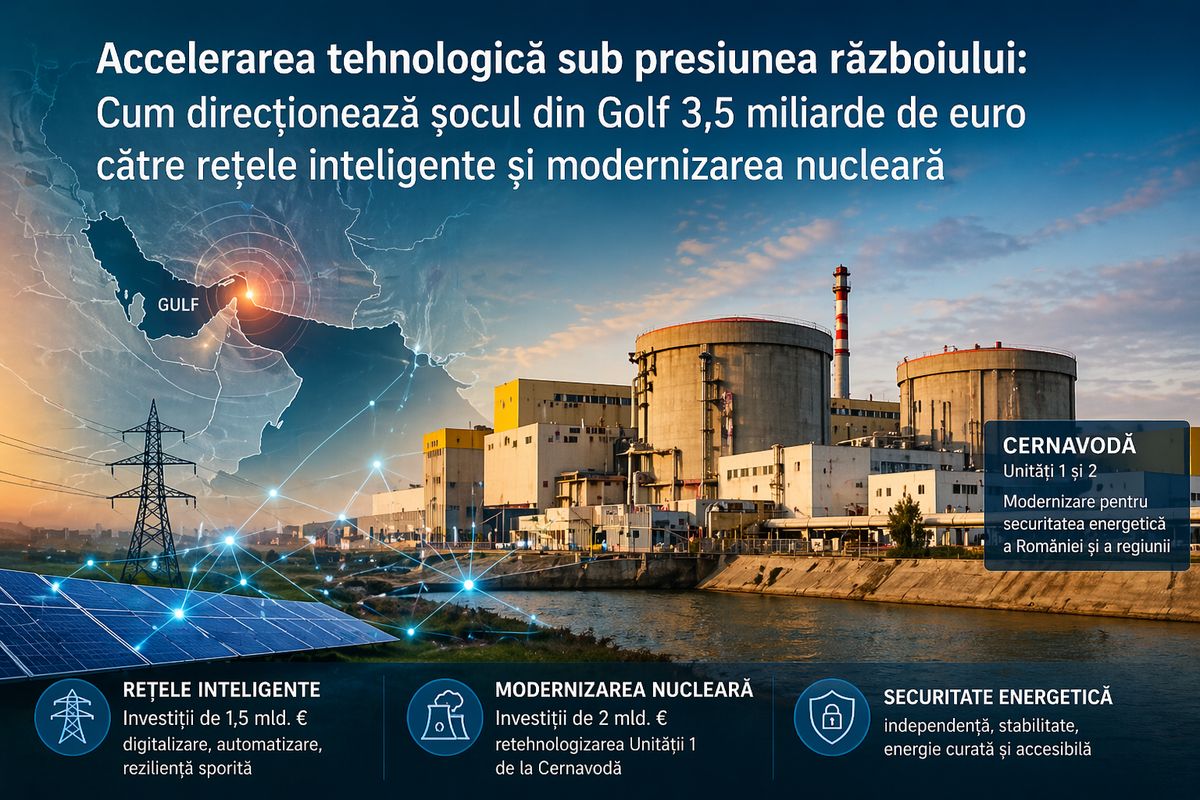
Context: Geopolitical Shock as a Technological Accelerator The European and Romanian energy sectors are at a severe inflection point, dictated by extreme volatility in the Middle East. The war in Iran and related logistical bottlenecks are no longer just a temporary price crisis, but a brutal catalyst for the adoption and integration of new energy technologies (Energy TECH). According to the Minister of Energy, Bogdan Ivan, the negative effects of the Gulf conflict will persist for 6 to 9 months, even in the unlikely scenario of an immediate cessation of hostilities, indicating a structural vulnerability in traditional supply chains. Regional data confirms the severity of this shock in the fossil fuel market. In Bulgaria, just a month and a half after the escalation of the conflict in Iran, prices have seen massive jumps: an advance of 38.8% for diesel and 19.9% for gasoline, according to the National Revenue Agency (NRA). In parallel, although there are signals regarding a possible resumption of Russian oil flow through the Druzhba pipeline to Hungary and Slovakia, announced by Peter Magyar, dependence on traditional hydrocarbon infrastructure is proving to be a major risk anchor for European economic security. Analysis: The Divergence Between Subsidies and Energy TECH Innovation Faced with this crisis, international financial institutions are proposing a radical paradigm shift: abandoning short-term protectionism in favor of massive investments in technology. The International Monetary Fund (IMF), through the voice of Alfred Kammer, has issued a clear warning to European governments, calling for the acceleration of the "Green Deal" and avoiding fuel price caps or tax cuts. The IMF's logic, based on the "Ukraine lesson," suggests that maintaining real (high) hydrocarbon prices is the only market mechanism capable of forcing industries and consumers to rapidly adopt energy-efficient technologies, from smart grids to large-scale electrification. This pressure for innovation is directly reflected in Romania's strategic decisions. Recently, in Washington, financing packages worth €3.5 billion were negotiated, aimed precisely at this technological leap. The funds target two critical directions of technological integration: Modernization of the nuclear sector: Implementing state-of-the-art technologies at Cernavodă, essential for ensuring clean and stable baseload production, at a time when the European Union is preparing directives to stop the premature closure of nuclear power plants on the continent. Development of transmission networks: The digitalization and capacity expansion of the national grid (Transelectrica), a sine qua non condition for integrating intermittent renewable sources and for automatic consumption balancing through advanced software systems. Implications: The Natural Gas Paradox and Industrial Collapse The technological transition, however, is not without collateral damage among heavy industries that cannot adapt quickly enough. The case of the Azomureș chemical plant is emblematic. Although Romania is the largest gas producer in the European Union, the country's last major chemical plant is on the verge of closure. This is where the need for technological and commercial integration between state producers and large consumers comes into play. Romgaz faces a difficult but vital mission. With a clear projection that in about a year Romania will record a significant natural gas surplus with the commissioning of new fields, extraction technology and predictive resource management become crucial. Natural gas, treated as a transition fuel, must be efficiently directed through modernized networks to the domestic petrochemical industry, preventing the collapse of agricultural fertilizer production chains, a sector vital to food security. Perspectives: The Future of Technological Integrations in Energy Looking to the near future, the Romanian energy landscape will be defined by a forced hybridization. (A conceptual graph of future investments would show a steep decline in CAPEX for traditional refining, offset by an exponential curve of investments in grid software, storage, and nuclear technology). On the one hand, European directives to maintain nuclear capacities, combined with the €3.5 billion investments, will transform nuclear energy into the backbone of the national energy system, supported by safety and operational technological solutions such as SMRs (small modular reactors) or refurbishments of existing units. On the other hand, IMF recommendations will discourage inefficient consumption, directing private capital towards Energy TECH solutions: smart building management, industrial and domestic battery energy storage, and peer-to-peer digital energy trading platforms. The current crisis in the Gulf is merely compressing the time Romania had available for this modernization. Without the rapid integration of grid technologies and without saving critical industry (such as Azomureș) through…
Gheorghe Răzuș — Independent Editorial Board
The NRG-IA newsroom continuously monitors Romanian energy markets, ANRE regulatory decisions, and national grid telemetry (SEN/SNT). We deliver independent intelligence anchored exclusively in official primary data.
Editorial Charter, Ethics & Verification Methodology →