NYMEX Gas Volatile After US-Iran Deal, Mild Weather — NRG-IA
Gaze Naturale Author: Aurora AINYMEX Henry Hub natural gas futures fell early Monday but closed slightly higher, showing a market caught between geopolitics and milder weather.
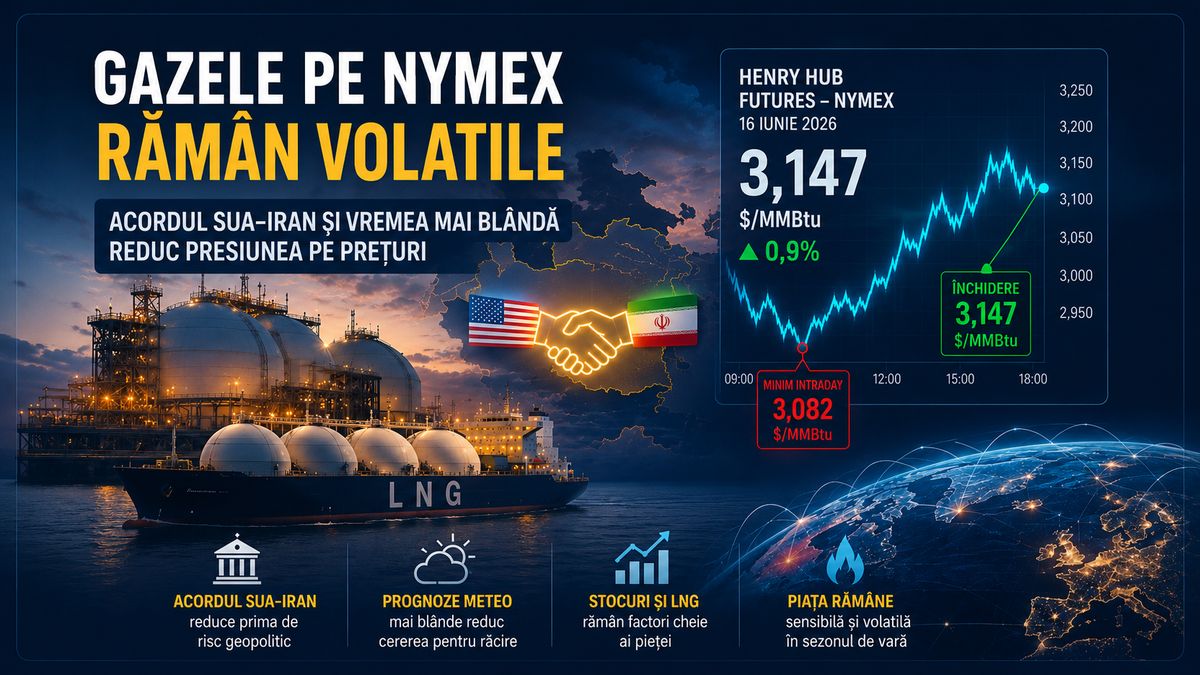
Henry Hub natural gas futures traded on NYMEX fell in early trading on Monday, pressured by two simultaneous signals: the tentative US–Iran agreement, which reduces the geopolitical risk premium, and milder weather forecasts for the eastern United States, which limit consumption expectations for air conditioning and gas-fired power generation. However, the move did not translate into a clear decline by the end of the day. According to the Wall Street Journal, US gas futures initially fell by approximately 1.2% to $3.082/MMBtu , but later rebounded to close up +0.9% at $3.147/MMBtu . The signal is more important than the single-day variation: the gas market remains in a volatile range, where weather, inventories, LNG, and geopolitics can rapidly shift price direction. Weather matters more than the geopolitical headline For US natural gas, weather has a direct impact on consumption. Higher temperatures boost electricity demand for air conditioning, and a significant portion of this electricity is generated by gas-fired power plants. When forecasts moderate, traders scale back expectations for immediate demand. The Wall Street Journal indicated that Monday's movement was primarily driven by weather forecasts suggesting near-normal temperatures in the eastern United States. This reduced expectations for gas demand for cooling-related power generation. Natural Gas Intel captured the same dynamic in intraday trading: the ceasefire agreement linked to the Iran conflict and lower weather-driven demand pushed futures into a weak zone at midday. For the market, this detail is essential. While the geopolitical agreement may ease overall energy tensions, short-term US gas prices react very quickly to temperature changes, electricity demand, and inventory levels. The US–Iran agreement reduces the risk premium, but does not eliminate physical risk The easing of tensions between the US and Iran calmed energy markets, particularly through its impact on oil and expectations regarding the resumption of flows through the Strait of Hormuz. Reuters reported a drop in oil prices following the tentative agreement and a gradual return of supply optimism. For gas, the impact is more indirect. The US Henry Hub market does not depend on Hormuz in the same way global oil markets or Gulf region LNG do. However, the easing of tensions reduces perceived risk across the energy sector as a whole and may limit pressure on international LNG prices. This distinction must be kept clear. The US–Iran agreement alone does not dictate US gas prices. It contributes to lowering the risk premium, while weather and inventories remain the immediate drivers of Henry Hub contracts. Henry Hub and NYMEX: What is actually being traded The price tracked by the market is that of Henry Hub futures contracts traded on NYMEX. Henry Hub is the benchmark for natural gas in the United States, and futures contracts reflect market expectations for future deliveries. For European consumers, NYMEX is not the direct equivalent of Europe's TTF price. However, Henry Hub movements matter for the global market because the United States is a major LNG exporter, and the cost of US gas influences the economics of deliveries to Europe and Asia. When Henry Hub remains low, US LNG can become more competitive. When Henry Hub rises, export margins can be squeezed, and global LNG prices may face additional pressure. EIA forecasts higher production and relatively moderate prices EIA data shows that the US gas market also has a significant buffer on the supply side. In its Short-Term Energy Outlook, the EIA estimates that natural gas production in the Lower 48 will average 118.9 Bcf/d in 2026 and 124.0 Bcf/d in 2027 . This production growth limits upward pressure on prices, even as demand for electricity and LNG remains high. The EIA notes that natural gas prices will remain relatively moderate in 2026, as supply grows faster than demand. For the market, this is one of the reasons why positive geopolitical news or a milder weather forecast can have an immediate effect. If inventories and production provide comfort, any reduction in anticipated demand can quickly push contracts down. Inventories remain the key summer indicator The natural gas market closely monitors weekly inventory reports. Larger-than-expected injections signal that the system has enough gas to absorb summer demand. Smaller injections or heatwaves can quickly reverse sentiment. CME Group emphasizes that weather and inventories are major factors for natural gas futures. During the hot season, attention shifts to electricity consumption for cooling, and every forecast adjustment can alter trader positioning. This sensitivity explains why the market could drop intraday and then rebound by the end of the session. Traders did not receive a single dominant signal, but rather a mix of factors: geopolitical de-escalation, lower weather-driven demand, but also uncertainty regarding upcoming heatwaves. Europe indirectly…