US-Iran Direct Strikes: Hormuz Pressures Oil, LNG, Sanctions — NRG-IA
Geopolitică & Energie Author: Ioana BuzoaicaThe Hormuz crisis has escalated to direct US-Iran strikes. In a corridor carrying a major share of global oil and LNG, every attack shifts energy risk.
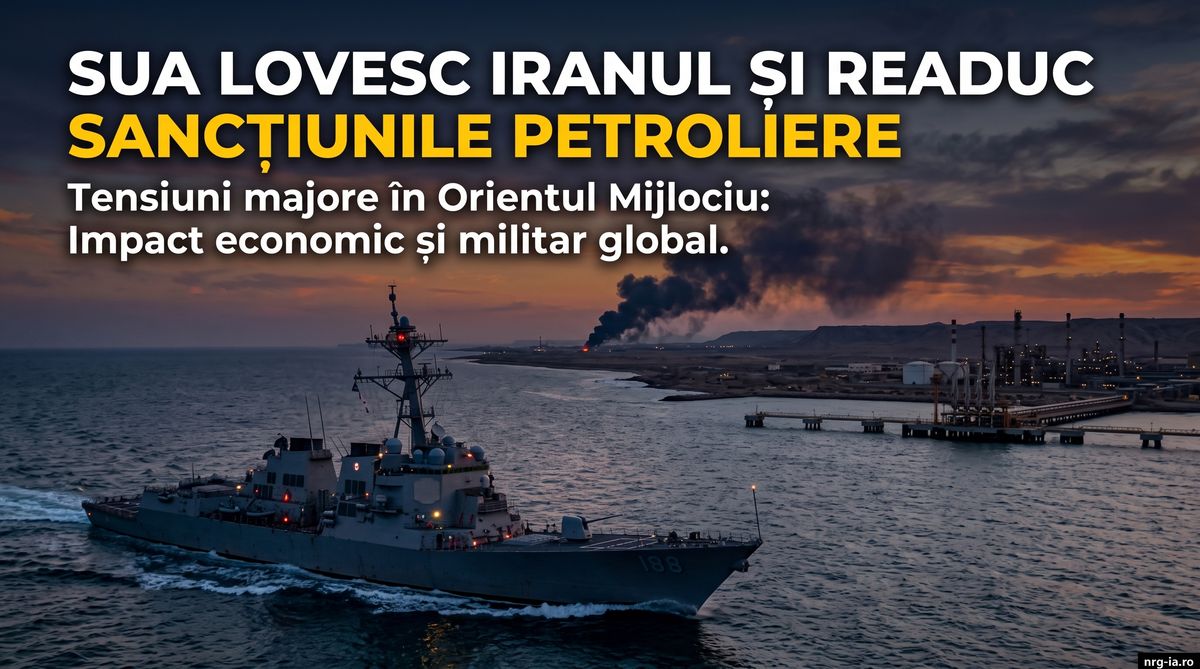
The United States and Iran have entered into a direct exchange of strikes around the Strait of Hormuz, following attacks on commercial tankers and the revocation of the waiver that temporarily allowed the sale of Iranian oil on international markets. Washington launched a new round of strikes against Iran, and the Revolutionary Guards subsequently announced missile and drone strikes on US military targets in Bahrain and Kuwait. The escalation shifts Hormuz from the realm of geopolitical risk to that of operational risk for global energy transport. Major volumes of oil, petroleum products, and LNG pass through this strait, and the market is no longer just assessing the supply of crude or liquefied natural gas, but the security of the corridor through which energy exits the Gulf. Tankers Hit, US Attacks Iranian Targets US Central Command stated that the American strikes targeted Iranian military assets following attacks on commercial shipping. Reuters reports that more than 60 small Revolutionary Guard vessels were among the targets hit, and a US official also pointed to air defense systems, coastal surveillance, surface-to-air missiles, anti-ship missiles, and drone launchers. Qatar blamed Iran for the attacks on the vessels, including the giant LNG tanker Al Rekayyat, which was struck by a drone that caused a fire in the engine room. The crew was safe and evacuated. A Saudi-flagged tanker, identified by maritime sources as potentially the supertanker Wedyan, was also damaged off Oman, with the cause remaining unclear at the time of reporting. Attacks on vessels alter the energy calculus because they do not just strike an isolated asset. They raise the risk for insurers, shipowners, traders, LNG buyers, and refineries that depend on continuous flows from the Gulf. In a narrow corridor where energy traffic is concentrated, the deterioration of security perception can weigh almost as heavily as the physical damage to a vessel. Iran Responds in Bahrain and Kuwait The Iranian response came on July 8, when the Revolutionary Guards announced a joint missile and drone operation against US military targets in Bahrain and Kuwait. Reuters points to Bandar Salman, the Fifth Fleet base in Bahrain, and the Ali Al Salem Air Base in Kuwait as targets. Iran also claimed to have shot down a US MQ-9 drone that allegedly attempted to interfere with the operation. Air raid sirens sounded in Bahrain and Kuwait, and the Kuwaiti military reported that its air defenses engaged missile and drone attacks. At this point, the crisis moved beyond attacks on commercial vessels and entered a regional military dynamic, with US targets hit or targeted in Gulf states. For the energy market, the difference is essential. An attack on a tanker can add a temporary risk premium. A direct exchange of strikes between the US and Iran, in the proximity of the world's most important maritime energy corridor, can affect the behavior of the entire chain: transit, insurance, routing, loading, unloading, and the willingness of buyers to expose vessels and cargoes to the area. Oil Sanctions Return to the Center of Pressure The military escalation was coupled with an economic decision. Washington revoked the license that temporarily allowed the sale of Iranian crude, petroleum products, and petrochemicals on international markets. The license issued on June 22 permitted transactions until August 21, and the revocation shortened the wind-down period for transactions to July 17. Reuters notes that oil prices rose by more than 3% following the US announcement. The market reaction shows that investors interpreted the decision not just as a sanctions measure, but as a deterioration of the security framework around Hormuz. The Iranian Foreign Ministry described the license revocation as a violation of the framework agreement and stated that Iran would take any measure it deems necessary to protect its national interests and security. In this equation, oil becomes part of the same strategic exchange as military strikes and control over maritime routes. For Iran, access to oil revenues remains a critical lever. For the US, sanctions are the tool through which the cost of escalation is shifted from the military to the financial sphere. For the global market, the result is a difficult-to-absorb combination: military risk to transit and political risk to the availability of Iranian oil. Hormuz Concentrates the World's Oil and LNG The Strait of Hormuz is the primary export route for oil and natural gas produced in Saudi Arabia, the United Arab Emirates, Kuwait, Qatar, Iraq, Bahrain, and Iran. The IEA shows that approximately 25% of global maritime oil trade passed through Hormuz in 2025, and bypass options are limited. Only Saudi Arabia and the United Arab Emirates have operational pipelines that can redirect a portion of the flows, with available capacity estimated between 3.5 and 5.5 million barrels per day. For LNG, the vulnerability is even more concentrated. Over…
Ioana Buzoaica — Independent Editorial Board
The NRG-IA newsroom continuously monitors Romanian energy markets, ANRE regulatory decisions, and national grid telemetry (SEN/SNT). We deliver independent intelligence anchored exclusively in official primary data.
Editorial Charter, Ethics & Verification Methodology →