Winter 2026–2027 Energy Bills: ANRE, OPCOM, and Gas Storage — NRG-IA
Piața de Energie Author: Ioana BuzoaicaWinter 2026–2027 bills depend on supply contracts, a special gas mechanism, and flexible EU storage targets, not just regulator decisions.
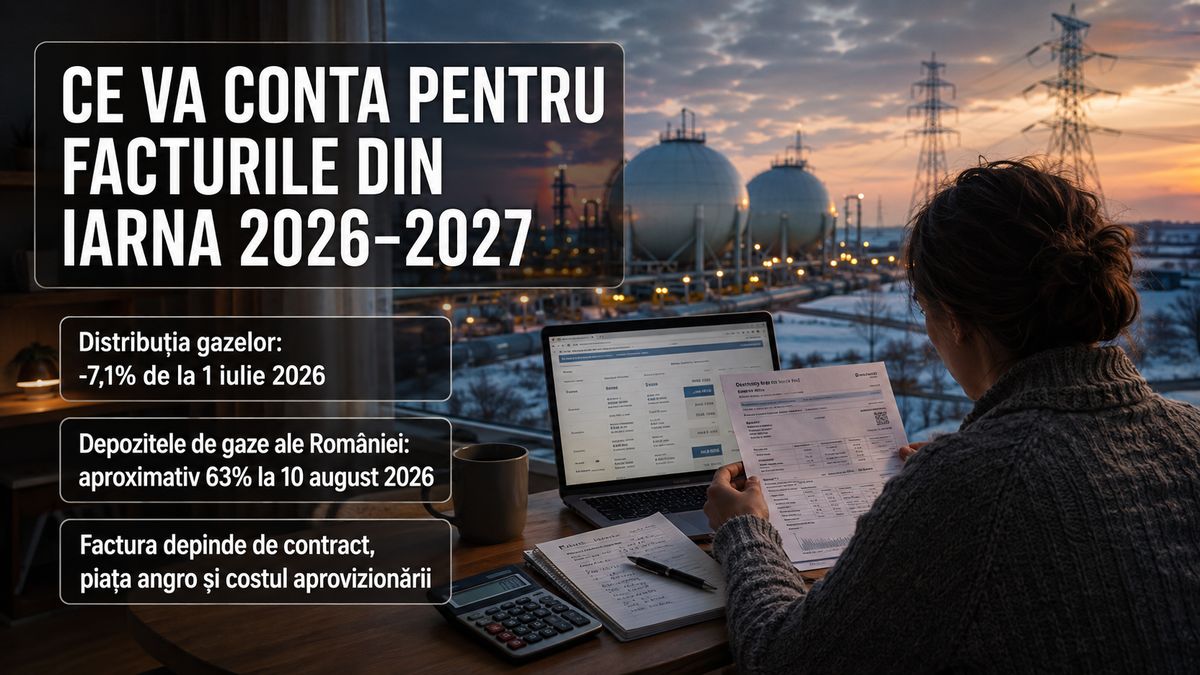
Romanian energy bills are entering the autumn of 2026 under the influence of three distinct mechanisms: regulated network tariffs, commercial prices in supply contracts, and procurement costs shaped on wholesale markets and in gas storage facilities. These do not move in tandem, nor do they follow the same logic. It is precisely this divergence that determines how much of the energy system's volatility ultimately impacts household budgets. For electricity, the distribution tariffs applicable in 2026 are already set and have been in force since January 1. They do not automatically change because a heatwave pushes up spot market prices or because wind generation drops in a given week. Instead, following the end of the general price cap, the active energy price in the supply contract has once again become one of the most critical commercial variables for consumers. For natural gas, the situation is different. Romania did not transition to a fully liberalized regime for households on April 1, 2026. Emergency Ordinance (OUG) 12/2026, as subsequently amended, establishes a special mechanism for residential customers until March 31, 2027, featuring rules on price formation, supplier procurement, and specific domestic production volumes allocated for household consumption and storage. At the same time, the gas distribution component has actually moved in the opposite direction of the renewed upward pressure on bills. As of July 1, 2026, the energy regulator ANRE set a weighted average distribution tariff of RON 54.32/MWh, down from the previous RON 58.47/MWh, representing an average decrease of 7.1%. While trends vary by operator, gas distribution has become cheaper on an aggregate level. Regulated tariffs and energy prices are two different things Electricity bills combine components with different pricing mechanisms. Distribution and other network services are regulated, whereas active energy is purchased by the supplier and sold to the customer under contractual terms. This separation becomes essential in a volatile market. An episode of very high prices on the Day-Ahead Market (DAM) operated by OPCOM may increase costs for a supplier exposed to the spot market at that moment, but it does not automatically alter the distribution tariff, nor does it instantly translate into an identical bill increase for every customer. In June 2026, the weighted average price on the DAM reached approximately RON 694.48/MWh, up from RON 565.05/MWh in May. During certain summer intervals, the spread between hours of abundant supply and those of system stress widened significantly, with some trading intervals on July 30 exceeding RON 1,700/MWh. These figures highlight genuine wholesale market volatility. However, the impact on consumers depends on how suppliers have structured their portfolios: how much energy they contracted in advance, at what price, for what duration, and how much additional volume they must purchase from the short-term market. For this reason, two contracts with the same consumption level can yield different costs, even if regulated network tariffs are identical. Distribution is not a fixed fee of 30–35% on every bill Nor can the share of distribution in the final bill be set at a universal percentage. Tariffs vary by distribution system operator and voltage level, and their weight in the total bill shifts depending on the active energy price and other applicable components. If contract energy prices rise, the percentage share of distribution may decrease, even if the distribution tariff itself remains unchanged. Furthermore, distribution is primarily a volumetric component applied to the energy consumed. A household that reduces its consumption also reduces the amount paid for components priced in RON/MWh. Treating distribution as a 'fixed cost' that remains unchanged regardless of consumption distorts how the bill actually works. For consumers, the practical takeaway is simple: energy conservation continues to lower the bill, but they cannot control the unit price of purchased energy or the regulated tariffs. The contract determines how much OPCOM volatility reaches the consumer Following the effective liberalization of active energy prices, choosing the right supply offer has become increasingly important. A fixed price offers predictability for the duration of the contract, whereas a variable-price product can pass through market changes more quickly. Neither option is automatically cheaper; the outcome depends on the price level at which the contract is signed and subsequent market developments. Therefore, the claim that September automatically represents the 'last window' for a favorable contract lacks a universal basis. Suppliers structure their offers based on their own procurement costs, forward contracts, portfolio profiles, and the level of risk they are willing to assume. For households, the useful comparison is not between 'now' and an allegedly inevitable price hike after a certain date, but…
Ioana Buzoaica — Independent Editorial Board
The NRG-IA newsroom continuously monitors Romanian energy markets, ANRE regulatory decisions, and national grid telemetry (SEN/SNT). We deliver independent intelligence anchored exclusively in official primary data.
Editorial Charter, Ethics & Verification Methodology →