District Cooling: The Solution for Romania's Grid Peaks — NRG-IA
Ghid Consumator Author: Ioana BuzoaicaRomania still treats cooling as an individual choice, though heatwaves make it a grid issue. AEI proposes upgrading district heating to supply cooling.
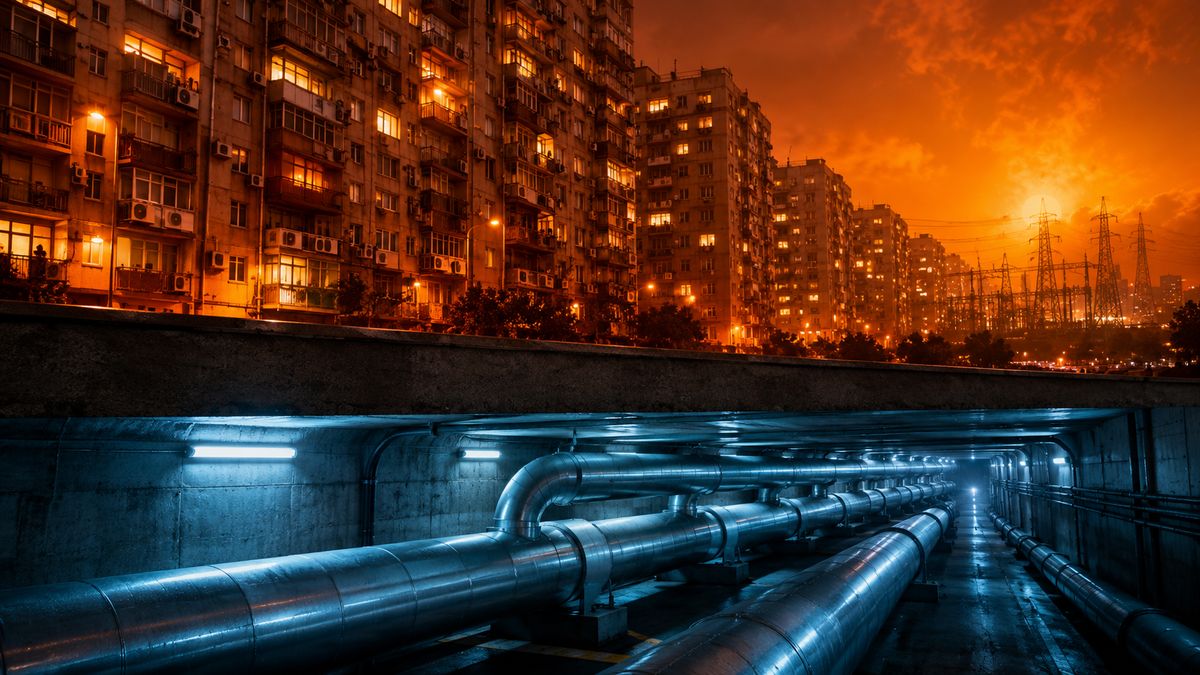
Heatwaves are putting pressure on the grid. In a large city, air conditioning is no longer just a living room appliance. It has become a collective source of consumption that kicks in almost simultaneously across apartment blocks, offices, shops, hospitals, campuses, and commercial spaces. And when temperatures remain high into the evening, cooling demand coincides precisely with the hours when solar power begins to fade, leaving the power system reliant on the most expensive and flexible resources available. The Intelligent Energy Association (AEI) warns that while Romania talks extensively about electricity, batteries, and solar panels, it discusses urban cooling far too little. In its analysis, the organization estimates that a 70-square-meter apartment can consume an additional 50 to 130 kWh of electricity during a month with seven days of extreme heat. On a city-wide scale, this consumption translates into hundreds of additional MWh precisely during the hours when the grid is already strained. This is the fundamental shift: cooling can no longer be treated simply as a choice between a cheaper or a quieter appliance. It is becoming an issue of peak power, local grid capacity, transformer investments, flexible generation, and energy costs on hot summer evenings. Air conditioning solves the home, not the city A modern air conditioning unit can be highly efficient for a single home, especially in a well-insulated building and when used correctly. The problem is not the appliance itself. The problem arises when individual solutions become the default urban model. During heatwaves, hundreds of thousands of units turn on at the same time, in the same neighborhoods, and on the same distribution grids. Electricity demand spikes rapidly, local transformers and cables are pushed to their limits, and the system must secure additional power precisely when the margin of flexibility is at its lowest. The IEA points out that space cooling is the fastest-growing source of energy demand in buildings, with an estimated growth rate of nearly 4% per year through 2035. The agency emphasizes that air conditioning drives up peak consumption both during the day and in the evening. During the 2025 heatwaves, France experienced an evening peak electricity demand 25% above the off-season average, while New York recorded a peak 90% higher. For Romania, the lesson is clear. It is not just about how many kWh are consumed in a month. It is about how many MW are demanded simultaneously in a single hour. The grid must be built to handle that peak, even if it only occurs a few days a year. This is what makes individual cooling expensive at a city-wide scale: not because each appliance is inefficient in isolation, but because millions of individual decisions exert the same collective pressure on the infrastructure. Romania has grids built for winter, but no strategy for heatwaves Romania is not starting from scratch. The Intelligent Energy Association points out that the country still has over 4,380 km of district heating networks and approximately 1.05 million connected customers. This is a massive infrastructure, concentrated in dense cities—exactly where district cooling could make economic and technical sense. The problem is that this infrastructure was built for winter. Classic networks were designed to transport thermal agents at high temperatures, in many cases between 90°C and 120°C. They were designed for heating, not for reducing summer electricity consumption. AEI proposes shifting the discussion from simple pipe rehabilitation to transforming district heating into an integrated urban thermal energy infrastructure. In this model, the network no longer just delivers heat during the cold season, but becomes a backbone for heating, hot water, cooling, waste heat recovery, and energy storage. The difference is fundamental. A network repaired only for winter can reduce losses and improve thermal comfort. A network adapted for both heating and cooling can also alleviate the electrical grid pressure caused by heatwaves. Low-temperature district heating changes the role of the grid The Intelligent Energy Association distinguishes between two relevant models. The first is 4th-generation district heating, known as 4GDH. These networks deliver thermal agents at approximately 50–70°C, well below classic systems. The lower temperature limits losses and enables better integration of heat pumps, geothermal energy, waste heat, and renewable sources. The second is the 5th-generation model, 5GDHC (district heating and cooling). Here, the network operates at temperatures close to ambient, around 10–30°C. Each building can use a heat pump to locally produce heating, hot water, or cooling, while the infrastructure becomes a platform that can harness various sources: wastewater, lakes, rivers, geothermal energy, industrial waste heat, or data centers. Not all cities and neighborhoods can transition directly to such a model. Older apartment blocks,…
Ioana Buzoaica — Independent Editorial Board
The NRG-IA newsroom continuously monitors Romanian energy markets, ANRE regulatory decisions, and national grid telemetry (SEN/SNT). We deliver independent intelligence anchored exclusively in official primary data.
Editorial Charter, Ethics & Verification Methodology →