AC Becomes an Energy Necessity in Europe: Grids & Solar — NRG-IA
Ghid Consumator Author: Ioana BuzoaicaEurope now views AC as climate adaptation, not just comfort. As demand spikes, the key is efficiency, solar, and grids to prevent rising energy bills.
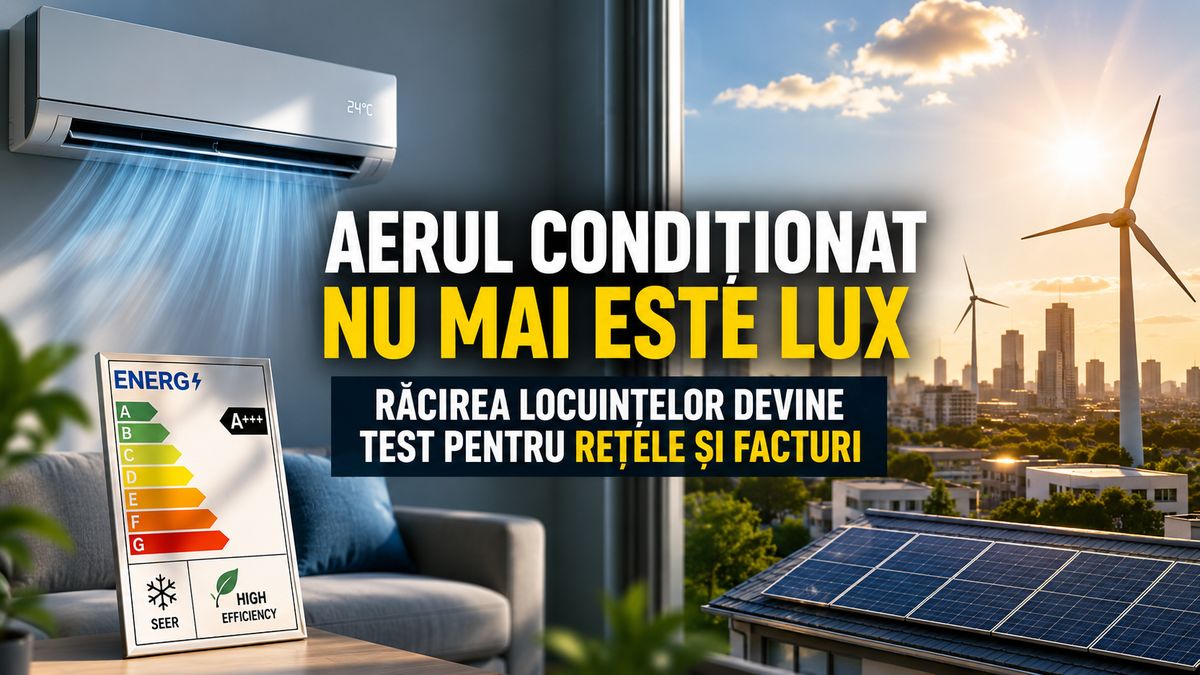
Europe is entering a phase where residential cooling can no longer be treated simply as a luxury. Heatwaves are becoming more frequent, extreme temperatures are impacting public health, and households that until recently had no need for air conditioning are now seeking rapid climate control solutions. At the same time, the European energy system is electrifying, and the question is no longer just how many air conditioning units will be purchased, but whether this new demand can be integrated without putting unnecessary strain on grids and bills. The Financial Times formulates one of the most important energy theses of the summer: in the clean system Europe is trying to build, air conditioning could be absorbed more easily than the classic image of incremental consumption suggests. The reason lies in how the electrical infrastructure will be sized. Grids and generation will need to be prepared for winter peaks, when electric heating, heat pumps, and electric vehicles will significantly drive up electricity demand. By comparison, summer demand starts from a lower baseline, and solar generation peaks precisely during the hottest hours of the day. Cooling is becoming a system-wide issue, not just an individual choice Air conditioning is changing the energy status of the home. Until now, in many European countries, cooling was viewed as a comfort option, especially in the north and west of the continent. However, repeated heatwaves are shifting this perspective. For the elderly, young children, the chronically ill, and poorly insulated homes, extreme temperatures can pose a direct health risk. This shift transforms air conditioning into an energy policy issue. If millions of consumers quickly buy cheap, inefficient units installed without clear standards, the result will be a new summer demand peak, higher bills, and additional pressure on grids. If the same demand is directed toward efficient equipment, flexible consumption, and daytime solar energy use, cooling can become far more manageable. The difference between these two scenarios is critical. The issue is not the existence of air conditioning itself, but the quality of the equipment, installation practices, home insulation, tariffs, and the system's capacity to utilize energy available during hours of high solar generation. Solar power changes the economics of air conditioning Cooling has an important characteristic compared to other forms of consumption: it occurs primarily on bright, sunny days. This makes it highly compatible with photovoltaic generation, at least during daylight hours. In a market with growing solar capacity, midday generation can cover a portion of the cooling demand without putting as much strain on conventional power plants. This alignment does not automatically solve the problem. Air conditioning consumption can continue into the evening when solar generation drops. Furthermore, local grids can become overloaded if many households turn on their units simultaneously in dense neighborhoods or areas with aging distribution infrastructure. However, compared to winter electric heating, air conditioning has the advantage of partially overlapping with peak solar generation. For Europe, this relationship points to a clear direction: cooling must not be treated in isolation from photovoltaic panels, storage, automation, and dynamic tariffs. The air conditioner can become a flexible load, especially if the home is well-insulated and can be pre-cooled during hours when energy is cheaper and more abundant. The European Commission wants more transparency at the point of sale The rising demand for air conditioning has already caught Brussels' attention. The European Commission proposes that installers provide buyers with clearer information regarding the energy efficiency of systems, including performance labels in commercial offers. The goal is simple: consumers should not choose based solely on the purchase price, but on the total cost of ownership. This rule could prove crucial for energy bills. Two seemingly similar units can have vastly different consumption levels, and the difference becomes apparent precisely during heatwaves when the equipment runs for many hours a day. A unit that is cheaper to buy but inefficient can end up costing more to operate and can amplify grid pressure. For households, the relevant criteria are not just the rated capacity or the initial price. What matters is the efficiency class, seasonal performance, correct sizing for the room, installation quality, maintenance, and how the unit is operated. Oversized, poorly installed equipment, or units run with open windows, turn cooling into an expensive and inefficient expense. The market is moving rapidly Heatwaves in Europe have accelerated the demand for air conditioning units. Reuters reported that Asian cooling equipment manufacturers are benefiting from rising sales in Europe, including in countries where air conditioning penetration was historically lower.…
Ioana Buzoaica — Independent Editorial Board
The NRG-IA newsroom continuously monitors Romanian energy markets, ANRE regulatory decisions, and national grid telemetry (SEN/SNT). We deliver independent intelligence anchored exclusively in official primary data.
Editorial Charter, Ethics & Verification Methodology →