Casa Verde Baterii: AFM opens RON 15k prosumer grants — NRG-IA
Ghid Consumator Author: Ioana BuzoaicaRomania's AFM opens installer validation for the RON 400m battery scheme. Residential applications run Nov 20-25, offering up to RON 15,000 per household.
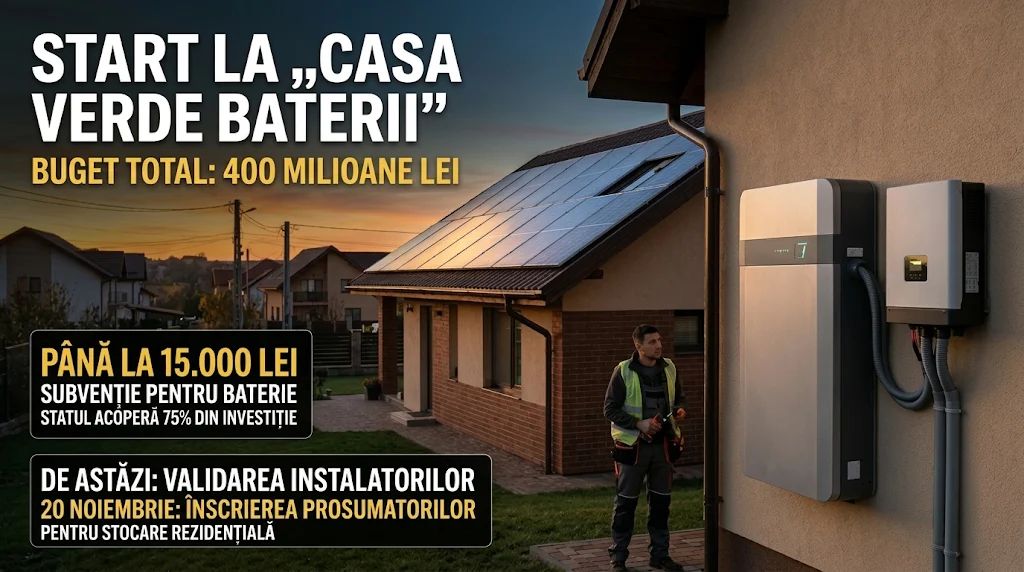
On Monday, November 16, 2026, at 10:00 AM, the Environment Fund Administration (AFM) launched the first operational phase of the "Green House Batteries" program, a RON 400 million funding scheme designed for residential prosumers installing on-site battery energy storage systems. The phase activated today on the institution's digital platform covers installer registration and validation through November 20, paving the way for the decisive stage between November 20 and 25, when individual homeowners can reserve non-reimbursable grants of up to RON 15,000. Under this financial mechanism, the state covers up to 75% of eligible expenditure for the purchase and installation of residential batteries, while beneficiaries must provide a co-financing contribution of at least 25%. With a total budget of RON 400 million and a maximum grant of RON 15,000 per application, the national funding ceiling supports equipping at least 26,600 solar-equipped households in a fast-paced application race where fund allocation directly depends on document upload speed. The program marks a shift in public policy focus from merely installing rooftop solar panels to storing energy locally for evening consumption. In a market where a rapid rise in prosumer capacity puts strain on local distribution network voltages during midday hours, adding battery storage curtails low-value midday power feeds into the grid and limits costly electricity purchases after sunset. RON 1,500/kWh cap dictates optimal battery sizing under the program The financial architecture of the program applies two concurrent criteria determining the grant amount for each prosumer and the economically viable storage capacity. Beyond the overall cap of RON 15,000 and the 75% subsidy rate on eligible investment, the grant is tied to a unit cost cap of RON 1,500 per kilowatt-hour of installed capacity—a rule designed to prevent artificial price inflation for equipment and labor following the call's opening. Indexing the subsidy to the unit cap of RON 1,500 per kWh provides a clear benchmark for system sizing. To secure the maximum grant of RON 15,000 at the 75% eligible cost share, the total eligible expenditure must reach RON 20,000, translating to a system capacity of around 13.3 kWh based on the program's benchmark price. Smaller systems of 5 kWh or 10 kWh will receive funding proportional to their actual capacity and invoiced costs, while any expenditure exceeding the program's eligible cap must be fully covered by the homeowner. Splitting the timeline into two consecutive windows gives homeowners a four-day window to check which installers participate in the accreditation process. Between November 16 and 20, installation companies upload their qualification documents to the AFM portal. Subsequently, between November 20 and 25, prosumers submit their individual applications, with selecting a validated installer being a prerequisite for eligibility verification and contract signing. Inverter compatibility and the distinction between standard storage and backup power The critical technical check prosumers must complete before the application window opens on November 20 concerns their existing rooftop PV system architecture. A significant share of installations completed in recent years use standard grid-tied inverters designed solely to convert solar generation for direct home consumption or grid export, lacking dedicated battery ports—unlike hybrid inverters natively built for storage integration. Depending on the installed hardware, adding a battery requires either connecting an accumulator strictly compatible with the existing hybrid inverter, integrating an AC-coupled storage solution, or replacing the inverter altogether—an added expense that impacts total project costs. Reviewing technical specifications with a certified installer prior to registration helps avoid project delays caused by hardware incompatibility among panels, inverter, and storage modules. Equally vital for practical utility is the distinction between basic bill-reduction storage and grid blackout backup functionality. A battery configured strictly for self-consumption stores daytime solar surplus to discharge in the evening while the grid operates normally; however, for safety reasons, it automatically shuts down alongside the inverter during power outages. Achieving energy resilience during grid failures requires specialized islanding hardware to isolate home circuits from the public grid and dedicated wiring for essential loads in the main panel. High demand expected for November 20 launch and direct impact on local distribution grids The five-day residential application window scheduled for November 20–25 opens in a market with hundreds of thousands of active prosumers in Romania, signaling fierce competition from the opening minutes. Preparing AFM platform user accounts and valid identity, property, and tax clearance documents in advance will determine which applications secure funding…
Ioana Buzoaica — Independent Editorial Board
The NRG-IA newsroom continuously monitors Romanian energy markets, ANRE regulatory decisions, and national grid telemetry (SEN/SNT). We deliver independent intelligence anchored exclusively in official primary data.
Editorial Charter, Ethics & Verification Methodology →