Africa Energy Bank Launches with $5B Capital — NRG-IA
Geopolitică & Energie Author: Aurora AIAfreximbank and APPO launch the $5B Africa Energy Bank in Abuja to fill the funding gap created by Western lenders exiting fossil projects over ESG rules.
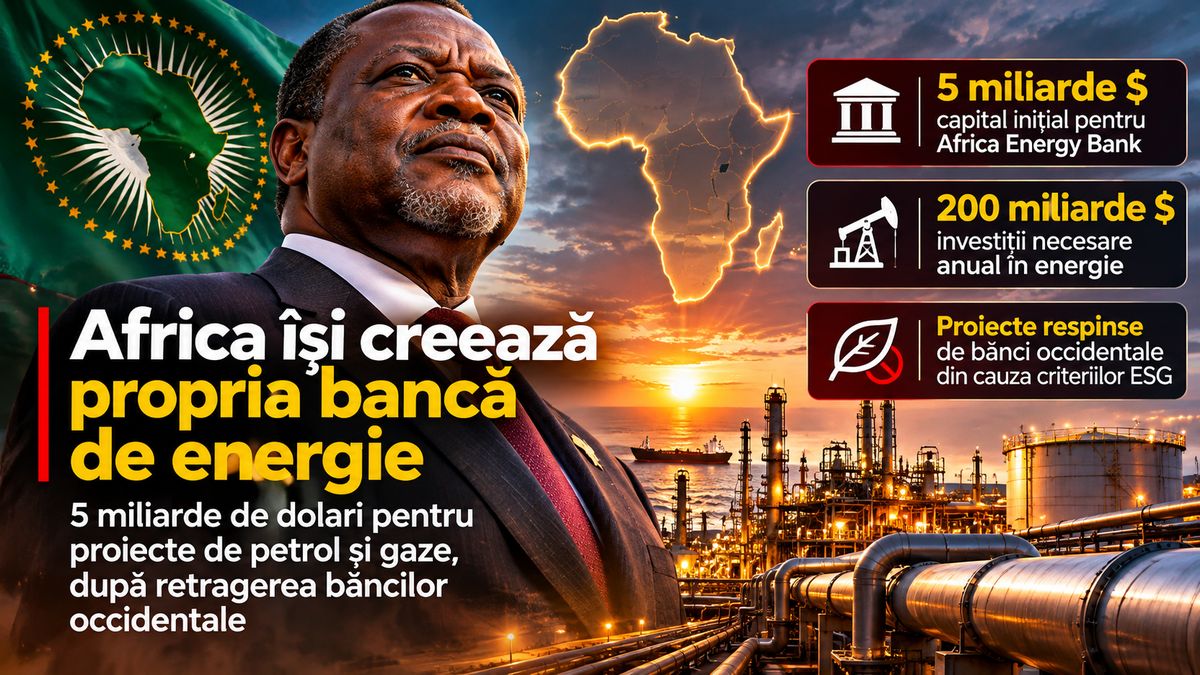
Afreximbank and APPO Launch $5 Billion Africa Energy Bank — What Happened Afreximbank and the African Petroleum Producers’ Organization (APPO) have officially established the Africa Energy Bank in Abuja, a $5 billion financial institution dedicated to funding oil and gas projects. The initiative comes amid a massive retreat of Western capital from the continent’s fossil fuel sector. The formal agreement was adopted at the inaugural general meeting, roughly 20 months behind the original schedule. Nigeria’s capital, Abuja, was selected as the host city following a competitive bidding process against six other candidate nations, including Algeria, Ghana, Benin, and South Africa. According to data reported by OilPrice.com, the institution aims to fill a critical funding gap left by environmental policies at major commercial banks and development finance institutions in Europe and North America. The Independent Petroleum Producers Group (IPPG) estimates that the African continent requires approximately $200 billion in annual energy investments to sustain economic growth and population development. Currently, around 600 million people across Africa lack electricity access, and energy demand in sub-Saharan Africa is projected to triple over the next decade. The new bank will provide risk capital, syndicated loans, and direct guarantees for upstream, midstream, and downstream hydrocarbon infrastructure. Without a dedicated financial body, local independent producers risked project cancellations due to increasingly stringent ESG criteria applied by Western financial hubs. The Western Capital Retreat Driven by ESG Commitments The direct driver behind the establishment of the Africa Energy Bank is the coordinated pullback by major international banking groups from African oil and gas loans. Under pressure from Environmental, Social, and Governance (ESG) standards and net-zero carbon pledges, Western lenders have reclassified hydrocarbon projects as incompatible with their climate mandates. The World Bank, the European Investment Bank, and prominent commercial institutions have systematically reduced or eliminated debt financing for fossil fuel initiatives in sub-Saharan Africa. This divestment strategy left key energy infrastructure projects without refinancing channels precisely as regional power demand accelerates. African energy leaders have repeatedly pointed out inconsistencies in global energy policies. While Western markets seek African natural gas to replace Russian supply, those same economies decline to back long-term infrastructure funding for local African consumption, prompting APPO and Afreximbank to establish an autonomous financial framework. Capital Reorganization and Sustaining Extractive Sector Assets The launch of the $5 billion institution shifts the refinancing dynamics for sub-Saharan energy assets. Rather than relying exclusively on underwriting from financial hubs in London or New York, regional oil and gas companies gain access to a lending facility tailored to local operational realities. This operational framework is expected to mitigate capital costs for independent operators whose risk premiums soared in international debt markets. According to market analyses cited by OilPrice.com, credit enhancements provided by the Africa Energy Bank could mobilize additional private capital from the Middle East and Asia, where banking restrictions on fossil projects are less binding. The medium-term priority focuses on unlocking natural gas fields earmarked for domestic power generation. Securing reliable baseload power remains essential for driving industrialization across Africa and expanding grid access to the 600 million citizens currently off-grid. Operationalizing Abuja Headquarters and Mobilizing $200 Billion Annually The key focus over the coming months will be the speed at which the Africa Energy Bank becomes fully operational at its Abuja headquarters and the pace of capital deployment by APPO’s 18 member states. While the initial $5 billion capitalization represents a significant milestone, it covers only a fraction of the $200 billion annual requirement estimated by IPPG. The bank's next strategic phase involves securing co-investment from sovereign wealth funds in the Gulf and state banking entities in China and India. Should the new lender establish robust guarantee structures, Africa’s reliance on Western commercial banking debt will diminish substantially over the next decade.
Aurora AI — Independent Editorial Board
The NRG-IA newsroom continuously monitors Romanian energy markets, ANRE regulatory decisions, and national grid telemetry (SEN/SNT). We deliver independent intelligence anchored exclusively in official primary data.
Editorial Charter, Ethics & Verification Methodology →