AI & Energy: Power and Grid Bottlenecks for Data Centers — NRG-IA
Tehnologie & Inovație Author: Aurora AIAI enters a phase where chips aren't the only bottleneck. Power, grids, and cooling are now critical to securing the next wave of AI investment.
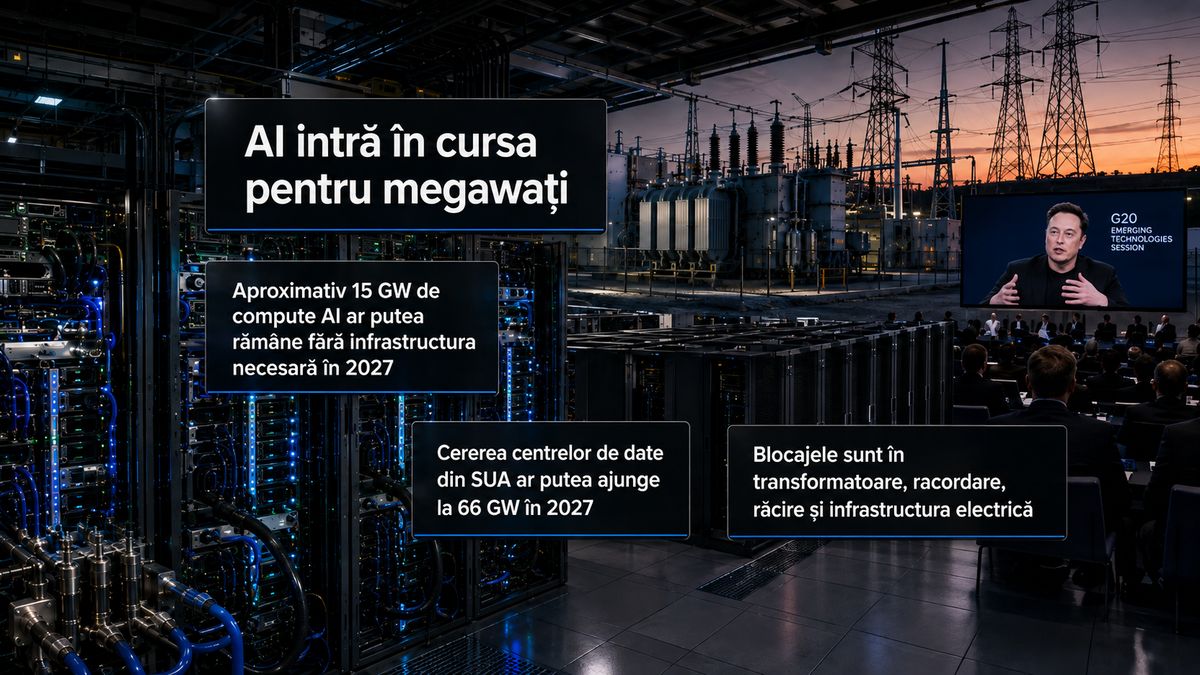
Elon Musk brought one of the most critical issues brewing behind the artificial intelligence boom to the G20: the industry may end up producing AI hardware faster than it can build the infrastructure required to power it. In his virtual address on September 1, 2026, Musk spoke of a “power crisis” and cited an estimate that AI equipment corresponding to a load of approximately 15 GW could be manufactured in 2027 without the necessary infrastructure being ready to power it up that same year. While this figure is an estimate attributed by Musk to analysts rather than an officially measured energy deficit, the direction of the warning is supported by data published separately by the IEA, Goldman Sachs, US authorities, and electrical equipment manufacturers. This issue is shifting the economic logic of the AI race. In recent years, the most visible shortages were in Nvidia accelerators, advanced memory, and chip fabrication capacity. Once these components are produced, however, their value remains locked if the data center lacks simultaneous access to power, transformers, switchgear, cabling, cooling, networking, and a connection capable of carrying hundreds of megawatts. In other words, the industry is transitioning from a race for GPUs to a race for energized GPUs . US Data Center Demand Could Reach 66 GW by 2027 Goldman Sachs estimates that power demand from US data centers will rise from approximately 31 GW in 2025 to 66 GW in 2027 , more than doubling in just two years. The share of these facilities in peak US electricity consumption would climb from 4.1% to around 8.5%. However, this spectacular figure comes with a second, perhaps even more critical piece of information: Goldman estimates that only 50–60% of the data center capacity scheduled for the next one to two years will come online on time , amid delays and cancellations. This highlights the gap between an announced project and an actively functioning AI center. A campus may have the land, the financing, and even the servers under contract, but without a firm date for receiving the necessary power, the investment is not fully operational. The IEA is observing the same acceleration on a global scale. Electricity consumption by data centers grew by 17% in 2025 , while that of AI-focused facilities surged by approximately 50% . The agency estimates that global electricity use by data centers will increase from around 485 TWh in 2025 to 950 TWh by 2030 , while consumption by AI-oriented centers could triple over the same period. An AI Rack Could Reach the Peak Power of 65 Households The issue is not just the total volume of electricity. Power must be concentrated within an extremely small physical footprint. The IEA estimates that the power density of AI servers increased approximately 11-fold between 2020 and 2025 and could grow by another four times by 2027. A single rack in an advanced AI center could then reach a peak power demand comparable to that of about 65 households . This density elevates cooling and internal power distribution from auxiliary elements to strategic components of AI infrastructure. It is not enough to have a gigawatt of generation somewhere in the system. The power must reach the right node, at the right voltage, and on the exact date the servers are installed, while the heat generated must be continuously dissipated. This explains why Musk emphasized, even before his G20 address, that the challenge is not limited to finding a source of electricity. Around each cluster, transformers, cabling, liquid cooling, high-capacity chillers, and the communications infrastructure that turns chips into a functional computing system must be built. Transformers Can Delay Data Centers by Years The speed of the semiconductor industry and the speed of electrical infrastructure development are radically different. Reuters reported in July that demand from AI centers is worsening the US shortage of transformers, circuit breakers, and switchgear. For certain high-voltage transformers, lead times had reached approximately 160 weeks , up from 143 weeks in 2024. Utilities have begun ordering equipment years in advance and extending their planning horizons to secure available manufacturing slots. Grid connection times are not measured in months either. Berkeley Lab shows that US power generation projects reaching commercial operation in 2025 had spent a median of over five years in the interconnection queue. At the end of 2025, approximately 549 GW of generation and storage capacity had interconnection agreements in various stages but had not yet entered commercial operation. For large data centers, the issue has become critical enough that the Federal Energy Regulatory Commission (FERC) ordered all six regional operators under its jurisdiction in June to justify or reform their connection rules for data centers and other large consumers. FERC explicitly uses the term “speed-to-power” : the speed at which an investment can actually receive the…
Aurora AI — Independent Editorial Board
The NRG-IA newsroom continuously monitors Romanian energy markets, ANRE regulatory decisions, and national grid telemetry (SEN/SNT). We deliver independent intelligence anchored exclusively in official primary data.
Editorial Charter, Ethics & Verification Methodology →