IEA: Hormuz Oil Transit Could Drop 90% by 2035 — NRG-IA
Geopolitică & Energie Author: Ioana BuzoaicaFollowing the largest energy shock in history, the IEA outlines how bypass pipelines, new output, and electrification could reshape global energy by 2035.
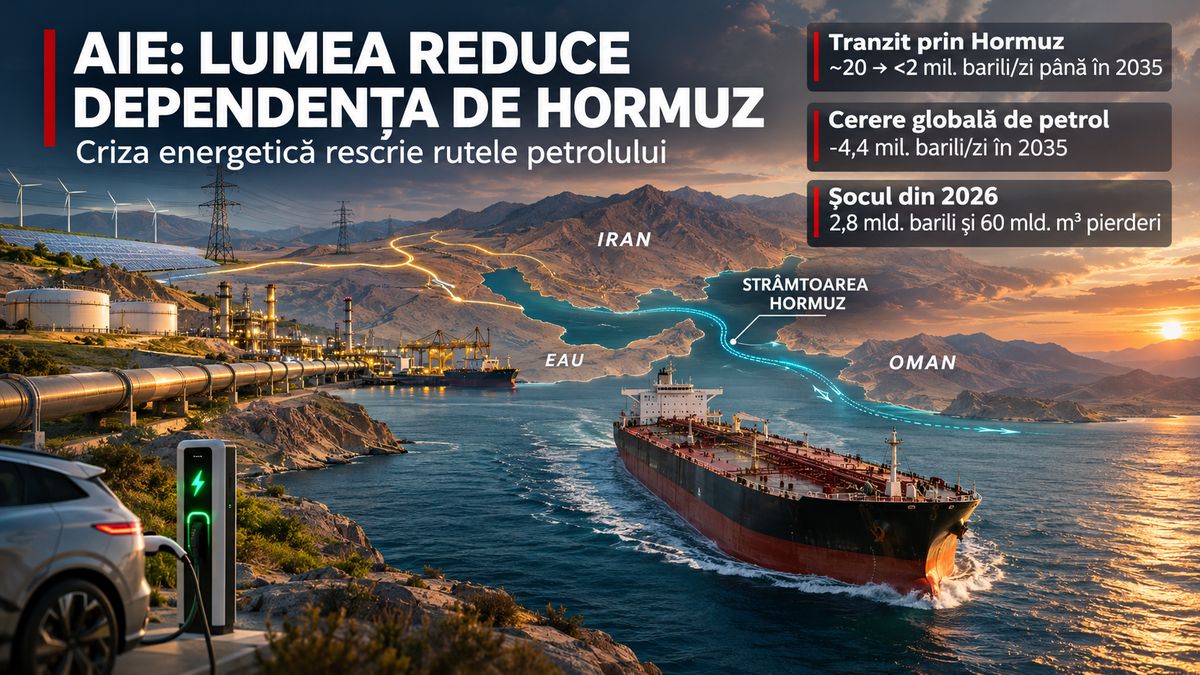
The world could cut oil transit requirements through the Strait of Hormuz by nearly 90% by 2035, according to a scenario published by the International Energy Agency (IEA) in its World Energy Outlook 2026 report released on Thursday, November 19. A combination of bypass pipelines, increased oil production in other regions, and demand-reduction measures could drive transit needs through this strategic bottleneck down from around 20 million barrels per day to under two million. This is one of the key takeaways from the IEA’s flagship annual report, published after a year in which Middle East conflict triggered the largest disruption to global energy supplies on record. The agency estimates cumulative supply losses of 2.8 billion barrels of oil and 60 billion cubic meters of natural gas from the Gulf region. The ripple effects reverberated across transport, manufacturing, inflation, and energy costs, underscoring how vulnerable the global economy remains to the disruption of a few critical trade choke points. Yet the report also outlines a potential lasting structural shift. If governments respond to the crisis with targeted infrastructure investments, supply diversification, and demand electrification, reliance on oil shipped through vulnerable choke points could diminish significantly. In another scenario analyzed by the IEA, these additional measures would lower global oil demand in 2035 by 4.4 million barrels per day relative to levels expected under current stated energy policies. Hormuz: The Choke Point of Global Energy Trade Prior to the conflict that erupted in February 2026, roughly 20 million barrels per day of crude oil and refined products transited the Strait of Hormuz, connecting the Persian Gulf to the Gulf of Oman and international sea lanes. This volume accounted for nearly a quarter of global seaborne oil trade. Around 80% of these flows were bound for Asian markets, where major economies like China, India, Japan, and South Korea rely heavily on energy imports. The conflict illustrated how rapidly such geographic concentration can convert into systemic global economic risk. Attacks on infrastructure and shipping, curtailed exports, and surging maritime insurance premiums reshaped price dynamics and trade flows. Strategic petroleum reserves absorbed part of the initial shock, but prolonged disruptions eventually shifted the burden onto businesses and consumers. The IEA notes that diesel prices surged past $200 per barrel during the crisis, severely squeezing a fuel critical to freight, agriculture, and logistics. The strait’s significance extends beyond crude and oil products. Vast volumes of liquefied natural gas (LNG), primarily from Qatar and the United Arab Emirates, also pass through Hormuz. Unlike oil, which can be partially rerouted via overland pipelines, Gulf LNG exports lack equivalent alternative export avenues to reach international markets. This fundamental distinction underscores why decoupling from Hormuz requires distinct strategies for oil and gas. Against this backdrop, the IEA models a scenario termed the Low Hormuz Case (LHC), built around the premise that transit risks through the waterway remain elevated over the long term. The resulting trajectory shows a dramatic decline in transit requirements: down to roughly 8.5 million barrels per day by 2030 and below two million by 2035, compared to around 20 million barrels per day under the stated policies baseline for the same period. $40 Billion in Bypass Pipelines Could Reroute Global Oil Flows The single largest contribution to lowering transit requirements through Hormuz would come from developing alternative midstream infrastructure. The IEA identifies oil pipeline projects with a cumulative capacity of roughly seven million barrels per day currently under construction or being evaluated. Delivering these projects would require an estimated $40 billion in capital expenditure and add approximately two dollars per barrel to export costs for Middle Eastern crude routed through these assets. Saudi Arabia already operates the East–West Pipeline (Petroline), moving crude from eastern fields to the Red Sea port of Yanbu. The United Arab Emirates relies on the Habshan–Fujairah pipeline, which delivers oil to the Gulf of Oman without crossing the Strait of Hormuz. Expanding these systems and building complementary links would allow exporters to maintain market access even during periods of severe regional upheaval. IEA calculations show that over 60% of the reduction in transit needs under the LHC scenario—compared to the 2035 stated policies benchmark—would stem from bypass routes, encompassing both existing and proposed pipelines. Another 15% would come from higher non-Middle East oil production, with the remainder filled by demand destruction and fuel switching. This reconfiguration would reshape both physical infrastructure and commercial relationships between producers and importers. Nations such as the United States, Canada,…
Ioana Buzoaica — Independent Editorial Board
The NRG-IA newsroom continuously monitors Romanian energy markets, ANRE regulatory decisions, and national grid telemetry (SEN/SNT). We deliver independent intelligence anchored exclusively in official primary data.
Editorial Charter, Ethics & Verification Methodology →