Heat-Driven Elastocaloric Cooling Cuts Electricity Use — NRG-IA
Tehnologie & Inovație Author: Ioana BuzoaicaCooling uses 10% of global power. KIT and Tsukuba researchers have shown how heat can drive cooling, opening a path to low-electricity air conditioning.
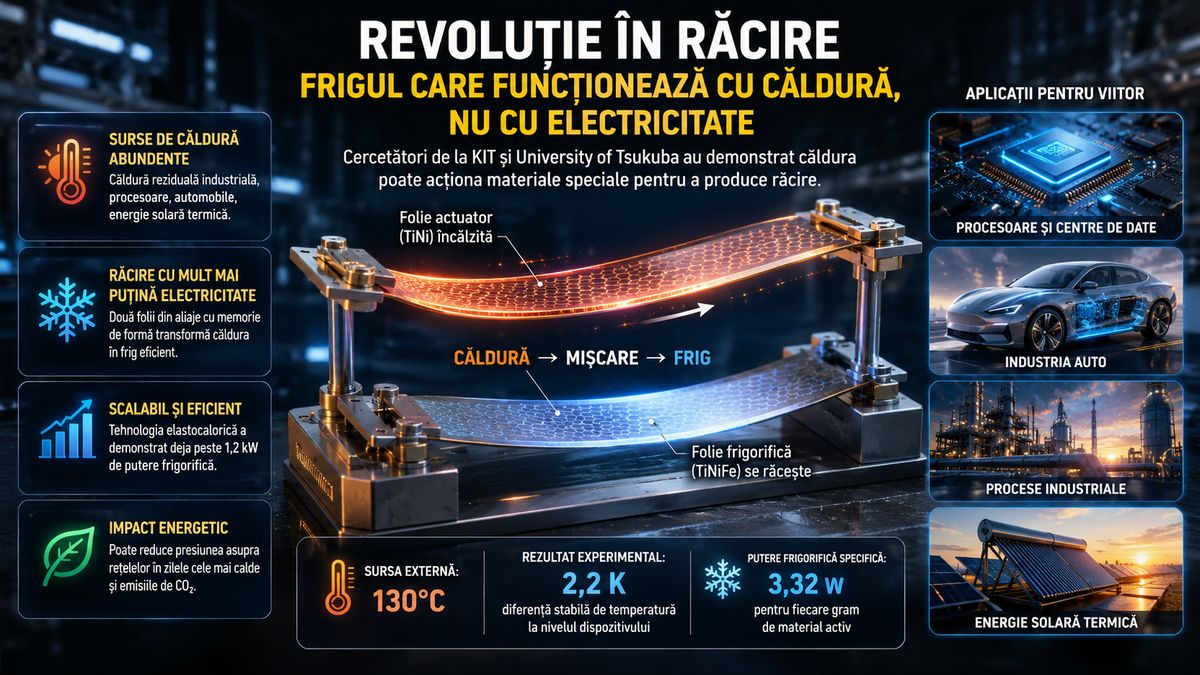
Air conditioning is becoming one of the greatest strains on power grids precisely on the days when temperatures peak. Cooling already accounts for approximately 10% of global annual electricity consumption and can reach around 30% of peak demand , according to the International Energy Agency. UNEP estimates that, under the current scenario, global cooling demand could more than triple by 2050. In this context, researchers from the Karlsruhe Institute of Technology (KIT) and the University of Tsukuba have demonstrated a radically different approach: instead of electricity producing the mechanical force required for cooling, heat can generate this force . The system, presented on August 28 in Nature Energy , uses two extremely thin shape-memory alloy films. The first is heated and contracts. Its movement stretches the second film. When the latter is released and returns to its initial state, it absorbs heat and cools down. The energy chain thus becomes very simple: heat → mechanical motion → cold. In the decisive experiment, an external source maintained at 130°C drove the system, which produced a stable temperature difference of 2.2 K at the device level and a specific cooling capacity of approximately 3.32 W for each gram of active cooling material . The stakes go far beyond a laboratory device. The researchers explicitly point to the possibility of a processor using part of its own waste heat for cooling, automotive electronics leveraging drivetrain heat, or solar thermal energy and currently discarded industrial waste heat becoming sources for refrigeration systems. Cooling is becoming an increasing challenge for grids and electricity bills The growing need for air conditioning is reshaping the electricity consumption profile. In the European Union, there were approximately 57 million room air conditioning units in 2020 , according to the European Commission. By 2030, their number is projected to reach around 104 million . During the heatwave of summer 2025, intensive air conditioning use contributed to daily electricity demand spikes of up to 14% in some European markets . The core issue is the concentration of consumption: millions of units turn on during the same intervals, when temperatures are at their highest. Globally, UNEP estimates that cooling demand could more than triple by 2050 under a business-as-usual scenario, with associated emissions potentially rising to approximately 7.2 billion tonnes of CO₂e annually . Any technology capable of shifting even a portion of the energy required for cooling from electricity to already available heat could therefore have far greater significance than the scale of the current prototype suggests. Two films of a few dozen micrometers replace the electric motor in the experiment Elastocaloric systems use materials that heat up or cool down when mechanically deformed. In the new device, the material producing the cooling effect is a film of TiNiFe, a nickel-titanium-iron alloy, approximately 26.5 micrometers thick . Stretching it requires force. In most elastocaloric prototypes, this force is supplied by an electric motor or actuator. The KIT–Tsukuba team replaced it with another shape-memory film made of TiNi—nickel and titanium—measuring about 22 micrometers in thickness . This essentially functions as a miniature heat engine. When sufficiently heated, its crystalline structure transforms, and the film attempts to return to its memorized shape. It contracts and mechanically pulls the cooling film. When the actuator's temperature drops, the force decreases, and the cooling film returns. During this reverse transformation, the material absorbs heat and cools down . The system thus utilizes two properties of shape-memory alloys in the same sequence: one converts heat into motion, while the other converts motion into a cooling effect. The experiment produced a temperature difference of nearly 13 degrees at the material level In the first configuration, the researchers electrically heated the actuator film to an average temperature of approximately 86°C . The cooling material then produced a temperature variation of up to 12.9 K , and the device, integrated with heat exchange surfaces, maintained a stable difference of 4.0 K between the hot and cold sides. The specific cooling capacity in this configuration reached approximately 4.43 W/g of active cooling material . This experiment demonstrated that the two films can work together as a complete actuation and cooling system. This was followed by the critical test for the new concept: the electrical energy used to heat the actuator was replaced with an external heat source at 130°C . The heated TiNi film produced a displacement of approximately 300 micrometers , sufficient to actuate the cooling material. After about 20 cycles, the device stabilized a temperature difference of 2.2 K . For the first time in this architecture, external heat directly provided the force required for the elastocaloric cycle. A…
Ioana Buzoaica — Independent Editorial Board
The NRG-IA newsroom continuously monitors Romanian energy markets, ANRE regulatory decisions, and national grid telemetry (SEN/SNT). We deliver independent intelligence anchored exclusively in official primary data.
Editorial Charter, Ethics & Verification Methodology →