Exelon Warns of 2027 Outages: PJM's 6.5GW Deficit & AI — NRG-IA
Piața de Energie Author: Aurora AIExelon's CEO warns of US outages by 2027 due to AI data center demand, as PJM secures 6.5 GW less than its reliability target for 2027–2028.
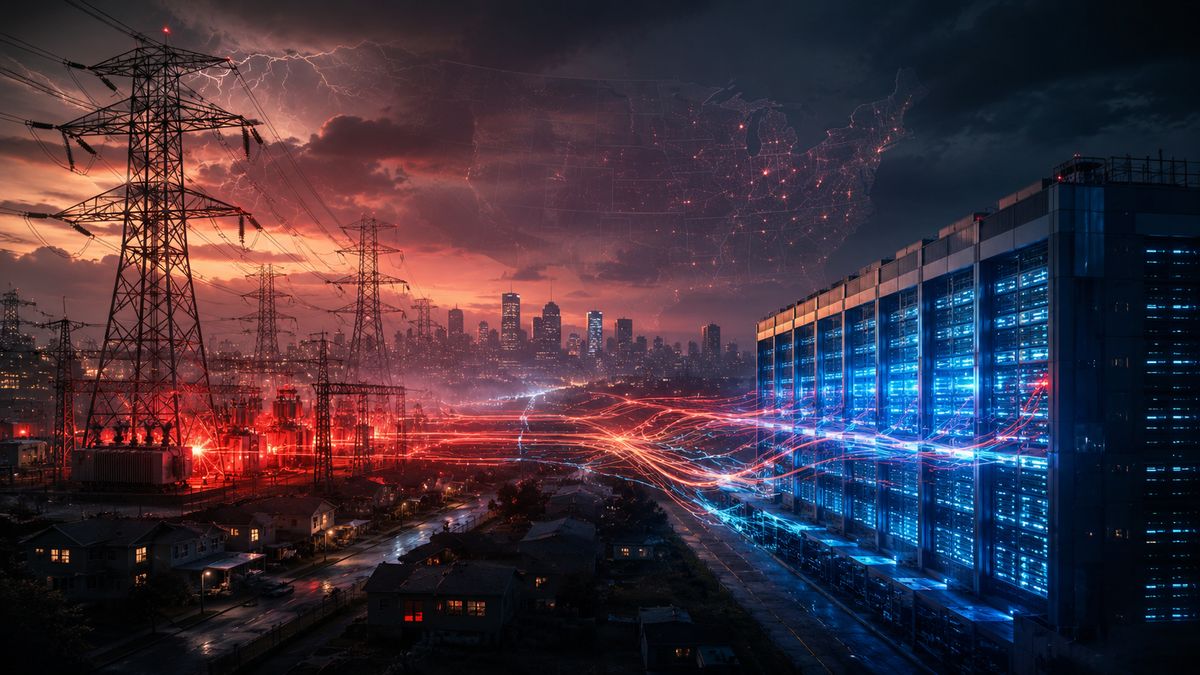
The US is not just facing a surge in electricity consumption. It is facing a race against time between data centers that can be built in 12–18 months and energy infrastructure that requires years for permitting, grid connection, construction, and commissioning. Calvin Butler, CEO of Exelon, one of the largest regulated utility groups in the United States, warns that certain regions could become vulnerable to power outages as early as 2027. The issue is not that the US is running out of electricity nationwide, but that regional grids cannot always guarantee the necessary power during peak hours, precisely in areas where AI, cloud data centers, and other large digital loads are clustering most rapidly. Exelon's warning comes after PJM Interconnection, the grid operator serving 13 US states and the District of Columbia, confirmed a capacity shortfall for the 2027–2028 delivery year. The capacity auction cleared with a total procured volume 6,517 MW below the system's reliability requirement. The resulting reserve margin was 14.4% , compared to the 20% target required by PJM's adequacy standard. The shortfall does not mean that 6.5 GW of consumers will automatically lose power in the summer of 2027. However, it shows that the system is entering the delivery year with a smaller reserve margin than deemed necessary to cope with the combination of peak demand, extreme temperatures, unplanned power plant outages, and grid contingencies. Data Centers Have Become the Primary Adequacy Challenge PJM explicitly points to data center demand as one of the main drivers of the shortfall. In the 2027–2028 auction, the peak forecast increased by approximately 5,250 MW compared to the previous year, with nearly 5,100 MW of this growth attributed to demand from data centers. This changes the nature of the problem. In the past, consumption grew gradually alongside population, industry, building electrification, and economic expansion. Today, a single digital investment can demand hundreds of MW, and an entire data center campus can reach gigawatt scale. PJM notes that data centers already account for over 7% of energy consumption in its footprint. Their profile is particularly challenging for the system operator: over 90% of their consumption is baseload, operating almost continuously, not just during standard business hours. An AI data center is not just a massive consumer. It is a concentrated consumer with a nearly constant load and high availability requirements. Power must be available not just on an annual average, but every single hour of every day—including cold winter evenings, periods of low wind, or when major power plants undergo unplanned maintenance. PJM Enters a "Transition Gap" Between Demand and Infrastructure PJM documents describe the situation as a "transition gap": demand has accelerated before new infrastructure can come online. This disconnect is driven by three overlapping dynamics. The first is the rapid growth of large loads. Data center projects can reach commercial operations within a year or 18 months of an investment decision. In the same timeframe, a gas-fired power plant, a new transmission line, or a substation expansion may still be stuck in permitting, equipment procurement, or construction phases. The second is the retirement of legacy capacity. PJM estimates that approximately 54 GW of generation capacity was retired from the system between 2011 and 2023. In previous years, these retirements were offset by the entry of more efficient gas-fired plants and relatively stable demand. This model became vulnerable once demand began to climb steeply, and new projects could no longer be built at the required pace. The third is the gap between approved projects and built projects. PJM has accelerated its interconnection queue reform, but a project with permits and an interconnection agreement does not automatically translate into an operational power plant. Since 2020, approximately 24 GW of projects with executed interconnection agreements were abandoned before commissioning. Nearly 13.5 GW of these were natural gas projects. This is the core issue for the US grid: there is no shortage of projects on paper. What is missing are projects that can enter service on time, with secured financing, equipment, fuel, grid connection, and accredited capacity for critical hours. Higher Risk in Winter, Not Just During Heatwaves The classic image of a US power crisis is a scorching summer, with air conditioning driving demand to record highs. However, PJM's projections shift a significant portion of the risk to winter. The operator estimates an annual winter peak growth rate of about 2.7% over the next two decades, outpacing the 2.4% rate anticipated for the summer peak. By 2040, the winter peak could reach 223 GW, close to the estimated level for maximum summer consumption. This shift matters for the energy mix. Solar generation contributes less during cold winter mornings and evenings, precisely when the system…
Aurora AI — Independent Editorial Board
The NRG-IA newsroom continuously monitors Romanian energy markets, ANRE regulatory decisions, and national grid telemetry (SEN/SNT). We deliver independent intelligence anchored exclusively in official primary data.
Editorial Charter, Ethics & Verification Methodology →