ANRE: 151,000 Romanian prosumers now own battery storage — NRG-IA
Prosumatori & Eficiență Author: Ioana BuzoaicaRomania has reached 400,000 prosumers, with 151,000 using battery storage, as day-ahead electricity prices swing from €5/MWh at noon to €520 at 7 p.m.
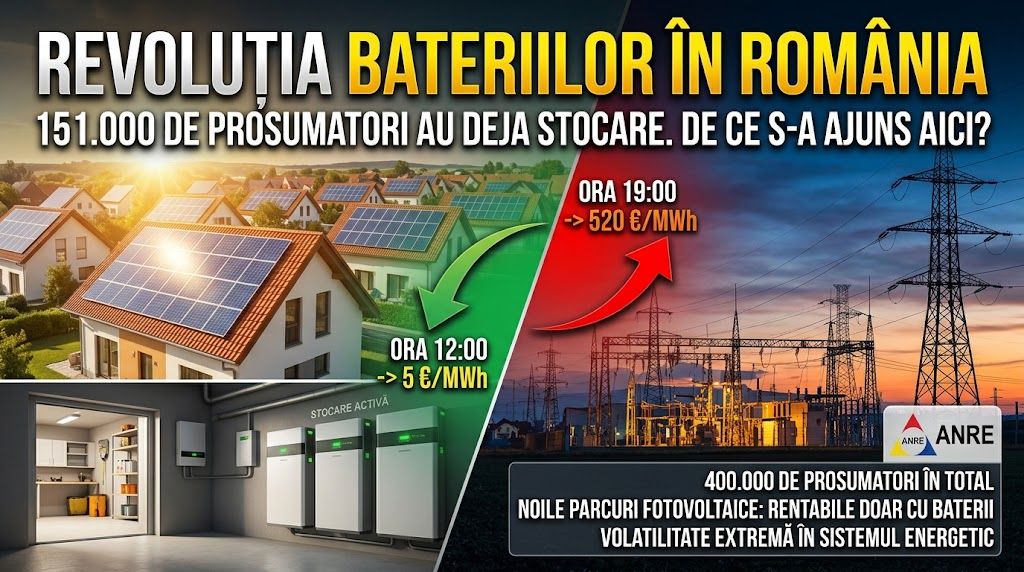
The number of prosumers in Romania has reached the 400,000 mark, with 151,000 of them already equipped with battery energy storage systems, announced Mircea Man, Vice President of the National Energy Regulatory Authority (ANRE). Official data reveals a rapid structural shift in the behavior of households and commercial entities with rooftop solar: nearly 38% of grid-connected small-scale producers no longer rely solely on feeding surplus power into the grid, opting instead to store daytime generation to cover their evening and nighttime consumption. This accelerated maturation of the residential and small commercial segment comes amid a radical transformation of Romania's wholesale electricity market. As total installed solar capacity approached 7,000 MW, peak midday solar generation began frequently exceeding demand during those hours, collapsing daytime prices and shifting all financial and technical stress onto the evening peak. The direct consequence of this imbalance is reflected on the Day-Ahead Market (DAM), where electricity prices fluctuate by more than a hundredfold within the same day. Energy sector experts warn that on sunny days, the price per megawatt-hour plunges to €5 at 12:00 p.m., only to surge seven hours later to €520/MWh at 7:00 p.m.—an economic reality that renders new solar investments viable only when co-located with storage capacity. Nearly 38% of prosumers have shifted from simple grid injection to battery storage Reaching the milestone of 400,000 prosumers confirms that decentralized power generation has become one of the most dynamic sectors of the Romanian economy. However, the key figure highlighted by ANRE leadership is that of battery storage: 151,000 prosumers equipped with storage demonstrate that nearly four out of ten users have already taken the step toward greater energy autonomy. For a household or commercial user with solar panels, the generation curve runs opposite to the typical family consumption profile. Panels generate maximum electricity between 11:00 a.m. and 3:00 p.m., precisely when homes are often unoccupied, whereas residential demand peaks between 6:00 p.m. and 10:00 p.m. after sunset. Without a battery, prosumers are forced to feed midday surplus into the distribution grid and purchase power from the system in the evening, remaining exposed to net billing or net metering policies and network tariffs. Furthermore, in areas where local low-voltage grids are congested by high rooftop solar penetration, grid voltage spikes beyond permissible technical limits during midday. This overvoltage triggers automatic inverter shutdowns, curtailing generation during peak sunshine hours. Installing a battery resolves both issues simultaneously: midday solar is absorbed locally by the battery, preventing inverter trips, and is discharged into the building's internal system in the evening, when grid power is most expensive. Spread from €5 at noon to €520 in the evening reshapes energy market economics While these 151,000 prosumers with batteries have established an individual hedge, the lack of utility-scale storage across the National Power System causes severe price distortions. Market data shows that the hourly spread on the Day-Ahead Market has reached extreme levels, with clearing prices recorded at €5/MWh at 12:00 p.m. and soaring to €520/MWh at 7:00 p.m. This phenomenon—known in developed energy markets as the classic "duck curve," featuring a deep midday belly and a steep evening ramp—is the direct result of Romania approaching 7,000 MW in total installed solar capacity across utility-scale projects and prosumer systems. At midday, this solar fleet feeds thousands of megawatts into the system at near-zero marginal cost, pushing wholesale spot prices down to nominal levels. As solar output collapses toward zero between 5:00 p.m. and 8:00 p.m., the power system must rapidly replace thousands of megawatts just as households return home and turn on appliances, lighting, and heating systems. When this evening ramp coincides with drought-stricken hydro generation and capacity constraints among baseload thermal plants, the supply deficit can only be covered by firing up expensive gas or coal units and relying on emergency imports, driving hourly clearing prices up to €520/MWh. The end of standalone solar farms: at 7,000 MW installed, profitability hinges entirely on storage This extreme volatility has fundamentally altered financial projections for renewable energy investors. Market analysts emphasize that under current conditions, developing new standalone solar farms without storage is no longer economically viable due to price cannibalization. A conventional solar asset generates its entire output during the exact hours when all other solar plants nationwide and across the region are generating at full capacity. Repeatedly selling power on the spot market at €5/MWh—or even at zero and negative prices during low-demand weekends—can no longer service debt, cover…
Ioana Buzoaica — Independent Editorial Board
The NRG-IA newsroom continuously monitors Romanian energy markets, ANRE regulatory decisions, and national grid telemetry (SEN/SNT). We deliver independent intelligence anchored exclusively in official primary data.
Editorial Charter, Ethics & Verification Methodology →