ANRE Investigates Distributors Over Long Plant Testing — NRG-IA
Legislație & Reglementări Author: Ioana BuzoaicaANRE audits distribution operators over unusually long testing periods for new power plants, targeting the critical commercial commissioning phase.
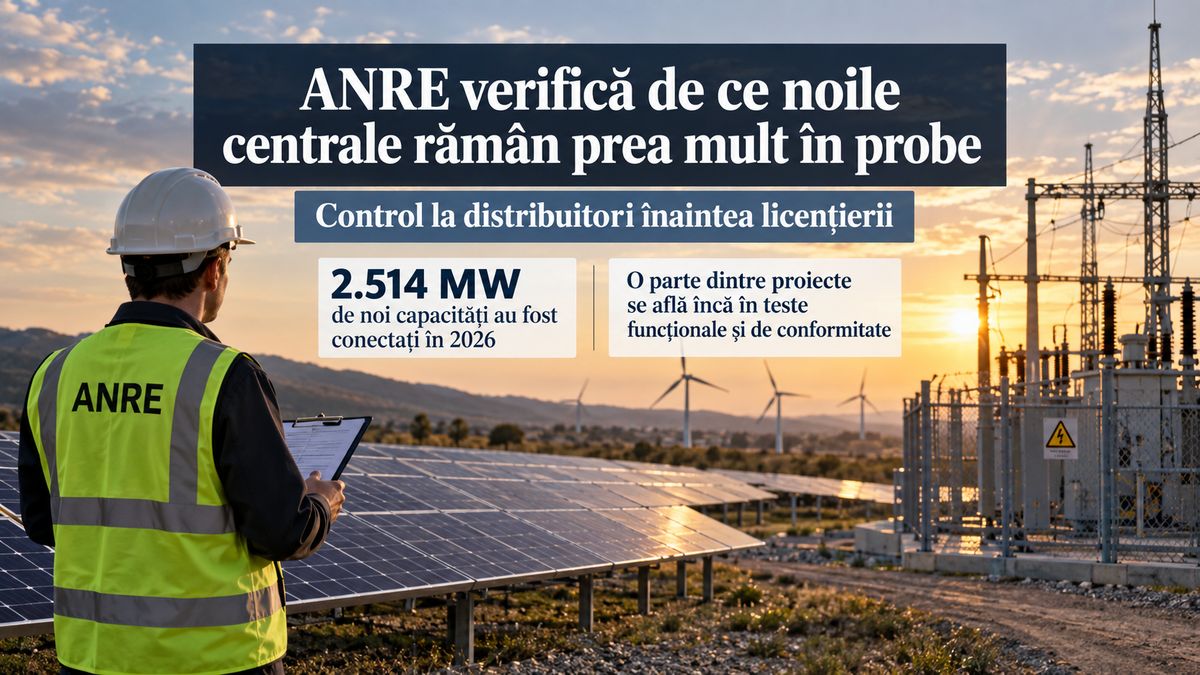
The National Energy Regulatory Authority (ANRE) is preparing a series of audits targeting distribution system operators after observing "unnaturally long" testing periods for certain power generation capacities. The investigation will focus on how the documents required for licensing are issued, specifically during the critical phase when a fully built and grid-connected plant must transition from trials to commercial operation. The announcement was made by ANRE President George Niculescu in a press release presenting the authority's enforcement balance sheet for the first eight months of the year. Between January 1 and August 31, ANRE carried out 671 inspections and issued 1,026 fines, with the total value of penalties reaching approximately RON 11 million. However, the piece of information with broader implications for the development of the power system is the newly announced audit of distributors. "We have observed unnaturally long testing periods relative to the respective installed capacities," stated George Niculescu, noting that the situation has raised questions about how power generation projects are being managed. ANRE has not yet disclosed the number of projects in this situation, their cumulative capacity, the technologies used, or which distribution operators will be audited. Nor has the authority claimed that any legal violations have already been established. The investigation is designed to determine exactly what is happening during this phase and whether the observed durations are justified by technical processes or documentation requirements. Romania is connecting thousands of megawatts, but a portion remains in the testing phase The audit comes at a time when the pace of connecting new capacities has accelerated sharply. On August 20, Transelectrica announced that since the beginning of 2026, new generation and storage capacities totaling 2,514 MW had been connected to the National Power Grid. Of this total, solar PV accounted for 1,331 MW, storage facilities for 663 MW, wind for 496 MW, thermal (hydrocarbons) for 20 MW, and biogas for 5 MW. The 2,514 MW figure represents the capacity of the new installations connected to the grid, not their actual generation or the capacity fully in commercial operation. Transelectrica explicitly pointed out that the projects are at different stages: some already hold commercial operation licenses, while others are undergoing internal functional and compliance testing. This distinction is precisely what makes ANRE's announced audit highly relevant. Physical grid connection does not automatically complete the journey of a new energy project. The plant must undergo the trials and technical verifications required by regulations and obtain the necessary documentation for normal operation and licensing. In a system where thousands of megawatts of new capacity are added in a single year, the duration of this transition becomes an issue with a direct impact on how quickly completed investments can reach commercial operation. Regulations allow testing periods from six months to two years, depending on the plant The testing period does not have the same duration for all facilities. Current ANRE regulations set different limits depending on the technical category of the generating unit. For Category A installations, the period can last up to six months from the initial energization. For Categories B and C, the limit is 12 months, while for Category D installations, it can reach up to 24 months. The grid operator may also establish a shorter period depending on the project's characteristics. Thus, the size of the facility directly influences the evaluation of the testing duration. ANRE's statement that "unnaturally long" periods were observed "for the respective installed capacities" points precisely to assessing the duration in relation to the specific characteristics of the analyzed capacities. However, a lengthy testing period is not, in itself, proof of a violation. Tests must demonstrate that the facility can operate under the technical conditions required by the grid, and any non-conformities must be resolved before the process is finalized. Grid operator documentation is part of the path to commercial operation Licensing regulations explicitly link commercial operation to the completion of testing and the documents issued during the connection process. To license a generation capacity, the documentation must certify the completion of trials conducted in accordance with the schedule agreed upon with the grid operator, as well as commissioning for normal operation. The connection certificate issued by the grid operator is also among the relevant documents for this stage. The audit announced by ANRE thus targets a sensitive link in the chain: the gap between when the investment physically exists in the system and when it can fully transition to commercial status. If the audits identify unjustified administrative delays in issuing documents, this could explain…