Prosumers 2026: New ANRE Rules for Net Billing and Invoices — NRG-IA
Prosumatori & Eficiență Author: Ioana BuzoaicaRomania is shifting prosumer surplus from 24-month energy roll-overs to monthly financial settlement. ANRE is consulting on multi-site allocation rules.
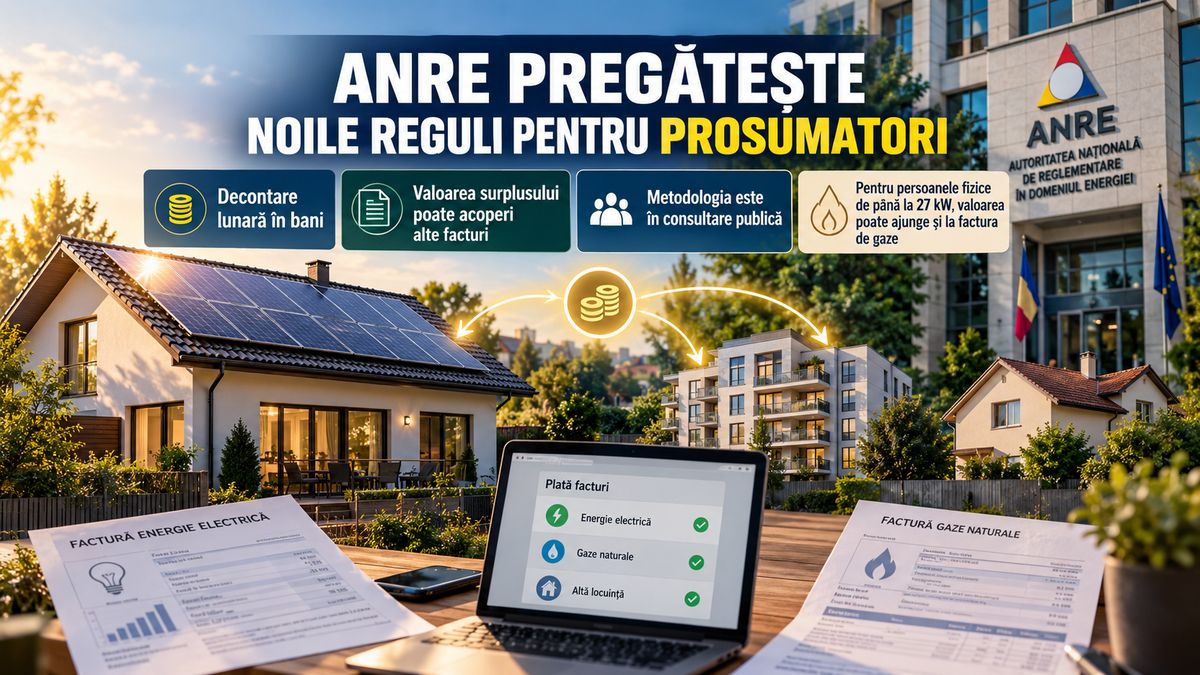
Romania is changing one of the core mechanisms upon which the prosumer market was built. Law No. 160/2026, which entered into force on July 26, shifts the compensation for newly exported grid energy from long-term quantitative roll-overs to a monthly financial settlement. ANRE is now drafting the rules through which this value can be used beyond the bill of the generation site. The change shifts the mechanism from rolling over energy volumes to the financial monetization of the surplus. Exported energy is settled, and the resulting amount can be used, under the conditions set by law and ANRE's methodology, to offset other eligible bills of the same prosumer. In other words, rather than transferring kWh between consumption sites, the monetary value obtained from the generated and exported energy is transferred. As of September 24, 2026, the framework operates on two distinct levels. Law 160/2026 is already in force, establishing the new rights and principles. However, the ANRE methodology required to operationalize these rights is still in its second phase of public consultation. ANRE has scheduled the public debate for September 25, and feedback on the drafts can be submitted until October 1. 24-Month Roll-Overs Disappear for New Energy Exports One of the most significant changes concerns energy generated and exported to the grid starting July 26, 2026. Under the old mechanism, energy delivered by a prosumer could generate rolled-over volumes to be used later within a period of up to 24 months. According to the transitional draft prepared by ANRE for the implementation of Law 160/2026, no such new quantitative roll-overs will be established for energy delivered after the new law's entry into force. Compensation is reorganized on a monthly basis. For prosumers with installations up to 200 kW per consumption site, the supplier bills the energy taken from the grid and separately values the energy delivered by the prosumer, in accordance with applicable prices and contractual rules. The difference is fundamental: for newly injected energy, the surplus no longer builds up a "stock" of kWh available for two years, but instead generates a financial value resulting from the settlement. However, this change does not erase already accumulated rights. Rolled-over volumes for energy delivered up to and including July 25, 2026, retain their previous regime, along with their associated value and deadlines. In the second phase of the draft, ANRE explicitly reinforced the protection of these historical roll-overs. Surplus Can Become Funds for Other Consumption Sites The new framework introduces one of the most important features for prosumers: multi-site value allocation. This "multi-site" mechanism does not involve transferring kWh from one address to another. The generated energy is measured, billed, and settled at the injection site. Following this stage, the credit available to the prosumer can be used, under conditions set by law and ANRE methodology, to offset obligations at other eligible sites. A property owner can thus have solar panels at a residence where they produce more than they consume, and the resulting settled value can be applied to another eligible bill in their portfolio. This change transforms the energy surplus into a far more flexible financial tool than the old quantitative roll-over tied to a single consumption site. Broadest Mechanism Introduced for Installations Up to 27 kW The regime becomes even more flexible for individual prosumers with installations of up to 27 kW per consumption site. The law allows them to opt to use the settled value to cover obligations across all their consumption or generation-and-consumption sites within the portfolio of the same electricity supplier. For this category, the law removes the general requirement that these sites be connected to the same distribution system operator (DSO). ANRE maintained this interpretation in the second phase of the consultation. The decisive condition thus becomes the commercial relationship with the supplier: the sites must belong to the same supplier's portfolio. For households owning multiple properties or consumption points, this change can significantly increase the economic utility of energy generated at a single site. Solar Energy Can Even Cover Natural Gas Bills Law 160 introduces a feature for the same category of individuals, with installations of up to 27 kW per consumption site, that extends the mechanism beyond electricity. The value resulting from electricity compensation can be used to pay obligations under natural gas supply contracts, provided that the legally prescribed conditions are met. In ANRE's draft, the common supplier is defined as the exact same legal entity, identified by the same unique registration code. The affiliation of electricity and gas suppliers to the same corporate group is not sufficient if the services are provided by different legal entities. This condition may limit practical applicability…