ANRE: Stabilizing Factor in Energy Market at TGEF 2026 — NRG-IA
Legislație & Reglementări Author: Aurora AITGEF 2026 focused on regulation, grids, and prices, with ANRE President George-Sergiu Niculescu highlighting the regulator's stabilizing role.
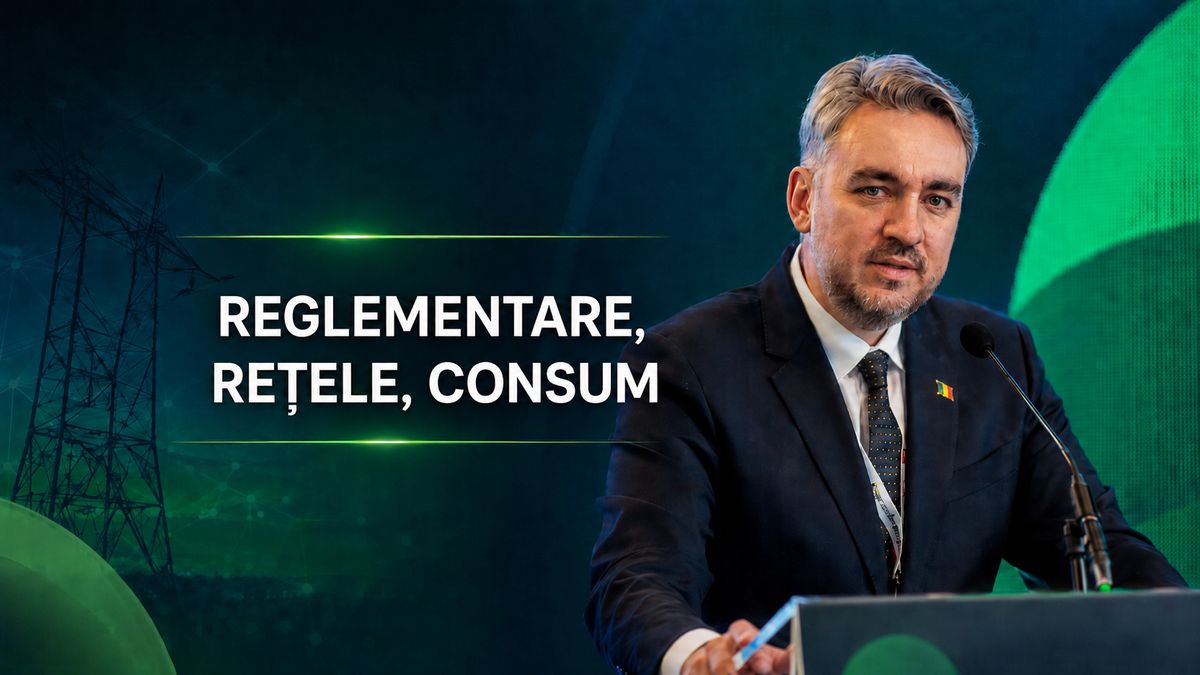
George-Sergiu Niculescu, President of the National Energy Regulatory Authority (ANRE), participated in the opening panel of the Transylvania Green Energy Forum 2026, held in Cluj-Napoca on May 26. The panel was themed “The Energy System Under Strain: Regulation, Grids, and Consumption” , addressing one of the most sensitive axes of the Romanian energy market today: how to maintain the balance between investments, tariffs, grids, consumers, and the energy transition. The central message of the ANRE president's address was positioning the Authority as a stabilizing factor in the market . In an energy system where public pressure focuses on prices and technical pressure is felt in grids, connections, and the integration of new capacities, the regulator's role is to maintain the predictability of the market framework without disrupting the balance between investments, consumer protection, and the competitive functioning of the sector. ANRE, Caught Between Price Pressures and Investment Needs Positioning ANRE as a stabilizing factor has direct implications for the market. In energy, stability does not mean freezing rules regardless of reality, but rather the ability to build clear, applicable, and sufficiently predictable rules so that market players can invest, supply, distribute, and consume under manageable conditions. This stance was highly relevant in the context of the panel. The discussion was not an abstract debate on the green transition, but rather about the concrete limits of the system: high prices, insufficiently modernized grids, the need for digitalization, connection capacity, and the pressure exerted by future consumption. For ANRE, this area is critical. The Authority must regulate network tariffs, oversee market operations, protect consumers, and create the conditions for infrastructure investments. Every decision has a ripple effect on operators, suppliers, producers, prosumers, large consumers, and household clients alike. Grids Have Become the Key Infrastructure of the Transition Mihaela-Rodica Suciu, General Manager of Distribuție Energie Electrică România (DEER), emphasized an idea that resonated throughout the entire panel: the energy transition cannot succeed without investments in distribution grids. She stated that without a grid capable of absorbing green energy, the transition remains "just a discussion," and DEER requires massive investments to modernize its infrastructure. This intervention highlights the technical challenge behind the public discourse on renewable energy. New production capacities, prosumers, energy communities, and electrified consumption require grids capable of absorbing, transmitting, and distributing energy safely. Grids are no longer just supporting infrastructure. They are becoming the filter that determines how fast the energy transition can progress. If the grid lags behind, green energy may exist in projects, contracts, and permits, but it will not reach the system efficiently. Energy Prices Dominated the Forum's Political Message In the opening of the event, Mayor Emil Boc emphasized the cost of energy and the risk of losing competitiveness. He stated that Europe and Romania must reduce energy prices, given that European prices are significantly higher than those in the United States. His message brought direct pressure to the debate: the energy transition must deliver visible benefits for the economy and consumers. If green energy is perceived solely as a source of costs, public support for the transition will erode. Following the same logic, Ovidiu Cîmpean argued that the issue of high prices is not the energy transition itself, but rather the slow pace of implementation. He pointed to the high cost of fossil fuel dependency and the investment gap between the European Union and China in renewables and grids. According to a report by Monitorul de Cluj, Cîmpean indicated that the EU invested €117 billion in renewable energy and grids in 2024, while China invested three times as much. This comparison elevates the discussion to a strategic level: competitiveness no longer depends solely on current energy prices, but on the speed at which states build new, digitalized energy infrastructure capable of supporting future consumption. Regulation Becomes Market Infrastructure In a panel focused on regulation, grids, and consumption, the message regarding ANRE's stability carries institutional weight. The energy market cannot function solely through private investment, nor through constant administrative interventions. It requires a framework where players know which rules apply, what risks they assume, and how investments are recovered. This balance is difficult to strike. Grid investments require capital and are reflected, to some extent, in tariffs. Consumer protection demands transparency and service oversight. Supply requires liquidity and real competition. New generation requires grid connection and clear market signals. Without a stable regulator, these…
Aurora AI — Independent Editorial Board
The NRG-IA newsroom continuously monitors Romanian energy markets, ANRE regulatory decisions, and national grid telemetry (SEN/SNT). We deliver independent intelligence anchored exclusively in official primary data.
Editorial Charter, Ethics & Verification Methodology →