Novorossiysk Exports Fall to 0.4M bpd: Petromidia's Risk — NRG-IA
Geopolitică & Energie Author: Ioana BuzoaicaBlack Sea disruptions persist. Urals and KEBCO exports via Novorossiysk fell to ~0.4M bpd in early August, threatening Romania's Kazakh crude supply.
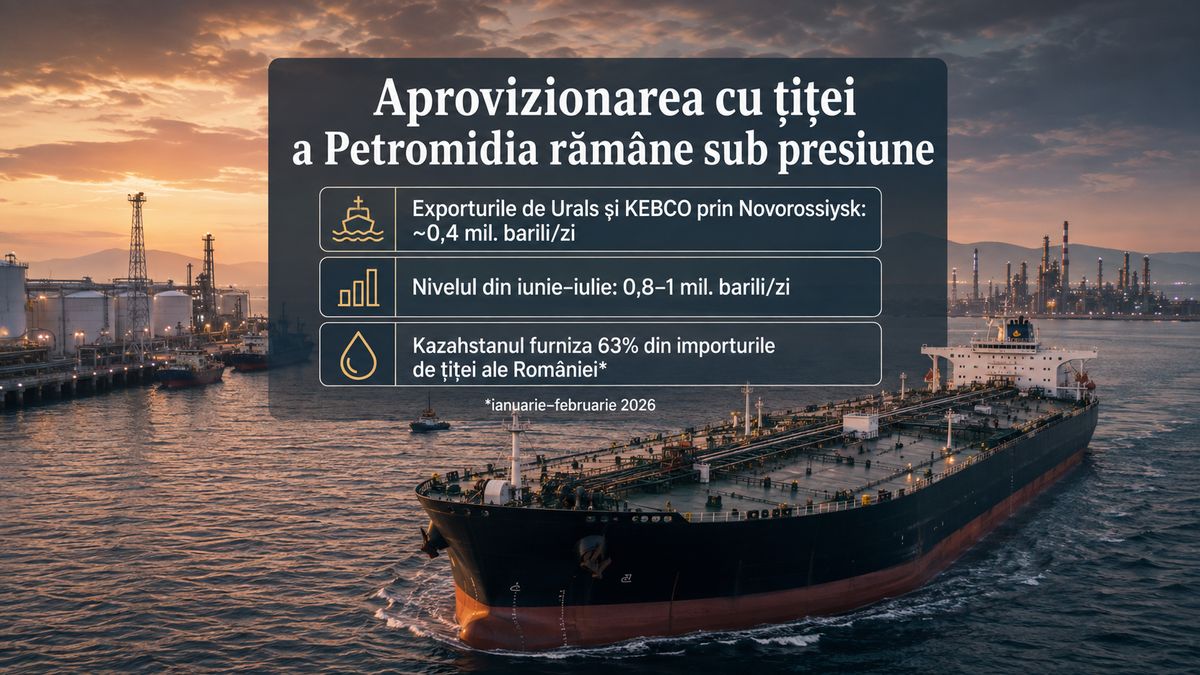
Crude oil exports through Novorossiysk, which include the Urals and KEBCO grades, fell in the first half of August to approximately 400,000 barrels per day (bpd), down from 800,000–1 million bpd in June and July, according to trader data provided to Reuters. The decline did not occur overnight and does not represent a sudden new halt in deliveries to Romania. Instead, it is the result of a multi-week period in which attacks, temporary operational suspensions, and loading delays slowed the pace of exports from the Russian Black Sea port. At the time of the Reuters report, the loading schedule was more than two weeks behind, with some cargoes scheduled for late July only departing in August. Compared to the 0.8–1 million bpd range recorded in June and July, the level of around 0.4 million bpd represents a reduction of approximately 50–60%. This is a comparison between periods, not a sudden halving that occurred on August 23 or 24. For Romania, the deteriorating logistics at Novorossiysk carry particular significance. KEBCO (Kazakhstan Export Blend Crude Oil) is the primary feedstock slated for Petromidia in 2026. Rompetrol Rafinare's budget for this year indicates a crude mix consisting of 57% KEBCO and 19% CPC, supplemented by Azeri Light and Es Sider. In other words, over three-quarters of the planned recipe for Romania's largest refinery is tied to Kazakh crude. The 0.4 million barrels per day does not represent the entire CPC flow Novorossiysk hosts two oil circuits that can easily be confused. The Sheskharis terminal handles exports of Urals, Siberian Light, and KEBCO, while the Caspian Pipeline Consortium (CPC) operates its own marine terminal nearby, at the terminus of the 1,511-kilometer Tengiz–Novorossiysk pipeline. The figure of approximately 0.4 million bpd reported for the first half of August refers to exports from Novorossiysk that include Urals and KEBCO. It does not represent the total CPC volume and cannot be translated into a claim that Kazakh exports via CPC have halved to 400,000 bpd. Reuters explicitly shows that the main terminal at Novorossiysk loads Urals and KEBCO, while CPC operates a distinct marine infrastructure for oil brought via the pipeline from Kazakhstan. However, this distinction does not reduce Romania's exposure. Petromidia uses both Kazakh grades—KEBCO and CPC—and both circuits in the Novorossiysk area have experienced episodes of disruption this summer. CPC confirms that its marine terminal was affected in July by attacks on tankers during loading. The consortium states that the Tengiz–Novorossiysk system carries more than two-thirds of Kazakhstan's crude oil exports, turning any prolonged disruption into a logistical risk that extends far beyond the Russian market. Kazakhstan supplies nearly two-thirds of Romanian crude oil imports Romania's dependence on this source is measurable. According to INS (National Institute of Statistics) data obtained by Mediafax, Romania imported 1.25 million tonnes of crude oil in January–February 2026, 17.8% less than in the same period of 2025. Kazakhstan supplied 63% of these imports, compared to 65% in the first two months of the previous year. The 63% figure does not represent Kazakhstan's share of all oil consumed by Romania, but rather its share of imported crude during that period. This distinction is important because Romania also has domestic production. However, concentrating imports on a single external source means that the operation of Black Sea routes directly impacts the Romanian market. In Petromidia's case, the connection is even stronger: Rompetrol has confirmed that the refinery predominantly processes Kazakh crude, and the 2026 budget explicitly indicates the dominance of KEBCO and CPC in the planned mix. Supply disruption has already reduced Petromidia's capacity this summer The effect of a crude delay is not merely theoretical. On August 3, interim Prime Minister Ilie Bolojan stated that Petromidia was operating at approximately half capacity because feedstock had not arrived in time for processing. According to him, the lower volumes delivered to the Romanian market contributed to pressure on fuel prices. The situation improved rapidly. On August 4, Bolojan announced that Petromidia had reached approximately 85% capacity and was expected to return to normal operations by the end of that week. The government stated at the time that it did not anticipate supply issues for the population, agriculture, or transport operators. Current data on Novorossiysk does not point to a new halving of Petromidia's activity. However, it shows that the factor behind the difficulties at the beginning of the month—the instability of Black Sea supply logistics—has not disappeared. On August 14, the Sheskharis terminal suspended loadings again following a drone attack. Operations were subsequently resumed, and Kazakh KEBCO was among the first cargoes loaded. This stop-and-start sequence explains why the average export pace can remain…
Ioana Buzoaica — Independent Editorial Board
The NRG-IA newsroom continuously monitors Romanian energy markets, ANRE regulatory decisions, and national grid telemetry (SEN/SNT). We deliver independent intelligence anchored exclusively in official primary data.
Editorial Charter, Ethics & Verification Methodology →