Saudi Arabia Pushes Gulf of Oman Oil Transfers to Limit — NRG-IA
Geopolitică & Energie Author: Ioana BuzoaicaThe makeshift ship-to-ship transfer system in the Gulf of Oman, which kept Gulf oil moving during the Hormuz crisis, is nearing its logistical limits.
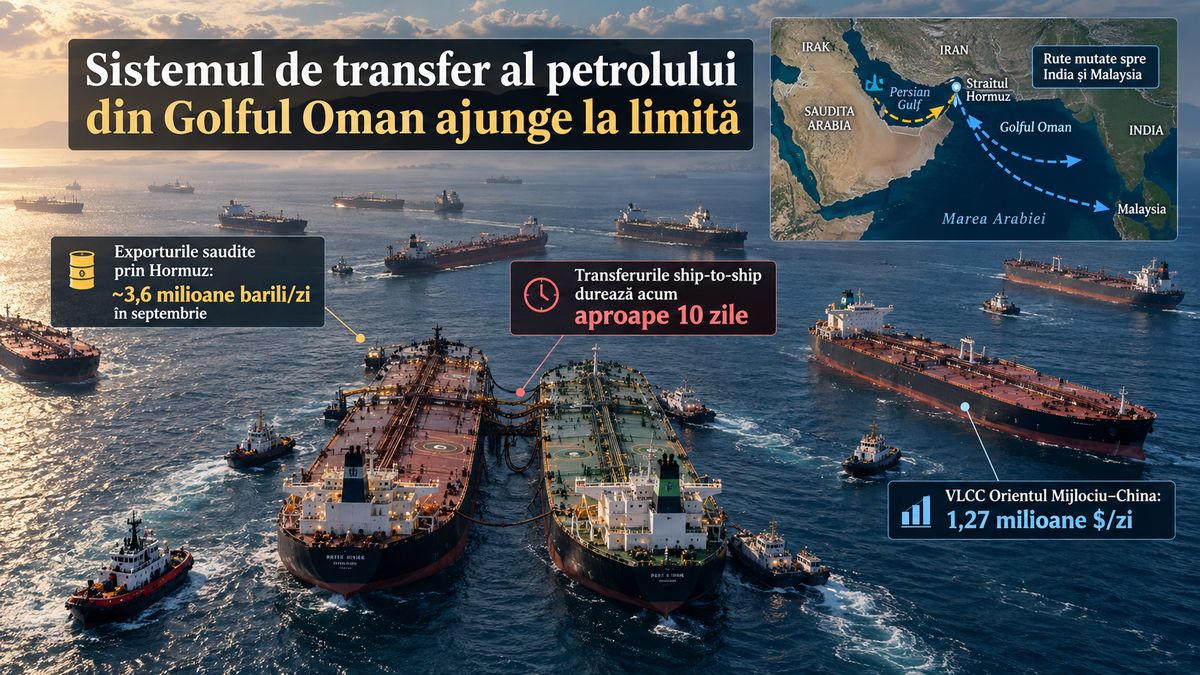
Oil continues to flow out of the Persian Gulf despite severe disruptions to traffic through Hormuz, but the mechanism built to keep exports moving is starting to hit a different limit: logistics. Ship-to-ship transfers in the Gulf of Oman, used to move crude from tankers transiting the strait to vessels heading onward to Asian refineries, have reached or are nearing the practical capacity available in the area. The massive surge in Saudi exports along this route is consuming more supertankers, lengthening transit times, and pushing shipping costs to record highs. Saudi Arabia is the factor that has suddenly amplified this pressure. Following the disruption of the East-West pipeline and flows through Yanbu, Saudi Aramco shifted a much larger share of its exports to eastern terminals. Kpler estimates that Saudi crude exports through Hormuz are on track to reach approximately 3.6 million barrels per day in September , up from around 900,000 barrels per day in August . At the same time, Aramco sold over 60 million barrels for ship-to-ship transfers off Sohar, Oman, in September and October. An emergency system has become a floating oil infrastructure Ship-to-ship (STS) transfers allow oil to be moved directly between two vessels at sea. In the current setup, a tanker loads crude inside the Persian Gulf, transits Hormuz, and transfers it in the Gulf of Oman to another vessel, which then continues its journey to the buyer. The vessel used for the regional leg can return for another load, limiting the time each ocean-going tanker must operate in the high-risk zone. The mechanism has allowed Gulf producers to avoid a much more severe reduction in exports. In September, Reuters estimated based on Kpler data that approximately 2.5 million barrels per day of crude were to be loaded via STS transfers in the Gulf of Oman, up from about 1.4 million barrels per day in August . However, the system represents a much more complex and costly solution than normal direct transport from terminal to refinery. The pressure no longer stems solely from the number of vessels. Transfers require tugboats, specialized crews, safe operating zones, coordination between tankers, and onshore support infrastructure. Kpler indicates that auxiliary services in Fujairah and Sohar are already operating at or near maximum capacity, turning the Gulf of Oman into a bottleneck for additional Middle Eastern exports. An operation that used to take 5–7 days now takes nearly 10 Congestion is starting to directly affect the system's speed. Vortexa estimates that an STS operation now requires nearly 10 days , up from 5–7 days previously , amid transfer queues and pressure on available services. Crude volumes loaded onto VLCCs and transferred from ports west of Hormuz have held steady at around 6 million barrels per day since late August. The increased duration has a ripple effect across the entire shipping market. If a vessel spends more days in a rotation, it can perform fewer voyages per month. Consequently, more tankers are needed to maintain the same volume of oil, reducing fleet availability for other routes. This issue becomes critical at current Saudi volumes. Kpler estimates that rerouting approximately 3 million barrels per day could require, in its base scenario, an additional 36–40 VLCCs . Each such supertanker can carry about 2 million barrels. The increase in vessel requirements is much larger than a simple volume increase would suggest, precisely because rotations are becoming longer and more complex. The cost of a supertanker has reached $1.27 million per day Pressure on the fleet has quickly translated into rates. LSEG data cited by Reuters shows that the daily charter rate for a VLCC carrying oil from the Middle East to China hit a record $1.27 million per day on Monday, September 21. This extraordinary cost does not just reflect the distance traveled. Tankers are tied up longer in rotations, some must be used exclusively as shuttles between Gulf terminals and STS points, and owners are demanding high premiums for operating in a region with elevated military and logistical risks. In a separate analysis, Reuters estimated that freight rates for a VLCC moving oil from the Gulf to China had exceeded the equivalent of $30 per barrel transported . With crude priced at around $105 per barrel at the time, freight had come to represent more than a quarter of the cargo's value, compared to about 2–3% before the war. Oil can thus continue to reach the market without the producer having to cut production by the same amount, but an increasing share of its economic value is being consumed by shipping costs. India and Malaysia can take transfers, but they reduce fleet efficiency Congestion in the Gulf of Oman is already forcing buyers and traders to seek alternative transfer points. Chinese refiners have requested STS deliveries off the west coast of India or in Malaysia, and some cargoes are being sent directly to refineries to eliminate an…
Ioana Buzoaica — Independent Editorial Board
The NRG-IA newsroom continuously monitors Romanian energy markets, ANRE regulatory decisions, and national grid telemetry (SEN/SNT). We deliver independent intelligence anchored exclusively in official primary data.
Editorial Charter, Ethics & Verification Methodology →