Saudi Arabia Reroutes Oil via Sohar; Brent Drops to $105 — NRG-IA
Ghid Consumator Author: Ioana BuzoaicaSaudi Arabia bypasses the Yanbu pipeline shutdown with ship-to-ship transfers off Oman, easing Brent to $105/bbl, though only partially offsetting losses.
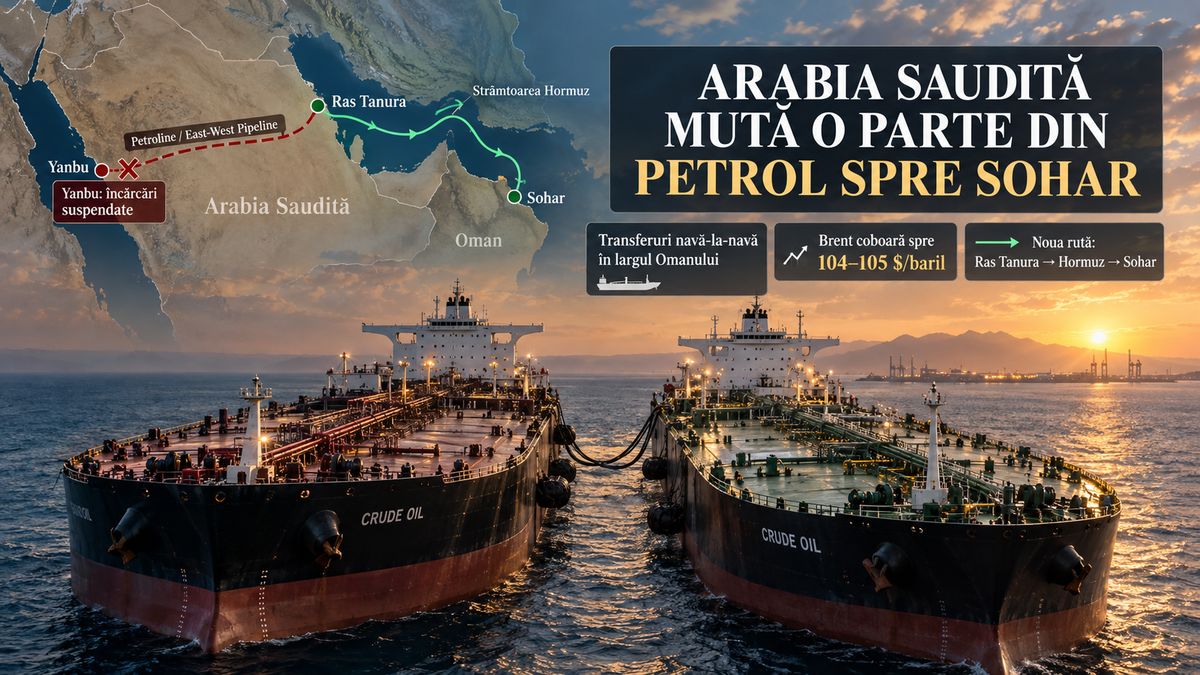
Saudi Arabia is moving quickly to restore a portion of the oil flows disrupted by the shutdown of the East-West Pipeline—the conduit that transported crude across the Arabian Peninsula to the port of Yanbu, allowing the kingdom to bypass the Strait of Hormuz. Saudi Aramco is now offering Asian refiners cargoes of Arab Light, Arab Medium, and Arab Heavy via ship-to-ship (STS) transfers off the port of Sohar in Oman, according to trade sources cited by Reuters. The market reacted swiftly. Brent crude closed down 2.7% on Wednesday at $105.83 per barrel, after gaining more than $3 in the previous session following the suspension of loadings at Yanbu. On Thursday morning, Brent contracts were trading around $105.64 per barrel. The move indicates that traders have scaled back their projected deficit, rather than suggesting that the Saudi export issue has been resolved. Sohar Emerges as the Transshipment Hub for Asian-Bound Oil Sohar possesses a critical strategic advantage: the port is located in the Gulf of Oman, outside the Strait of Hormuz. Port operator Asyad has confirmed that the facility offers ship-to-ship transfer services—the exact mechanism currently being deployed to reroute a portion of Saudi crude. The workaround operates in two stages. Crude is loaded at the Saudi terminals of Ras Tanura and Juaymah inside the Persian Gulf, then transported through Hormuz to the Sohar area, where it can be transferred onto other tankers to continue its journey to Asian refineries. Reuters reports that Aramco has made at least two similar offers for Arab Medium and Arab Heavy in recent weeks, and has now added Arab Light, the kingdom's flagship grade. The company has not publicly commented on these offers. Over the past week, Saudi Arabia doubled its daily loadings at Ras Tanura and Juaymah to approximately two Very Large Crude Carriers (VLCCs), equivalent to about 4 million barrels per day, according to Energy Aspects data cited by Reuters. Separately, Kpler identified four VLCCs on Wednesday with a combined capacity of roughly 8 million barrels loading at Ras Tanura. This ramp-up explains a significant portion of the oil price correction: volumes that risked being stranded without an immediate route to market can continue to reach buyers. The New Workaround Is No Substitute for the Petroline The difference between the Sohar route and the East-West Pipeline is fundamental. The Petroline transported crude directly from eastern Saudi Arabia to Yanbu on the Red Sea coast, bypassing the Strait of Hormuz entirely. In the first quarter of 2026, Aramco ramped up the pipeline to its maximum capacity of 7 million barrels per day , turning it into the primary infrastructure safeguarding Saudi exports amid restricted traffic in the Gulf. Sohar solves a different problem. It provides a secure transshipment point once outside the strait, but crude loaded at Ras Tanura or Juaymah must still transit Hormuz to get there. Consequently, flows through Oman can only offset a fraction of the losses caused by the Petroline shutdown. Saxo Bank noted that resuming some flows through Hormuz only partially covers the barrels lost after the attacks that knocked the East-West Pipeline offline. Reuters reports that two pumping stations were damaged, and the timeline for repairs remains unclear. Yanbu Was the Outlet Reducing Saudi Dependence on Hormuz The significance of the pipeline shutdown is underscored by the infrastructure built over the last decade. The Yanbu South Terminal alone added 3 million barrels per day to the Saudi west coast's export capacity in 2018, according to Aramco. The terminal can receive, store, and directly load crude transported via the domestic network. Following the severe curtailment of shipping through Hormuz in 2026, this infrastructure became far more than just an alternative route. Yanbu was transformed into the primary Saudi outlet capable of delivering substantial volumes to the global market without transiting the strait. The attack on the East-West Pipeline severed this architecture at the exact point linking eastern oil fields to Red Sea ports. Crude loadings at Yanbu were suspended, and Saudi Arabia announced the cancellation of scheduled cargoes to European customers. The fallout is already visible in Europe. Orlen, one of the main European buyers of Saudi crude, has purchased 16 additional cargoes to secure supplies for its refineries in Poland, Lithuania, and the Czech Republic, sourcing crude from Norway, the UK, Algeria, Kazakhstan, Azerbaijan, and the Americas. Hormuz Remains the Vulnerability of the New Route Sohar can only ease the pressure on Saudi exports as long as tankers can safely transit the Gulf and the Strait of Hormuz. Preliminary Kpler data showed that only three transits through the strait were identified on Wednesday, down from 12 the previous day and well below the 10-day average of approximately 17 vessels. However, this data does not account for ships that may have transited with…