Saudi Arabia restarts Petroline: Hormuz bypass route — NRG-IA
Geopolitică & Energie Author: Ioana BuzoaicaSaudi Arabia is gradually recovering its main land route bypassing the Strait of Hormuz, but the Petroline restart highlights key strategic vulnerabilities.
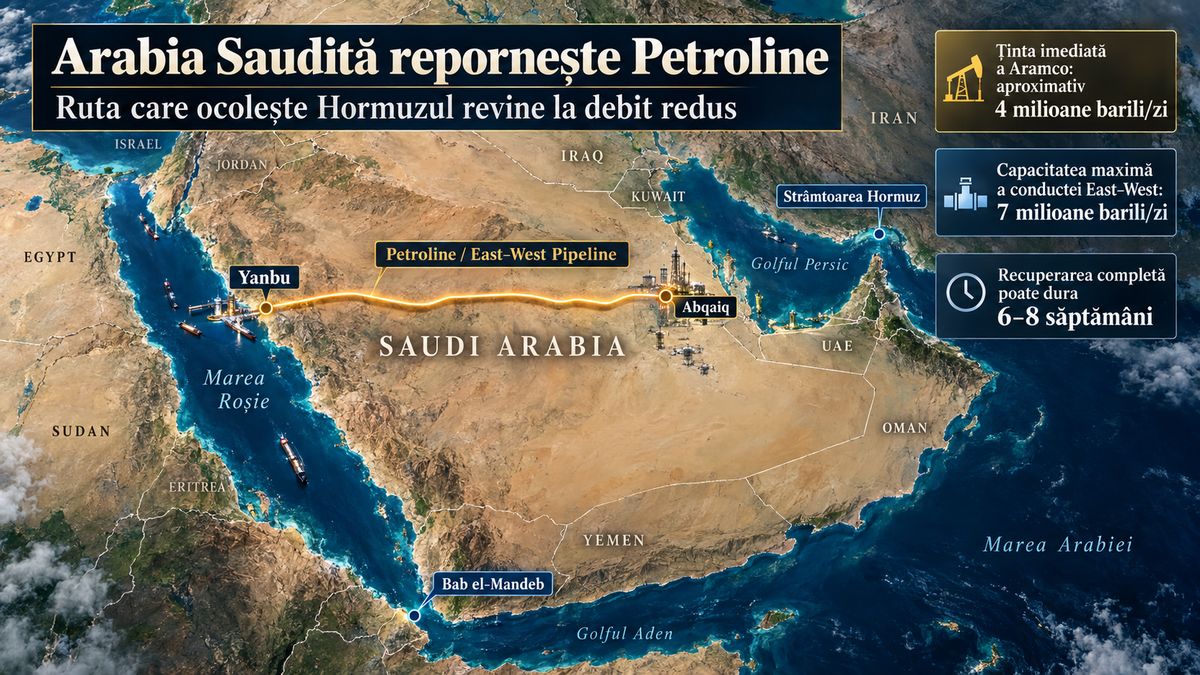
Saudi Arabia has restarted Petroline, the East–West pipeline that transports oil from the east of the country to Yanbu on the Red Sea coast, reopening one of the few routes in the world capable of moving millions of barrels per day without crossing the Strait of Hormuz. However, the pipeline is currently operating at a reduced flow rate, and a full return to operational capacity may require six to eight weeks, according to sources cited by Reuters. In the first phase, Saudi Aramco aims to restore flows to approximately 4 million barrels per day , a level close to the volume transported through Petroline before the September 11 attack. The pipeline has a maximum capacity of approximately 7 million barrels per day , but this figure represents the technical limit of the system, not the current flow rate. The difference is essential. In an oil market that has been trying for months to compensate for disruptions in the Gulf, even a partial return of Petroline gives Saudi Arabia access once again to an export route that bypasses Hormuz and reduces pressure on increasingly complex maritime operations in the region. Petroline can move millions of barrels without passing through Hormuz The East–West Pipeline is approximately 1,200 kilometers long and connects the oil infrastructure in the Abqaiq area to the terminals in Yanbu, on the Red Sea coast. Its strategic role is direct: oil pumped westward can reach an export terminal without crossing the Strait of Hormuz. Prior to the conflict, approximately 20 million barrels per day of crude oil and petroleum products passed through Hormuz, according to IEA data, making the strait one of the most important transit chokepoints in the global energy system. Only a few Gulf states possess infrastructure capable of bypassing the route on a significant scale, and Petroline is the most important of these alternatives. Saudi Aramco announced in the first quarter of 2026 that the system had been brought to a maximum capacity of 7 million barrels/day , precisely to increase export flexibility amid deteriorating security in Hormuz. Prior to the September attack, approximately 4–5 million barrels/day actually flowed through the pipeline. At this level, Petroline alone transported a volume equivalent to about 4–5% of the global oil supply. The attack struck the very infrastructure built for crisis situations On September 11, a drone attack launched from Iraq damaged three of the pipeline's 11 pumping stations. Saudi authorities attributed the attack to Iraqi militias, though publicly available information does not allow for the independent attribution of responsibility to a specific group. The shutdown of Petroline struck the exact infrastructure designed to protect Saudi exports when Hormuz becomes unsafe. This is the vulnerability that the current crisis has brought to light. Saudi Arabia has built redundancy and can move significant volumes between the Gulf coast and the Red Sea, but the alternative route itself becomes strategic infrastructure and, by extension, a target in a regional conflict. The current restart recovers part of this redundancy, but work toward full recovery continues. Reuters sources indicate that reaching approximately 40% of the pipeline's capacity could take a few days, while restoring full operational capacity could take between six and eight weeks. Aramco's immediate target is to return to around 4 million barrels/day, not to operate instantly at the technical limit of 7 million barrels/day. Yanbu gradually returns to the Saudi export equation With the restart of the pipeline, oil is beginning to be pushed toward Yanbu once again. A cargo bound for China had been scheduled for loading following the resumption of operations, and traders have begun repositioning vessels in anticipation of returning flows from the Red Sea. However, pipeline throughput is not identical to exported volume. Some of the oil may also feed Aramco's refineries on the west coast, and the pace of exports additionally depends on terminals, inventories, vessel scheduling, and commercial destinations. The restart of Petroline should therefore be viewed as the reopening of logistical capacity, rather than an instantaneous return of exports to pre-attack levels. For the global market, even this difference matters. Every million barrels per day that can be redirected to the Red Sea reduces pressure on flows dependent on Hormuz and provides Aramco with a flexibility that few other producers possess. Saudi Arabia uses Petroline and Hormuz simultaneously The Saudi strategy is not currently about choosing a single route. Aramco is trying to simultaneously maximize all available pathways. During the period when Petroline was shut down, the company increased export volumes from Gulf terminals and even utilized ship-to-ship transfers near Oman. Reuters reported that Aramco sold approximately 60 million barrels for loading in September and October from Ras Tanura, with subsequent transfer near the…