Aramco Shifts Oil Pickups Outside Hormuz via STS — NRG-IA
Geopolitică & Energie Author: Ioana BuzoaicaAramco offers September crude via STS transfers outside Hormuz, keeping buyers' tankers out of the Gulf to reduce risk and maintain Saudi exports.
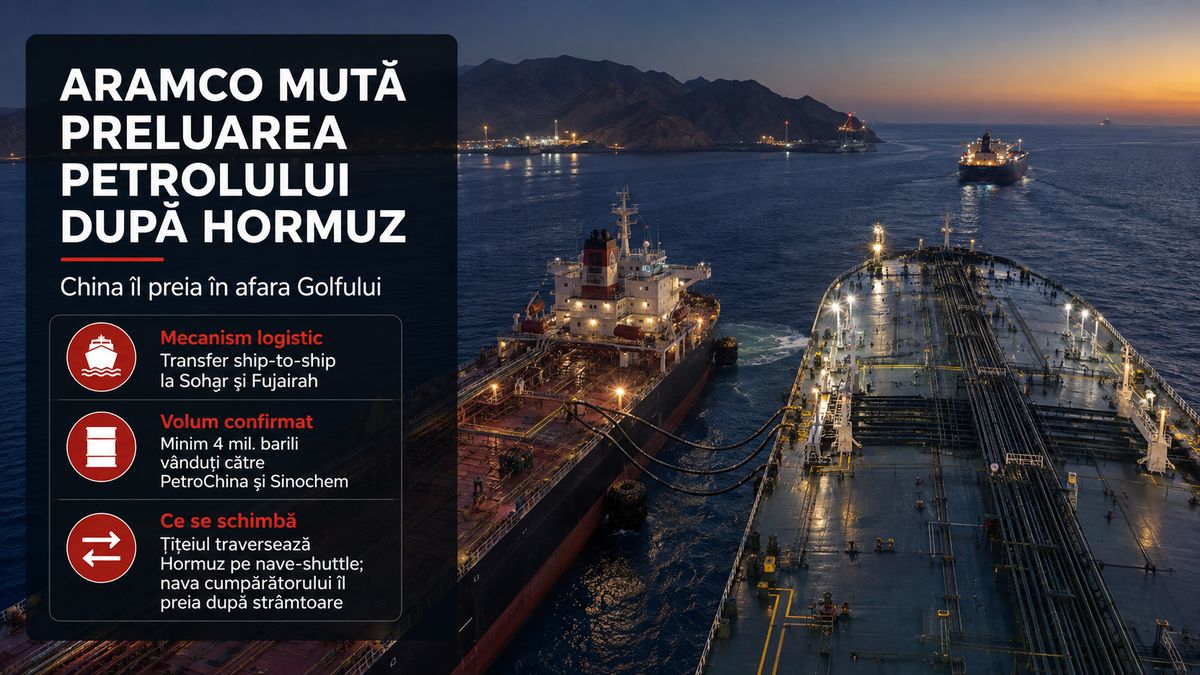
Saudi Aramco is beginning to transform oil transit through the Strait of Hormuz into a shuttle system. Dedicated tankers load crude at Saudi terminals in the Persian Gulf, cross the strait, and then transfer the cargo off Sohar or Fujairah to vessels carrying it onward to Asia. For Chinese buyers, the effect is direct: the supertankers transporting the oil to China no longer need to enter the Persian Gulf themselves. Reuters reported on August 26, citing four sources familiar with the operations, that Aramco is offering Arab Medium and Arab Heavy grades for the second consecutive week with delivery via ship-to-ship transfers outside Hormuz. The new round targets September cargoes and continues a mechanism that has already been commercially and operationally tested. PetroChina and Sinochem previously purchased approximately 2 million barrels each through this system, representing a minimum of 4 million barrels sold for pickup outside the strait. Separately, two Saudi cargoes totaling around 4 million barrels were transferred to China-bound vessels for Sinopec. Not all of these volumes can be automatically aggregated into a single total of 8 million barrels, as Reuters does not explicitly confirm that they represent completely distinct transactions. What is certain, however, is that the mechanism has moved past the hypothetical stage: the oil has been loaded, crossed Hormuz, been transferred in the Gulf of Oman, and is continuing its journey to Asian buyers. Oil crosses Hormuz, but Chinese vessels can stay outside the Gulf The new architecture does not eliminate the Strait of Hormuz from the route of Saudi crude loaded at Ras Tanura or Juaymah. These terminals are located inside the Persian Gulf, and the crude must still cross the strait to reach the Gulf of Oman. The shift lies in how the transport is split. Instead of the same vessel entering the Gulf, loading in Saudi Arabia, crossing Hormuz, and then continuing thousands of miles to China, Aramco can use a tanker as a shuttle for the most exposed leg. After crossing the strait, the crude is transferred at sea to another supertanker, which takes over the long-haul voyage to Asia. The Singapore Prosperity provides an example of this mechanism. The vessel loaded approximately 301,000 tons of crude at Ras Tanura and Juaymah, subsequently turned off its Automatic Identification System (AIS) transponder, and reappeared outside Hormuz. The cargo was then transferred to the Xin Hui Yang , a vessel bound for Ningbo. A similar mechanism was used by the Algeria Prosperity , which transferred oil to the Xin Han Yang for transport to Zhanjiang. The risk of transit does not disappear. However, it is concentrated on a shorter segment of the logistics chain and on dedicated vessels, while the tankers carrying the cargo to the final buyer can remain outside the Gulf. China keeps part of its fleet away from the two hotspots Aramco's adaptation aligns with the strategy adopted by some of China's largest shippers. Reuters reported on August 18 that COSCO Shipping Energy Transportation and China Merchants Energy Shipping halted transits through Hormuz and Bab el-Mandeb in late July, beginning to position tankers outside risk zones for ship-to-ship transfers. The two groups previously transported about half of China's oil imports from the Middle East, according to sources cited by Reuters. The two adaptations essentially meet in the Gulf of Oman: Aramco moves the crude out of the Persian Gulf, and the buyer's vessel takes it over after it crosses Hormuz. This model allows trade to continue without exposing the entire fleet supplying China directly to the strait. However, the price of resilience is high. Reuters indicated charter rates of around $140,000 per day for the Oman–China route, nearly four times pre-disruption levels. Added to the vessel cost are the transfer operation, the availability of suitable tonnage, insurance, and the risk premium associated with navigating the region. Oil can continue to flow, but the chain becomes operationally longer and more expensive. Saudi Arabia has a pipeline bypassing Hormuz, but the western route is also vulnerable Saudi Aramco already possesses physical infrastructure to completely bypass Hormuz: the East-West Pipeline crosses Saudi Arabia from east to the Yanbu terminal on the Red Sea. Aramco indicates a capacity of approximately 7 million barrels per day (bpd) for this system, of which about 5 million bpd can be made available for export after supplying domestic refineries. This is the actual bypass of Hormuz. Crude transported via the East-West Pipeline no longer needs to pass through the strait. The problem for Saudi Arabia is that the western outlet no longer offers the same predictability either. Security risks in the Red Sea and the Bab el-Mandeb area have reduced the attractiveness of shipping along this route, particularly for cargoes destined for Asia. Aramco thus faces two sensitive maritime chokepoints at either end of…
Ioana Buzoaica — Independent Editorial Board
The NRG-IA newsroom continuously monitors Romanian energy markets, ANRE regulatory decisions, and national grid telemetry (SEN/SNT). We deliver independent intelligence anchored exclusively in official primary data.
Editorial Charter, Ethics & Verification Methodology →