Coal Returns: Romania Delays, Europe Resists, Asia Reacts — NRG-IA
Geopolitică & Energie Author: Ioana BuzoaicaRomania faces a delicate transition: phasing out coal is delayed by slow replacement projects, while the LNG crisis pushes Asia back to fossil fuels.
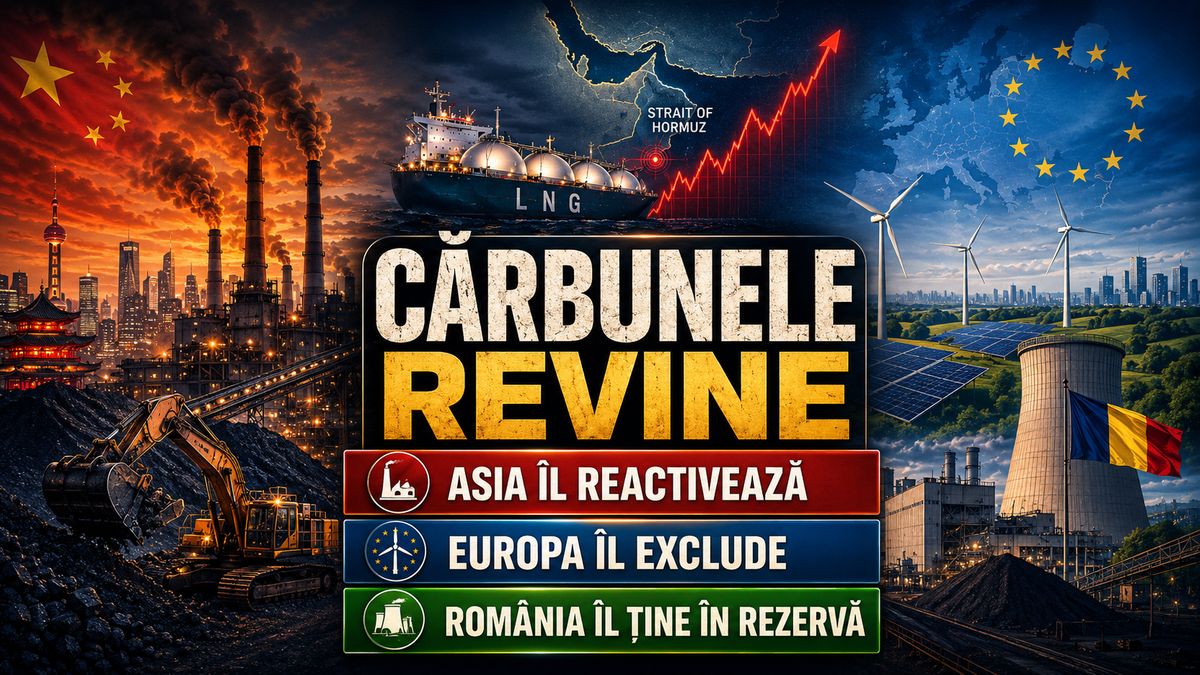
Romania is not returning to coal, but cannot phase it out without real replacements The LNG crisis triggered by the Middle East conflict brings coal back to the center of the most uncomfortable energy debate: what does a power system do when its transition fuel becomes too expensive, too scarce, or too geopolitically exposed? For Romania, this question is not theoretical. Under the European framework and its National Recovery and Resilience Plan (NRRP), the country has committed to phasing out coal and accelerating renewable energy deployment. The European Commission describes the energy reform in Romania's NRRP as having two major pillars: phasing out coal and increasing renewable generation capacity, with at least 3,000 MW of wind and solar capacity to be commissioned and grid-connected by June 30, 2026. The issue is that the energy transition is not measured solely in commitments, but in megawatts available at peak hours. Romania has found that coal replacements are not entering the system fast enough. Reuters reported in September 2025 that Romania was negotiating with the European Commission to delay the closure of 2.6 GW of coal-fired capacity, citing delays in replacement projects, including gas-fired plants and solar parks developed around CE Oltenia. Subsequently, Reuters reported that the Minister of Energy announced the European Commission's agreement to postpone the closure of five coal units until the end of 2026 and 2029, as a measure to mitigate blackout risks and higher prices during the cold season. This is Romania's actual stance: it is not building its future on coal, but is trying to temporarily maintain a safety net until new capacities become fully operational. The LNG crisis shows that transition gas can become a vulnerability For years, natural gas has been pitched as the transition solution bridging coal and a system dominated by renewables, nuclear, storage, and flexibility. The current crisis highlights the limits of this assumption. While gas is less polluting than coal for power generation, it remains a fossil fuel, imported in many regions and exposed to shipping routes, geopolitical bottlenecks, and global competition for LNG. Reuters reported that in April and early May 2026, major Asian LNG importers, such as Japan and South Korea, sharply increased coal-fired generation following supply disruptions caused by the conflict with Iran. In Japan, gas-fired generation fell by 12.9% while coal-fired generation rose by 11.1%; in South Korea, gas-fired generation dropped by 6.4% while coal-fired generation surged by 39.7%. These figures are relevant to Romania not because the Asian situation can be mechanically replicated in Europe, but because they demonstrate the actual behavior of energy systems in a crisis. When LNG becomes expensive or scarce, countries with available coal plants will run them. Coal is not making a comeback because it is clean or strategically desired, but because it is storable, operationally familiar, and available during times of stress. This is the harsh lesson of the moment: the energy transition only works if replacements are built before legacy capacities are completely shut down. Asia burns more coal for security, while Europe tries to avoid a U-turn Asia reacts differently than Europe because it has a different market structure, different exposure to LNG, different demographic and industrial pressures, and, in many cases, a different capacity to absorb high prices. For economies that must sustain industrial output and uninterrupted power supply, coal remains the backup fuel of choice when gas becomes too expensive. Reuters previously showed that several Asian economies, including Bangladesh, Pakistan, the Philippines, Vietnam, Thailand, South Korea, and Japan, have increased or considered increasing coal use to cut costs and protect security of supply amid LNG bottlenecks and soaring spot gas prices. Europe is in a different position. Over time, the European Union has built a framework that makes returning to coal far more difficult: the ETS, the Green Deal, REPowerEU, decarbonization targets, transition funds, capacity closures, and an accelerated rollout of renewables. REPowerEU was introduced by the European Commission as a plan to rapidly reduce dependence on Russian fossil fuels and accelerate the green transition following Russia's invasion of Ukraine. The result is visible in the power mix. Ember shows that in 2025, wind and solar reached 30.1% of EU electricity generation, surpassing all fossil fuels combined, which provided 29%. Reuters notes that coal's share in the EU power mix fell to 9.2%, an all-time low. The contrast is clear: Asia uses coal as a direct response to the LNG shock, while Europe tries to prevent a coal comeback through carbon pricing, renewables, and decarbonization rules. Yet Europe is not immune. If gas prices spike and flexibility is lacking, pressure builds on prices, system adequacy, and requests to delay capacity…
Ioana Buzoaica — Independent Editorial Board
The NRG-IA newsroom continuously monitors Romanian energy markets, ANRE regulatory decisions, and national grid telemetry (SEN/SNT). We deliver independent intelligence anchored exclusively in official primary data.
Editorial Charter, Ethics & Verification Methodology →