Brent Nears $90; IEA Sees 1.8M bpd Q3 Deficit — NRG-IA
Geopolitică & Energie Author: Ioana BuzoaicaBrent rose to $89.22/bbl after Bab el-Mandeb attacks. The IEA warns of a 4.3M bpd supply drop in 2026 and the largest quarterly deficit in five years.
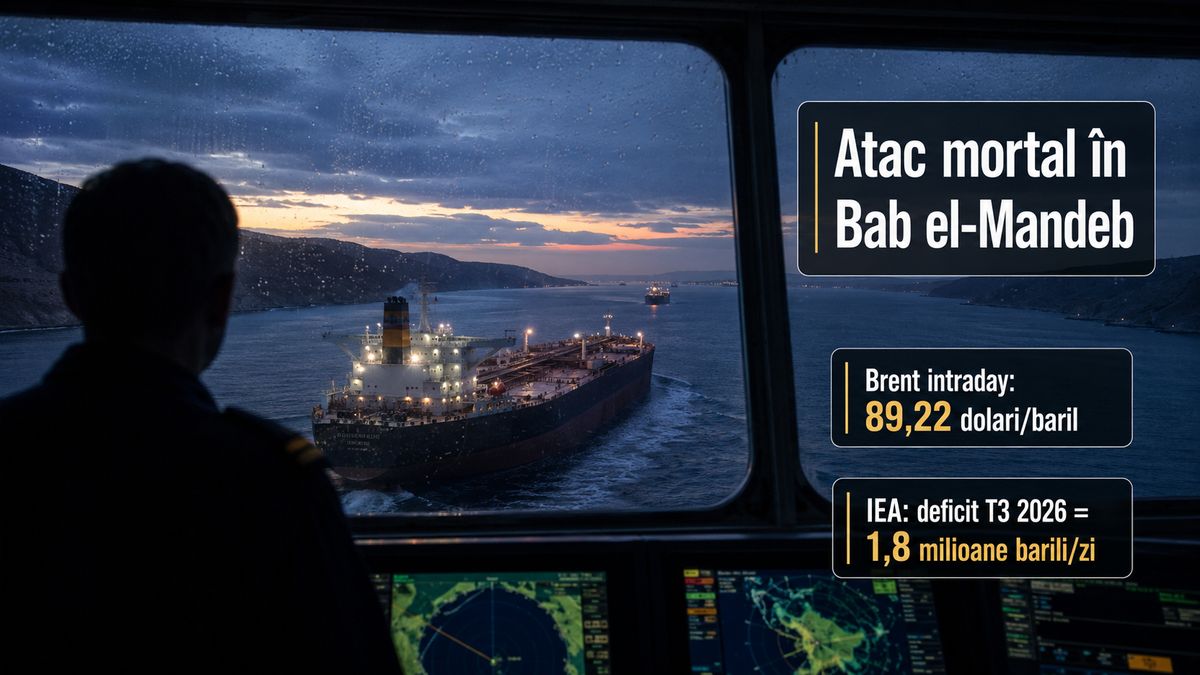
Brent crude rebounded toward the $90 per barrel threshold on Wednesday, August 12, following a fresh military escalation along Middle Eastern shipping routes. The benchmark hit an intraday high of $89.22 per barrel after a deadly attack on the vessel 'Tihamah' in the Bab el-Mandeb strait and a separate incident in the Gulf of Oman, at a time when the market is already struggling to operate with millions of barrels per day less than before the war. However, this price movement is merely the surface of a much broader shift. The International Energy Agency (IEA) now estimates a supply-demand deficit of approximately 1.8 million barrels per day for the July-September quarter, the most severe quarterly deficit since the final quarter of 2021. For the full year, global supply is projected to fall by 4.3 million barrels per day to 102.02 million barrels per day. This situation creates a rare paradox: global oil consumption is beginning to decline, but supply is shrinking even faster. The IEA projects a contraction in global demand of 1.6 million barrels per day in 2026. Conversely, OPEC sees a radically different market and continues to forecast demand growth of approximately 580,000 barrels per day. The gap between these two outlooks thus stands at roughly 2.18 million barrels per day . The Bab el-Mandeb attack shifts risk from charts back to the sea The August 11 escalation has a physical dimension that the market cannot ignore. The cargo vessel 'Tihamah' was attacked near the Bab el-Mandeb strait, the route connecting the Red Sea to the Gulf of Aden and the Indian Ocean. According to reports cited by Reuters, the attack resulted in the deaths of four crew members and two Yemeni rescuers, with several others injured. Houthi forces claimed responsibility for the attack, asserting that the vessel was carrying Saudi military equipment—a claim that has not been independently verified. On the same day, a separate incident involved the container ship 'Vela Nova' in the Gulf of Oman. United States Central Command stated that it targeted the vessel with two Hellfire missiles after it allegedly ignored warnings and attempted to head toward an Iranian port despite the maritime blockade imposed by Washington. These two episodes occurred at opposite ends of the regional energy transit system. The Bab el-Mandeb strait controls access between the Indian Ocean and the Red Sea, while the Gulf of Oman provides immediate access to the Strait of Hormuz—a route through which approximately one-fifth of global oil consumption passed prior to the conflict. Consequently, the risk is no longer confined to a single chokepoint. Prior to the new escalation, 5.4 million barrels per day passed through Bab el-Mandeb EIA data highlights the economic scale of this route. In the first quarter of 2026, approximately 5.4 million barrels per day of crude oil and petroleum products flowed through Bab el-Mandeb, of which around 3.2 million barrels per day consisted of crude and condensate, and roughly 2.2 million barrels per day were refined products. Closing or avoiding this route does not automatically remove oil from the market, but it reroutes it. Vessels avoiding the Red Sea must circumnavigate Africa via the Cape of Good Hope, which can add approximately two weeks to a voyage between the Arabian Sea and Europe. This additional transit time translates to more charter days, higher fuel consumption, and a larger number of vessels required to transport the same volume of oil over a given period. Added to this are rising insurance costs in an area where military threats have escalated. Traffic already reflects this deterioration. The average number of vessels transiting the Bab el-Mandeb strait recently dropped to around 32 per day , down from approximately 50 before the latest phase of Houthi threats. Saudi Arabia is already altering its export routes Pressure on the Red Sea is also driving a less visible but market-significant shift: Saudi shipments are becoming harder to track. Following Houthi threats against tankers and Saudi infrastructure along the Red Sea coast, vessels loading crude at the port of Yanbu have begun turning off or disabling their Automatic Identification Systems (AIS). Vortexa data indicated that recent loadings from Yanbu were conducted without continuous AIS transmission, while Kpler estimated that approximately 70% of recent loadings from Saudi Arabia's west coast experienced signal disruptions. The consequences extend beyond vessel security. Traders, analytics firms, and energy institutions base a significant portion of their physical flow estimates on shipping data. As more vessels become difficult to track, uncertainty over actual exported volumes increases. In parallel, Saudi Arabia has increased its utilization of routes to the Mediterranean. Crude and condensate loadings from Sidi Kerir, the Egyptian terminal connected to the SUMED pipeline, reached a record high of approximately 2.17 million barrels per day , with…
Ioana Buzoaica — Independent Editorial Board
The NRG-IA newsroom continuously monitors Romanian energy markets, ANRE regulatory decisions, and national grid telemetry (SEN/SNT). We deliver independent intelligence anchored exclusively in official primary data.
Editorial Charter, Ethics & Verification Methodology →