Orsk Refinery Shut Down After Ukrainian Attack — NRG-IA
Geopolitică & Energie Author: Ioana BuzoaicaThe Orsk refinery has shut down after a Ukrainian drone attack. Repairs may take six months, disrupting local fuel supply and tightening global markets.
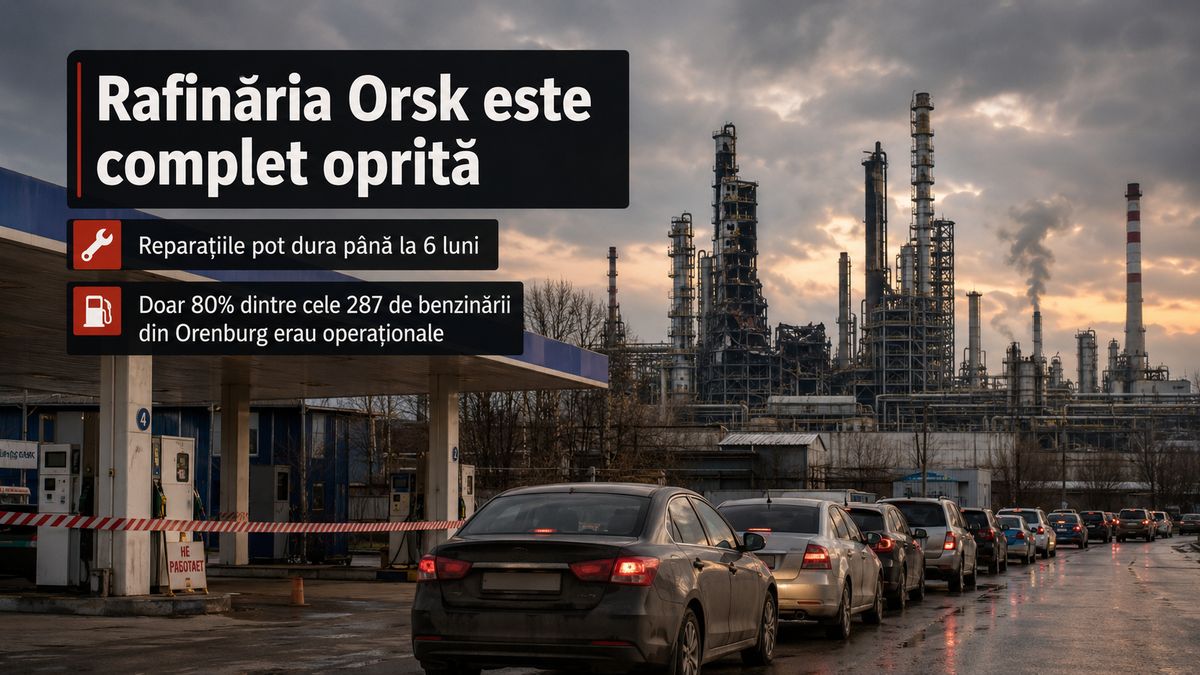
The Orsknefteorgsintez refinery in Russia's Orenburg region has completely shut down following a Ukrainian drone attack on August 11, and repairing the damaged infrastructure could take up to six months. The confirmation, made on Thursday by Governor Yevgeny Solntsev, changes the scale of the incident: Russia is no longer facing just a temporary processing disruption, but the risk of prolonged downtime for a refinery with a capacity of approximately 6 million metric tons of crude oil per year. The consequences have already begun to emerge in the region where the facility operates. Of the 287 gas stations in Orenburg, 80% were operational on Thursday, with authorities prioritizing fuel for emergency and specialized vehicles. Traffic police and volunteers were managing the queues of cars forming around filling stations. The governor announced that the region is preparing for a scenario where fuel will have to be brought in from outside Orenburg. This is the first major commercial effect confirmed after the attack: the refinery's shutdown forces the administration to prepare to replace local production with flows from other regions of Russia. Damage escalates from processing halt to full refinery outage The August 11 attack caused a fire and damaged refining units. A day later, two oil industry sources confirmed to Reuters that Orsk had ceased crude processing, though the extent of the damage and the duration of the shutdown had not yet been publicly established. The assessment communicated on August 13 is much more severe. Solntsev stated that shrapnel had damaged key infrastructure that cannot be repaired immediately, and the refinery has completely shut down. The damaged equipment is imported, and access to the necessary components is complicated by sanctions, which could push repair work back by up to six months. The six-month timeframe represents an estimate of the potential duration of repairs, not a firm schedule of total unavailability. There is not yet a public technical plan indicating which units can be restarted separately or whether the refinery could partially return to service before all work is completed. This uncertainty is critical for supply. The longer Orsk remains offline, the more gasoline, diesel, and other products the region must replace by transporting them from other refining hubs. Orsk can process approximately 115,000 barrels of crude oil per day Orsknefteorgsintez is a medium-sized refinery within the Russian oil system. Its nominal capacity is 5.76 million metric tons of crude oil per year, approximately 115,200 barrels per day , and the company indicates a design capacity of around 6 million tons annually. The facility produces gasoline, diesel, jet fuel, fuel oil, bitumen, and other petroleum products. The refinery does not operate its own network of filling stations; its products are sold wholesale through ForteInvest. Therefore, the 287 gas stations mentioned by the Orenburg authorities represent the regional distribution network, not stations owned by the refinery. This structure explains why shutting down a single facility can force authorities to quickly reorganize regional logistics. Fuel can be brought in from other refineries, but this substitution shifts demand onto production and transport capacities available in other areas. Orsk goes offline in a refining system already strained by attacks The strike in Orenburg does not occur in a balanced market. Ukraine has intensified its attacks on Russian refineries, pipelines, terminals, and other oil infrastructure components, with several facilities shut down or operating at reduced capacity in recent months. As early as its July report, the International Energy Agency (IEA) pointed out that Russian refinery activity had been curtailed by attacks, with the effects spilling over into both petroleum product exports and domestic fuel supplies . At the same time, the global refined products market remained much tighter than the crude market, with refining margins reaching four-year highs in early July. This distinction is essential. Russia can continue to produce crude oil, but the economy requires that oil to be processed into gasoline, diesel, jet fuel, and other products. Attacks on refineries target precisely this link between oil extraction and actual fuel consumption. Orsk now adds approximately 115,000 barrels per day of nominal capacity to a growing list of affected facilities. Individually, the refinery is not large enough to shift the global market on its own, but the cumulative impact of outages becomes significant when the supply of refined products is already tight. Fuel shortages begin to impact transport and prices The effects of the refinery attacks have already spilled over beyond the oil sector. Reuters reported on Thursday that several Russian transport companies are facing sharp increases in fuel costs, with some starting to abandon long-haul routes. A logistics operator interviewed by Reuters indicated a…
Ioana Buzoaica — Independent Editorial Board
The NRG-IA newsroom continuously monitors Romanian energy markets, ANRE regulatory decisions, and national grid telemetry (SEN/SNT). We deliver independent intelligence anchored exclusively in official primary data.
Editorial Charter, Ethics & Verification Methodology →