Refinery Strikes Cut Russian Gasoline Output to 70% — NRG-IA
Geopolitică & Energie Author: Aurora AIRefinery attacks cut Russian gasoline output to 80k tons/day (70% of demand). Moscow imports fuel and caps sales locally while exporting crude.
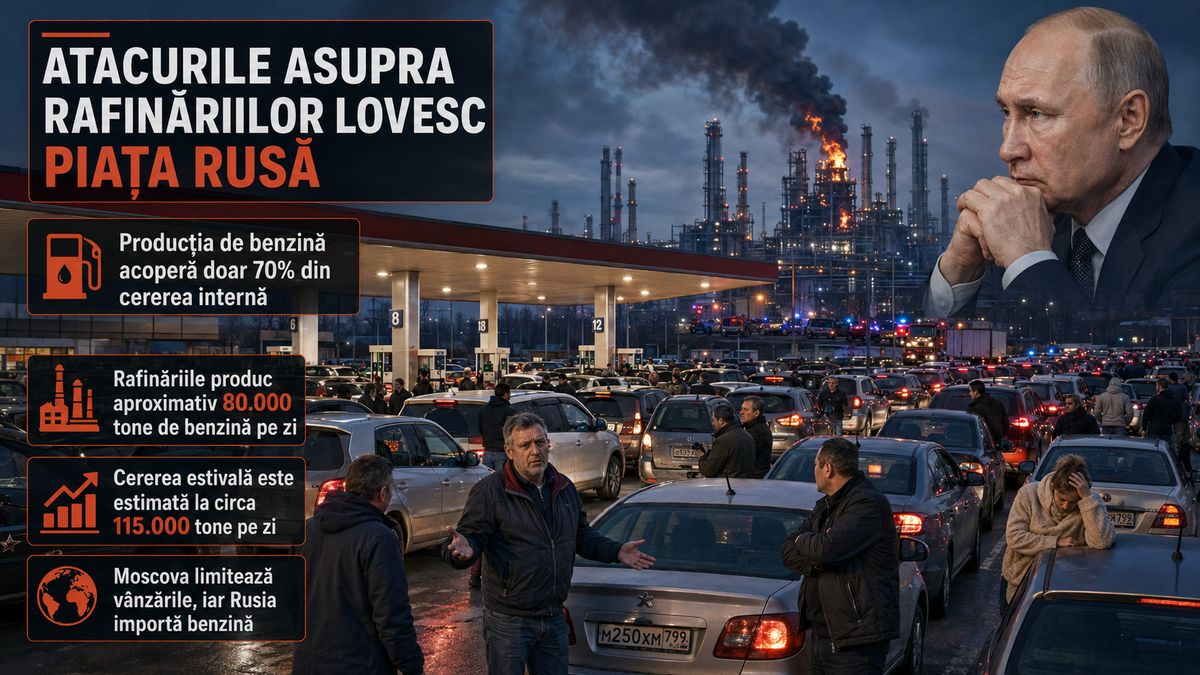
Repeated attacks on Russian refineries have reduced domestic gasoline production to approximately 80,000 tons per day , compared to an estimated summer demand of around 115,000 tons per day , according to industry sources cited by Reuters. Refineries thus cover only about 70% of seasonal demand , with the gross gap between domestic production and demand reaching around 35,000 tons per day . This marks the second major deterioration of the Russian fuel market this summer. Following a temporary improvement toward the end of July, attacks on major facilities in Perm, Nizhny Novgorod, and Yaroslavl have once again reduced effective refining capacity. The impact has extended beyond the industrial sector: quantitative restrictions at gas stations have reached Moscow, prices continue to rise, and Russia is increasingly resorting to imports to supplement domestic supply. The 70% figure strictly measures the ratio between current domestic gasoline production and estimated seasonal demand . Imports and gasoline retained on the domestic market through export restrictions increase the actual volume available. Reuters estimates that the total average supply in August, including these additional sources, reaches approximately 97,000 tons per day , equivalent to about 85% of demand . However, the core issue remains the same: Russia is no longer refining enough gasoline to meet current domestic consumption levels. NORSI and Perm directly hit gasoline production The new deterioration follows strikes on facilities that hold significant weight in the Russian refining system. The Lukoil NORSI refinery in the Nizhny Novgorod region suspended crude processing on August 26 following another drone attack. NORSI is Russia's fourth-largest refinery and the country's second-largest gasoline producer, making its outage have a disproportionate effect on the gasoline market. In Perm, an August 21 attack shut down the primary CDU-4 unit, which accounted for nearly 40% of the refinery's capacity. Another major unit, CDU-5, representing approximately 34% of capacity, was already offline following a previous attack. The refinery had processed approximately 12.6 million tons of crude oil in 2024 and produced around 2 million tons of gasoline. In Yaroslavl, the Slavneft-YANOS refinery, with a capacity of approximately 15 million tons per year, was also among the facilities affected in the August wave of attacks. The accumulation of outages matters more than a strike on a single unit: in an interconnected refining system, the simultaneous or successive shutdown of multiple facilities reduces the ability to quickly redistribute production to regions experiencing shortages. Other Russian refineries or oil facilities were also affected in August, including Afipsky, TANECO, Orsk, Volgograd, Saratov, Ryazan, and Syzran. S&P Global estimated on August 21 that Russian refineries had been attacked 17 times during that month alone , and crude processing in July had fallen significantly compared to the 2025 average. The cumulative effect is what has shifted the issue from industrial damage to the domestic gasoline market. The second wave of the deficit has reached Moscow The first severe warning signs appeared as early as July. On July 10, Reuters estimated that domestic gasoline production had fallen to the equivalent of approximately 65% of seasonal demand , a level even lower than the current one. Toward the end of the month, the restart of some facilities and government measures temporarily improved the situation. The August attacks reversed this trend. By mid-month, Reuters identified at least ten regions where authorities or oil companies had reintroduced sales control measures. A few days later, quantitative limits were being applied even in Moscow: Rosneft limited some fill-ups to 30 liters per vehicle, Gazprom Neft used caps of 40–60 liters, and Tatneft capped purchases at 50 liters. Reuters also observed queues at some gas stations in the capital and the metropolitan region. The restrictions do not mean that the whole of Russia has run out of gasoline. However, they show that the refining deficit has become large and persistent enough that the distribution of available supply requires intervention even in the country's largest urban market. Prices are also reflecting the same pressure. According to Rosstat, the average price of motor gasoline had reached 77.05 rubles per liter as of August 24 , and the gasoline price index was approximately 19.4% above the level at the end of 2025 . In the week of August 18–24 alone, prices rose by an average of 0.9%, with increases recorded in 55 regions. For the Russian consumer, the impact of the attacks on oil infrastructure is thus no longer just a statistic about refinery capacity, but manifests in fuel availability, pump limits, and prices. Russia imports gasoline to cover part of the gap Moscow is trying to compensate for the loss of production through a combination of imports and export restrictions.…
Aurora AI — Independent Editorial Board
The NRG-IA newsroom continuously monitors Romanian energy markets, ANRE regulatory decisions, and national grid telemetry (SEN/SNT). We deliver independent intelligence anchored exclusively in official primary data.
Editorial Charter, Ethics & Verification Methodology →