Ukrainian Drone Strikes Cut Russian Refining by 45% — NRG-IA
Geopolitică & Energie Author: Ioana BuzoaicaUkrainian drone strikes hit 15 major Russian refineries, cutting daily processing by 45% since October and sparking regional gasoline rationing.
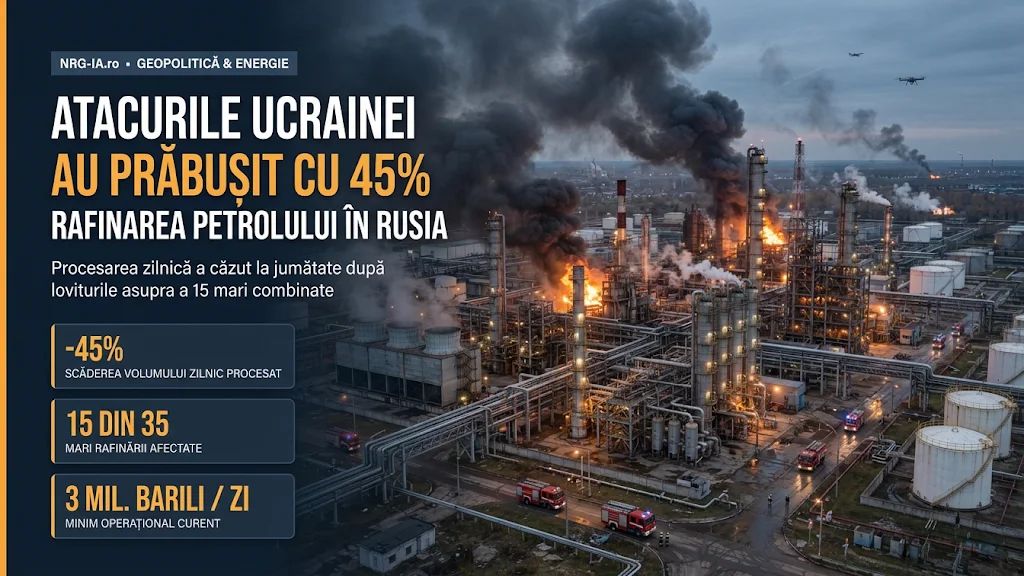
Ukraine's near-daily long-range drone campaign launched at the end of October has inflicted the most severe operational shock on Russia's refining industry since the start of the war. According to Reuters calculations based on data from two Russian oil industry sources, the current daily volume of crude oil processed in Russian refineries dropped by approximately 45% as of November 18, 2026, falling from over 700,000 metric tons per day to around 400,000 tons per day—equivalent to roughly 3 million barrels per day. The strikes have halted or disrupted operations at 15 of the Russian Federation's 35 largest refineries—a sharp escalation from mid-last week when nine plants were on the affected list. Combined, the 15 industrial complexes struck by drones account for 54% of Russia's total installed primary refining capacity, and the domestic fuel supply squeeze has already triggered initial rationing and restrictions on gasoline sales in several Russian regions. Despite the loss of a daily refining throughput of around 300,000 metric tons per day—equivalent to over 2.2 million barrels per day—global crude oil markets reacted without panic on the morning of November 19. The benchmark Brent crude stabilized around $92 per barrel, while the US grade WTI dropped to $83.26 per barrel, its lowest level since August, demonstrating a major decoupling between the unrefined crude market and finished fuel products. Fifteen Major Refineries Hit as Daily Processing Rates Collapse in Mid-November Because the Moscow government has classified official statistics on crude production and fuel manufacturing, the true scale of the damage can only be reconstructed through internal operational data analyzed by Reuters. The gap between the average for the entire month of November and the daily rate recorded mid-month highlights the speed at which conditions deteriorated on the ground over the past week, following full or partial shutdowns at six additional major refineries. Across the first eighteen days of November, Russia's daily processing average held above 500,000 metric tons per day—5% to 10% below September and October averages—sustained by high run rates in the month's early days. However, the drop in current rates to 400,000 tons per day marks a severe disruption that, absent rapid restarts, will weigh heavily on Russia's entire energy balance entering winter. The technical distinction between the 54% share of targeted installed capacity and the actual 45% drop in daily processing lies in the architecture of large petrochemical complexes. A major refining complex operates multiple atmospheric and vacuum distillation units; thus, damage to a primary unit severely reduces the plant's overall throughput without necessarily halting all technology lines. However, the simultaneous hitting of 15 facilities of this scale has exhausted the buffer capacity that previously allowed Russian oil companies to reroute crude to undamaged refineries. Primary distillation columns represent the single most vulnerable link in the oil supply chain against drone attacks. These tall steel towers—where crude oil is heated to high temperatures to separate into gasoline, kerosene, diesel, and fuel oil—operate under pressure in open space and are extremely difficult to protect physically without violating fire safety regulations. Under Western sanctions blocking Russia's access to compressors, sensors, catalysts, and automation equipment, replacing damaged components extends every technical shutdown from weeks to several months. Unrefined Crude Surplus Calms Brent Benchmark While Shifting Pressure to Diesel The muted reaction of international oil prices stems from a physical reality often overlooked outside commodity markets: shutting down a producing country's refineries reduces gasoline and diesel supply while simultaneously increasing the volume of available crude oil seeking buyers. Oil wells in Siberia and the Volga-Ural basin cannot be shut in abruptly ahead of winter freezing without risking irreversible damage to reservoir pressure, ensuring extraction continues even when domestic refineries can no longer process the raw material. The roughly 300,000 metric tons per day of crude oil no longer entering Russian distillation units must either be stored in limited domestic storage capacity or routed to seaborne export terminals as unrefined crude, often at steep discounts. For the global crude market, Ukrainian strikes do not remove barrels from short-term global production; rather, they displace a portion of Russian oil from high-value-added refined products to raw unrefined crude. On November 18, this dynamic coincided with the official US Energy Information Administration report showing an unexpected surplus in the US market. Commercial crude inventories in the United States rose by 3.4 million barrels in a single week—nearly sixty times the 58,000-barrel build projected by Reuters-surveyed analysts—while US gasoline inventories jumped by 5.2…
Ioana Buzoaica — Independent Editorial Board
The NRG-IA newsroom continuously monitors Romanian energy markets, ANRE regulatory decisions, and national grid telemetry (SEN/SNT). We deliver independent intelligence anchored exclusively in official primary data.
Editorial Charter, Ethics & Verification Methodology →