Ukraine Hits 30% of Russian Refining: Why Diesel Stays High — NRG-IA
Geopolitică & Energie Author: Auorora AIUkrainian drone strikes cut Russian refining by 230k t/d, forcing fuel caps. Despite Brent crude falling over 21%, European diesel prices stay elevated.
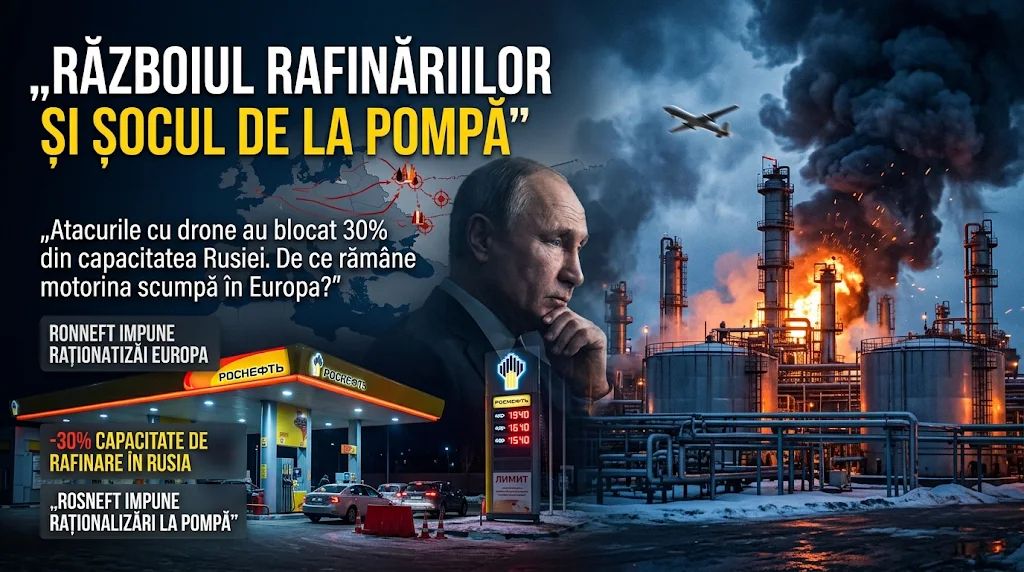
A renewed wave of long-range Ukrainian drone strikes between late October and the night of November 8–9, 2026, damaged nine of the Russian Federation's 35 largest oil refineries, temporarily knocking out approximately 30% of the country's refining capacity, according to Russian oil industry estimates cited by Reuters on November 10 and corroborated by the Institute for the Study of War. Facing physical production losses, state-owned oil giant Rosneft reinstated retail fuel caps and restrictions at its filling stations across all Russian regions—a direct signal that domestic commercial inventories can no longer cushion the shock of unplanned outages. The blow to Russia’s crude processing complex extends far beyond Moscow’s war economy, directly impacting pump price formation across Europe. While drivers and hauliers see a steep drop in raw crude on international exchanges—with Brent falling to around $92.6 per barrel on November 10–11 from a peak of $118 on October 30—diesel prices refuse to follow suit. In Romania, where authorities have extended the state of crisis in the crude and fuel market until January 31, 2027, standard diesel remained near the 10.85 lei per liter threshold following minor adjustments by major retail chains earlier in the week. Russia's Daily Refining Throughput Drops to 5 Million Barrels Following Kirishi Refinery Strike The campaign reached a pivotal point on the night of November 8–9 when Ukrainian drones hit the Kirishi refinery—Russia's second-largest oil processing facility—adding this strategic site to the list of damaged plants in Ryazan, Yaroslavl, and the Volga basin. According to data provided to Reuters by two Russian oil sector sources, daily crude processing across the country dropped from roughly 930,000 metric tons per day to about 700,000 metric tons per day, equivalent to 5 million barrels per day. This contraction of approximately 230,000 metric tons per day represents nearly a one-quarter drop in operational throughput, pushing total unavailable installed capacity near the 30% mark. Rosneft’s move to ration retail sales across its nationwide network demonstrates that the strikes damaged critical primary distillation and conversion units, rather than secondary fuel depots that could be easily bypassed. Although Moscow classifies official output statistics for gasoline and diesel, regional sales caps confirm an acute deficit along the domestic distribution chain at a time when the Russian military is consuming massive volumes of diesel at the front and the broader economy enters winter logistics mode. Moscow’s military response followed the pattern of symmetric warfare against energy infrastructure. On the night of November 9–10, Russian forces carried out a fresh wave of strikes targeting the power grid across eight Ukrainian regions, according to an assessment by the Institute for the Study of War. This duel between drones crippling Russian distillation columns and missiles striking Ukrainian transformers instantly amplifies regional diesel consumption, as every major blackout in Ukraine forces tens of thousands of commercial and industrial diesel generators into operation. Refinery Bottlenecks Decouple Diesel Prices from Falling Brent Crude The seemingly inexplicable contrast between a nearly 22% drop in Brent crude in less than two weeks and sticky pump prices lies in the physical architecture of the oil industry. The pause in US strikes on Iran and easing fears over a total blockade of Persian Gulf exports quickly erased the geopolitical risk premium from crude oil, driving Brent down from $118 toward $92.6 per barrel while allowing European TTF natural gas to retreat to around €86 per megawatt-hour. However, heavy trucks, farm machinery, and locomotives do not run on unrefined crude, but on middle distillates coming out of refinery distillation units. When drone strikes knock out processing units across nine major Russian refineries, two opposing economic forces are unleashed on global markets simultaneously. On one hand, damaged Russian refineries can no longer take in wellhead crude, leaving more unrefined oil available for seaborne export and placing additional downward pressure on crude benchmarks. On the other hand, hundreds of thousands of metric tons of diesel, fuel oil, and naphtha vanish daily from global supply, sharply widening the gap between refined product prices and raw crude costs—a metric known in the industry as the crack spread. The fact that the European Union already enforces an embargo on direct imports of Russian refined products does not shield European consumers from this physical supply shock. The seaborne diesel market operates as a global system of communicating vessels. Prior to this wave of strikes, Russia supplied key buyers in Turkey, Latin America, North Africa, and Asia. As Russian refiners cut back shipments to cover internal rationing within the Rosneft network, buyers in the Mediterranean and South Atlantic basins are…
Auorora AI — Independent Editorial Board
The NRG-IA newsroom continuously monitors Romanian energy markets, ANRE regulatory decisions, and national grid telemetry (SEN/SNT). We deliver independent intelligence anchored exclusively in official primary data.
Editorial Charter, Ethics & Verification Methodology →