Kazakh Oil & Romania: Stocks, Risks & Prices 2026–2027 — NRG-IA
Geopolitică & Energie Author: Ioana BuzoaicaRomania faces no immediate fuel shortage, but Black Sea attacks on Kazakh crude routes raise supply risks, threatening a new wave of price hikes.
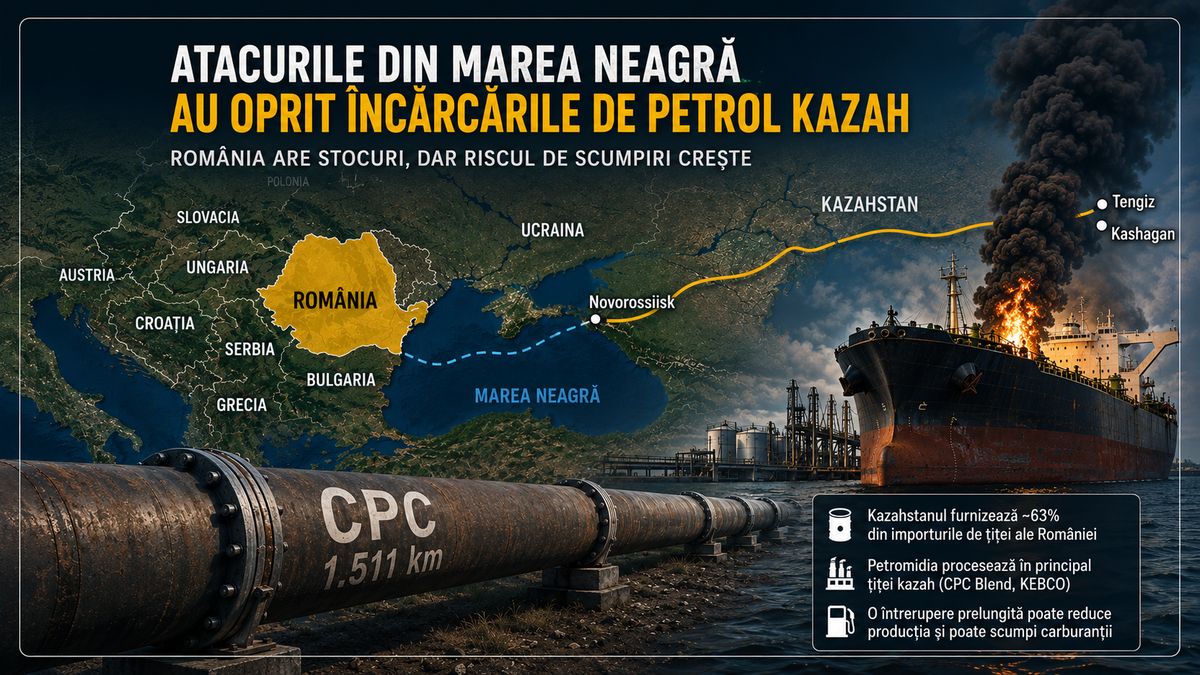
Romania has sufficient resources to avoid an immediate fuel crisis, but enters August with its primary oil vulnerability fully exposed. Attacks on vessels loading Kazakh crude at the terminal near Novorossiysk have suspended loadings, forced Kazakhstan to cut production, and put pressure on the Petromidia refinery, the country's largest fuel producer. For now, the issue is not a physical shortage of oil on the market. Romania has domestic production, contracted cargoes, commercial inventories, emergency reserves, and the option to import finished fuels. However, the risk escalates with every week that Kazakh flows fail to normalize: alternatives must be sourced from further afield, shipping becomes more expensive, and diesel must be purchased in a global market where refining capacity remains tight. Attacks Blocked Vessels, Did Not Destroy Pipeline Crude extracted from the giant Tengiz, Kashagan, and Karachaganak fields is transported via the Caspian Pipeline Consortium (CPC) system over a distance of 1,511 kilometers from western Kazakhstan to the Black Sea. The pipeline carries over two-thirds of Kazakhstan's oil exports, and its marine terminal loaded approximately 70.5 million tonnes in 2025. This volume represents nearly 2% of global oil supply. On July 19, 2026, the tankers ASIA and NISSOS IOS were attacked by drones during loading. A fire broke out aboard the ASIA, but no casualties or oil spills were reported. Operations resumed that same evening, but on July 20, the tanker NELSA was also attacked. The crew was almost entirely evacuated, the fire was extinguished, and oil loading was halted once again. There is no public information indicating that the pipeline has been destroyed or requires major reconstruction. The bottleneck is maritime: vessels cannot be loaded under acceptable safety conditions. This distinction leaves open the possibility of a rapid recovery, but only if tankers can re-enter the terminal area without facing risks deemed unacceptable by shipowners, insurers, and crews. As of July 26, the operator had not published confirmation of a stable resumption of loadings following the July 20 attack. Reuters reported that Kazakh authorities, producers, and the pipeline operator were discussing solutions to restore exports. Meanwhile, Kazakhstan has reduced extraction to prevent storage tanks at oil fields from reaching capacity. Production at Tengiz fell from an average of approximately 925,000 barrels per day (bpd) to around 406,000 bpd, while national oil and condensate production dropped from about 2.07 million to 1.63 million bpd. The cut is temporary, but it demonstrates that the transport disruption has begun to directly limit upstream extraction. The Kazakh Route Also Carries Western Interests The consortium is not exclusively controlled by Russia and Kazakhstan. The Russian Federation holds 24%, the national company KazMunayGas owns 19%, Chevron holds 15%, and ExxonMobil's affiliate has 7.5%. Other shareholders include Lukoil, Shell, and Eni. More than 75% of the crude loaded in 2025 belonged to international shippers, including Chevron, ExxonMobil, KazMunayGas, Eni, and Shell. This ownership structure raises the diplomatic stakes of the incident. The attacks do not only hit Kazakhstan's revenues and infrastructure on Russian territory, but also the production and commercial flows of major US and European corporations. Western involvement does not guarantee an end to the attacks, but it increases pressure to protect a route deemed vital for the international market. Nearly Half of Romania's Available Crude Can Be of Kazakh Origin In 2025, Romania produced approximately 2.472 million tonnes of oil equivalent (toe) and imported 8.894 million toe. Imports thus accounted for roughly 78% of the total supply (domestic production plus external supply). National production fell by 7.6% compared to the previous year, primarily due to the decline of mature fields. In the first two months of 2026, Romania imported approximately 1.25 million tonnes of crude oil. Kazakhstan supplied 63% of this volume, Azerbaijan 16%, and the remainder came primarily from Norway, Libya, and Côte d’Ivoire. These two shares should not be confused. Kazakhstan does not cover 63% of Romania's total oil requirements, but rather 63% of its imports. Correlating this share with the total import dependency indicates an estimated exposure of approximately 49% of the crude oil available to Romanian refineries. Consequently, the claim that Romania has instantly lost 60% of its oil is incorrect. Part of the demand is met by domestic production, and already-delivered Kazakh volumes, cargoes in transit, and existing inventories do not vanish the moment loadings are suspended. However, dependency remains high enough that a prolonged bottleneck would impact refining and prices. Petromidia Translates an External Issue into a Domestic Risk This exposure is concentrated at the Petromidia refinery. In 2025, it processed a record…