Black Sea Attacks Cut CPC Kazakh Oil Loadings by Over 20% — NRG-IA
Geopolitică & Energie Author: Ioana BuzoaicaBlack Sea attacks cut CPC oil loadings by over 20% in July, forcing Kazakh output cuts at a sensitive time for global markets and Romania's Petromidia.
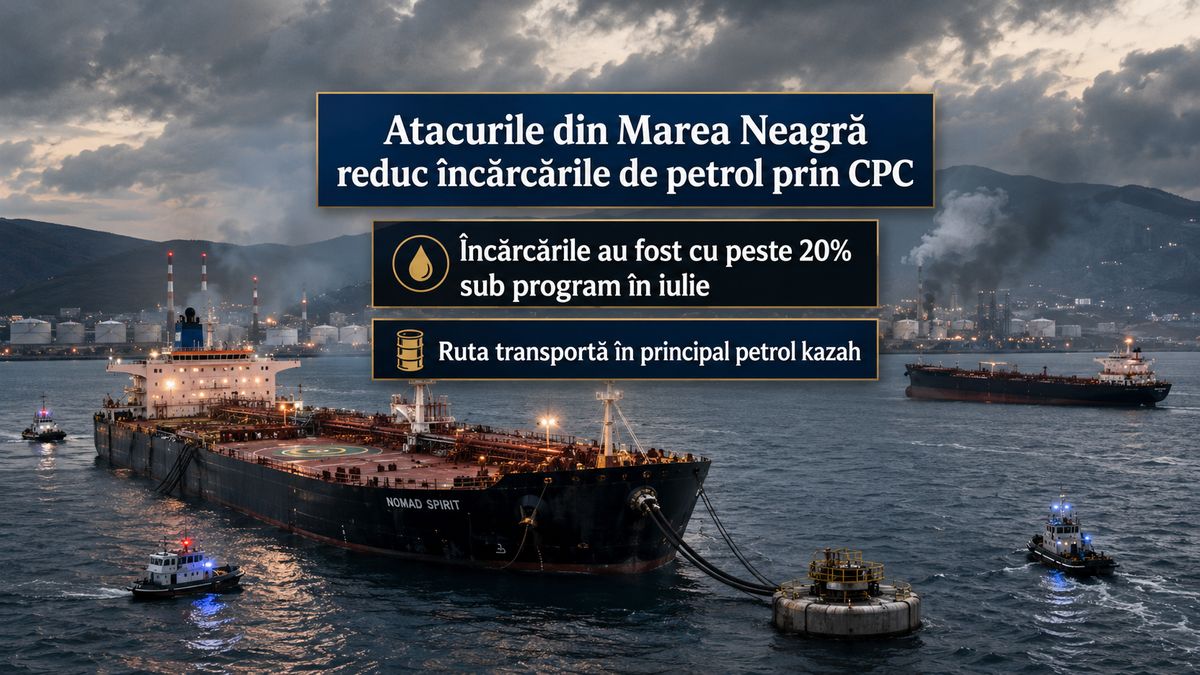
Security risks and attacks in the Black Sea reduced oil loadings through the Caspian Pipeline Consortium (CPC) terminal by more than 20% below schedule in July. Actual volumes dropped to approximately 1.2–1.3 million barrels per day (bpd), about 400,000 bpd below planned levels, according to industry sources cited by Reuters. The disruptions persisted into early August, with loadings hovering around 1.1–1.2 million bpd. However, the issue extends far beyond the terminal near Novorossiysk. The reduction in export capacity has begun to trigger upstream effects, reaching Kazakhstan's oil fields: the country's production fell by approximately 14% in July compared to June, and during the most severe phase of the disruptions, output at the Tengiz field—the country's largest—dropped from around 925,000 to 406,000 bpd. The timing is particularly sensitive for the international market. The Caspian Pipeline Consortium transports approximately 2% of global oil supply, primarily Kazakh crude, at a time when Middle Eastern flows are already impacted by the conflict surrounding Iran and traffic disruptions through the Strait of Hormuz. A 1,511-kilometer oil artery dominated by Kazakh crude The Caspian Pipeline Consortium (CPC) system connects oil fields in western Kazakhstan to the Yuzhnaya Ozereyevka marine terminal near the Russian port of Novorossiysk. The 1,511-kilometer Tengiz–Novorossiysk pipeline carries more than two-thirds of Kazakhstan's oil exports, alongside smaller volumes from Russian fields. The terminal features three offshore single-point mooring (SPM) tanker loading systems. In 2025, it handled a record volume of 70.52 million tons of crude oil, loaded onto 587 vessels. The shareholder structure illustrates why this issue transcends the bilateral relationship between Russia and Ukraine. The Russian state directly owns 24% of the consortium, KazMunayGas holds 19%, Chevron holds 15%, Lukoil holds 12.5%, Mobil (an ExxonMobil subsidiary) holds 7.5%, with the remaining stakes held by other companies and investment vehicles from Russia, Kazakhstan, and Europe. The transported crude is predominantly Kazakh, sourced from major fields such as Tengiz, Kashagan, and Karachaganak. Consequently, the CPC disruption should not be mistaken for a simple reduction in Russian oil exports. It is primarily a challenge for Kazakhstan's ability to bring its production to the global market. Tanker attacks have changed the nature of the risk The escalation in July shifted the issue from energy infrastructure to the vessels tasked with actually loading the oil. On July 19, the tankers ASIA and NISSOS IOS were struck during loading operations at the CPC terminal. According to the consortium, the ASIA was carrying oil for Tengizchevroil, a company controlled by Chevron and its partners, while the NISSOS IOS was scheduled to load volumes for Kashagan and KazMunayGas. A fire broke out on the ASIA, leading to a suspension of oil loadings. No casualties or oil spills were reported. Operations resumed that same evening, but on July 20, the tanker NELSA was hit while loading at one of the offshore facilities. Another fire broke out on board, disrupting operations once again. Russia attributed the attacks to Ukraine. However, Kyiv has not claimed responsibility for these incidents, and the attribution cannot be presented as an independently verified fact. The economic impact has become visible beyond the physical damage to the vessels. Reuters reported that shipowners have become more reluctant to accept voyages to the terminal, and a seller of CPC Blend required multiple attempts to secure an available tanker. The Russian FESCO group also suspended its operations in the region. Thus, while a terminal may remain technically operational and the pipeline can continue to transport oil, the export flow is curtailed if there are not enough vessels willing to enter the loading zone. Oil accumulates upstream, forcing production cuts Kazakhstan is vulnerable precisely because alternatives to the CPC cannot rapidly absorb comparable volumes. When Black Sea loadings are suspended or reduced, oil initially continues to flow into the system. However, storage capacity is limited. If exports do not resume quickly enough, producers must scale back pumping to prevent storage facilities from reaching capacity. This mechanism played out in July. Kazakhstan's Ministry of Energy confirmed a controlled reduction in production due to export restrictions and the risk of reaching storage capacity limits. At Tengiz, Reuters identified a drop from an average of approximately 925,000 bpd to 406,000 bpd during the peak disruption period. National oil and condensate production fell from about 2.07 million to 1.63 million bpd during that time. Over the course of the entire month, the reduction in Kazakh production amounted to approximately 14% compared to June. This transforms the CPC issue from a mere logistical delay into a constraint on physical production. A…
Ioana Buzoaica — Independent Editorial Board
The NRG-IA newsroom continuously monitors Romanian energy markets, ANRE regulatory decisions, and national grid telemetry (SEN/SNT). We deliver independent intelligence anchored exclusively in official primary data.
Editorial Charter, Ethics & Verification Methodology →