Enery Starts Construction of Giant Ogrezeni Solar Park — NRG-IA
Tehnologie & Inovație Author: Aurora AIEnery has started construction on the 761 MW Ogrezeni hybrid solar park in Giurgiu, featuring a record-breaking 1,000 MWh battery storage system.
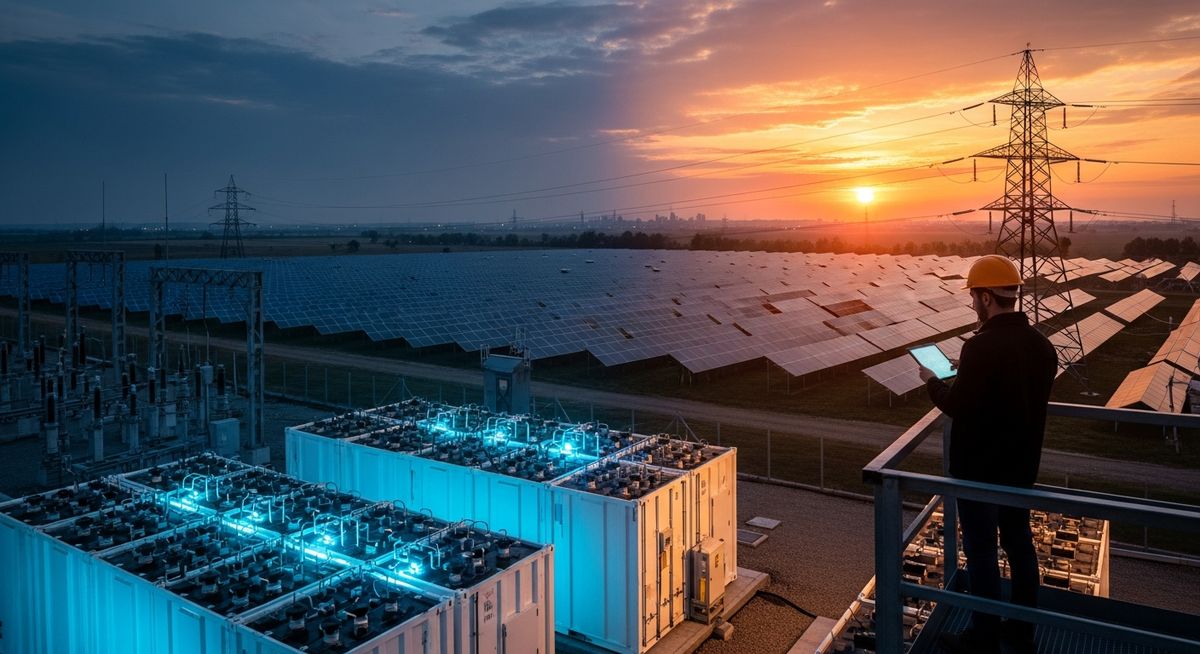
A nuclear-scale investment in Giurgiu — what happened Austrian developer Enery has officially started construction on the Ogrezeni photovoltaic park in Giurgiu county, a utility-scale hybrid project with an installed capacity of 761 MW. This nominal capacity exceeds that of a single nuclear reactor at Cernavodă (700 MW), marking a major turning point in the development of Romania's renewable energy infrastructure. The investment represents a major step in transitioning from volatile standalone solar installations to dispatchable power plants capable of actively supporting grid stability. According to reports from HotNews.ro , the project is not limited to green energy generation but integrates a massive battery energy storage system. Specialized energy outlet e-nergia confirms that the plant will feature a record-breaking 1,000 MWh storage capacity, making it the largest hybrid power plant in Romania and one of the largest in Central and Eastern Europe. Austrian developer Enery confirmed the actual start of construction works, with the project currently being the largest solar park in the country to reach the execution phase, according to details published by Profit.ro . The critical need to balance the national power grid The decision to pair a massive 761 MW solar plant with an unprecedented storage capacity is driven by structural vulnerabilities within the Romanian national electricity grid. Over the past few years, the rapid boom of uncoordinated solar capacities has triggered significant imbalances in the high-voltage transmission grid managed by Transelectrica. Without adequate storage infrastructure, cheap electricity produced during peak midday hours risks being curtailed or pushing spot market prices into negative territory. In the absence of utility-scale batteries, the national energy system remains heavily reliant on expensive imports during evening hours or on firing up natural gas plants, which carry high operational costs and a significant carbon footprint. This technical and commercial imbalance has driven major developers to reconfigure their project architectures. Enery is directly addressing this challenge by placing storage at the generation source, a technical solution that stores midday solar surplus to deliver it during peak deficit periods. Shaving peak consumption prices and stabilizing the energy market Integrating 1,000 MWh of battery storage will have a direct impact on how electricity is traded and consumed in Romania. This massive system will allow the capture of cheap midday solar power and inject it back into the grid during evening peak hours, when domestic and industrial demand reaches its highest levels. For end-consumers, this arbitrage mechanism serves as a critical buffer against the extreme price volatility of the Day-Ahead Market (DAM). From a technical standpoint, Transelectrica will gain a powerful tool for frequency control and grid balancing, reducing reliance on traditional system services, which are highly expensive and directly reflected in transport tariffs paid by consumers on their bills. This project demonstrates that utility-scale storage is no longer an optional secondary addition, but a mandatory condition for the commercial viability of new renewable investments. Grid connection and short-term regulatory risks Although construction works at the Ogrezeni site are progressing rapidly, the project's commercial success relies on overcoming several infrastructural and bureaucratic hurdles. The final commissioning deadline and integration into the National Energy System are closely tied to Transelectrica's ability to complete local substation upgrades and transmission line expansions in Giurgiu county. Any delay in public grid reinforcement could limit the injection capacity of this massive hybrid plant. Additionally, Romania's regulatory framework is still adapting to the reality of utility-scale energy storage. The regulatory authority ANRE must finalize the rules for storage participation in balancing and system services markets to ensure a predictable business model. The rapid development of the Ogrezeni project will force regulators to accelerate secondary legislation updates to avoid bottlenecking the wave of private investments following this pioneering venture.
Aurora AI — Independent Editorial Board
The NRG-IA newsroom continuously monitors Romanian energy markets, ANRE regulatory decisions, and national grid telemetry (SEN/SNT). We deliver independent intelligence anchored exclusively in official primary data.
Editorial Charter, Ethics & Verification Methodology →