IEA Warning: Global LNG Supply Drops Record 3% in 2026 — NRG-IA
Gaze Naturale Author: Ioana BuzoaicaGlobal LNG supply drops a record 3% in 2026 amid Gulf blockades, forcing IEA to warn EU gas storage could fall below 10% by end of winter 2027.
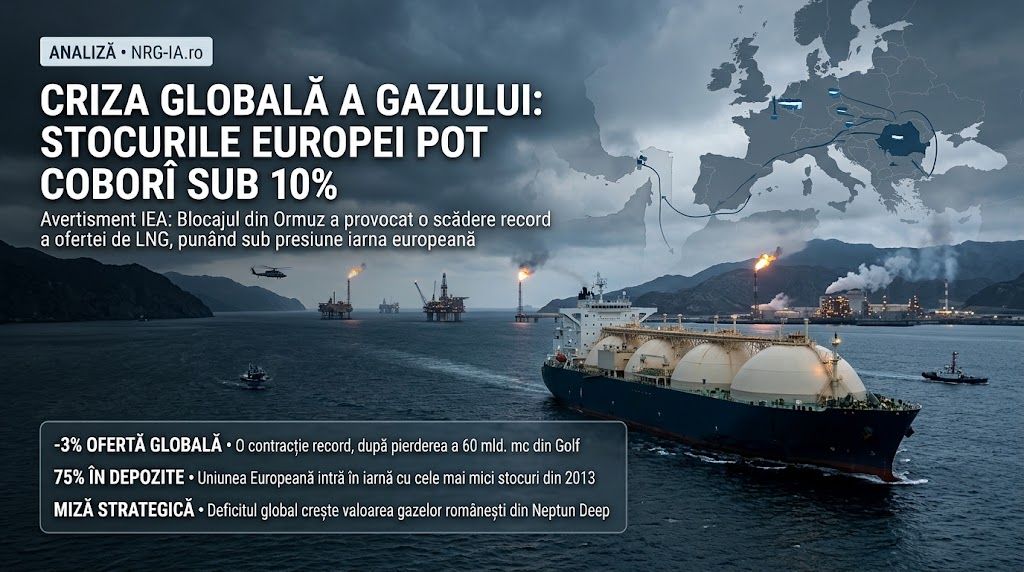
The global natural gas market is experiencing its most severe physical supply shock in the 2026–2027 winter since the 2022 energy crisis, according to the annual gas security report published on November 3 by the International Energy Agency. The war in the Middle East, naval blockades in the Strait of Hormuz, and damage suffered at the Ras Laffan liquefaction complex reduced liquefied natural gas deliveries from Qatar and the United Arab Emirates by more than 60 billion cubic meters between March and October 2026. Although export terminals in the United States and other Atlantic basins operated at maximum capacity, offsetting about two-thirds of this loss, net global LNG supply is set to drop by a record 3% in 2026, equivalent to roughly 20 billion cubic meters. The direct impact is already visible in the European Union's energy balance sheet; the EU missed its 80% storage target and entered the cold season with underground storage facilities filled to just 75% of capacity—the lowest level recorded at the start of winter since 2013. The Hormuz Blockade Has Turned Qatar into the Largest Buyer of US LNG Unlike the oil market, where Saudi Arabia and the United Arab Emirates operate major overland pipelines that can partially bypass the Strait of Hormuz to reach the Red Sea or the Gulf of Oman, liquefied natural gas from the Persian Gulf has no alternative export route. The entire output from Qatar and the UAE relies on cooling natural gas to minus 162 degrees Celsius at coastal plants and loading it onto LNG carriers that must transit the strait. Damage to the Ras Laffan complex and the threat of sea mines forced state-owned QatarEnergy to extend force majeure on its own Gulf exports through the end of December 2026. To meet its commercial commitments to international customers without incurring massive penalties, the Qatari giant executed an unprecedented move in energy industry history, becoming the largest buyer of LNG from the United States. QatarEnergy signed two major long-term agreements to purchase 7 million tonnes per annum (mtpa) of LNG from US terminals, contracting 4 mtpa from Cheniere Energy and 3 mtpa from Woodside Energy. Upon regasification, this volume is equivalent to roughly 9.5 billion cubic meters of gas per year—close to Romania's entire annual consumption—which Qatar is sourcing from the Atlantic basin to replace stranded cargoes in the Persian Gulf. Competition with Asia and the Risk of European Storage Falling Below 10% in March 2027 The loss of more than 60 billion cubic meters of Middle Eastern gas triggered a bidding war between Asia and Europe for every available LNG carrier on the spot market. Because roughly 80% of Qatari exports traditionally supplied Asian economies, importers in Japan, South Korea, China, and India aggressively outbid competitors for American and African cargoes, pushing the Asian benchmark JKM above the threshold of $31 per MMBtu—equivalent to nearly €100 per MWh. On Europe's TTF hub in Amsterdam, spot prices surged by nearly 70% compared to pre-conflict levels, settling at an average of around $20 per MMBtu, or over €62 per MWh. The wide premium in favor of the Asian market prompted traders to divert flexible-destination vessels away from European terminals toward the Far East throughout the summer and autumn, leaving the European Union with a storage fill level of just 75%. Compounding this storage deficit, skyrocketing electricity demand from new artificial intelligence data centers across North America, Europe, and Asia is keeping gas-fired power generation demand elevated, preventing a natural demand reduction. Simulations by the International Energy Agency show that in a scenario featuring a colder-than-average winter in the Northern Hemisphere and a continued blockade of exports through the Strait of Hormuz, reserves in the European Union's underground storage facilities could drop below the critical 10% threshold by March 31, 2027. From a technical standpoint, depleting storage reservoirs below 15–10% drastically reduces internal rock pore gas pressure, meaning daily withdrawal rates decline precisely during late-winter cold snaps when the grid requires maximum deliverability. Europe's vulnerability to any unplanned outage of remaining supply flows was underscored on Wednesday, November 4, when an electrical fire caused an emergency shutdown of Equinor's offshore Visund platform in the North Sea, cutting 13.2 million cubic meters per day of Norwegian gas deliveries. Meanwhile, rising gas and oil prices pushed annual energy inflation in the euro area to 20.8% in October, driving headline inflation to 4.0%, according to Eurostat data. Against this tense backdrop, the US administration exerted diplomatic pressure to resume Russian gas transit to Europe via Ukrainian pipelines under an energy truce framework; however, the European Commission rejected the proposal, maintaining its ban on short-term contracts with Russia that took effect in June. Loss of…
Ioana Buzoaica — Independent Editorial Board
The NRG-IA newsroom continuously monitors Romanian energy markets, ANRE regulatory decisions, and national grid telemetry (SEN/SNT). We deliver independent intelligence anchored exclusively in official primary data.
Editorial Charter, Ethics & Verification Methodology →