Natural gas prices 2026: industrial impact and forecasts — NRG-IA
Piața de Energie Author: Ioana BuzoaicaThe Romgaz-Azomureș deadlock confirms industrial demand destruction. Natural gas prices are forcing investments to pivot towards nuclear and renewables.
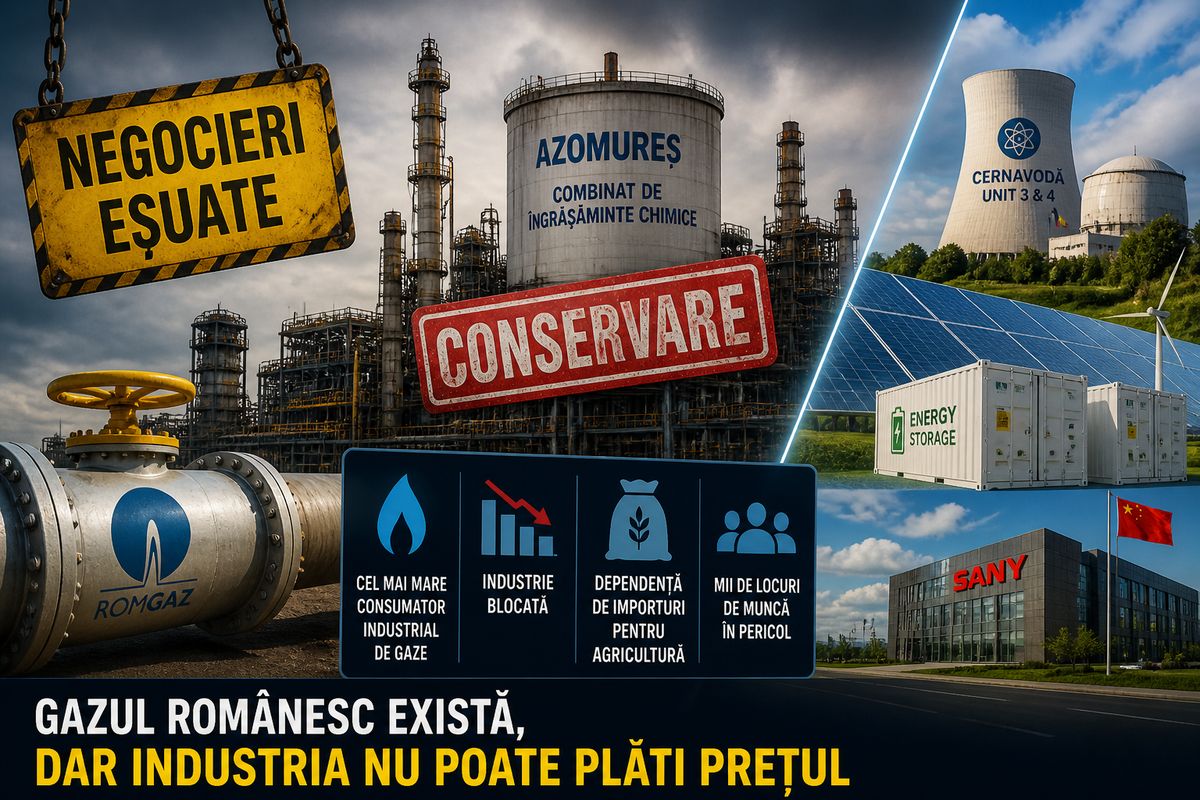
Current Situation Romania's largest natural gas consumer remains closed after negotiations for raw material prices definitively failed—an undeniable signal that the domestic energy market is far from offering viable commercial conditions for heavy industry. Although European stock market quotes have corrected from previous years' peaks, the reality of bilateral contracts in Romania paints a entirely different picture. The deadlock between the main state producer and the chemical industry represents a major stress indicator for the entire economy. The situation was officially confirmed by the Swiss group Ameropa, owner of the Azomureș chemical fertilizer plant. In a functional market, a consumer that historically absorbs up to 10% of national gas production should benefit from optimal commercial conditions. The reality, however, is diametrically opposed. "The conservation process of the Azomureș plant moves forward, we did not reach an agreement with Romgaz. In 2025, the Swiss group focused on consolidating its position, less so with the production activity at Azomureș," Ameropa representatives state. This contractual failure is not an isolated incident, but a symptom of an energy market marked by rigidity and high operating costs. Supply chain tensions are felt across all energy tiers. In the fuel market, for instance, quotes have hit new alert thresholds, with diesel selling at 8.92 lei per liter in Petrom stations in early May. Distribution companies like SOCAR and OMV Petrom report commercial difficulties and temporary unavailability due to price differences between supply sources, confirming a generalized inflationary environment in the energy sector. Analysis What does the inability to align prices between Romgaz and Azomureș actually mean? In economic terms, we are witnessing the phenomenon of "demand destruction." Gas producers prefer to maintain profit margins at lower volumes, selling to the regulated sector (households and district heating), rather than offering volume discounts that would allow the chemical industry to restart. This decision makes short-term financial sense for extraction companies but hides a long-term systemic risk. Without a baseload industrial consumer, the flexibility of the national gas system is compromised. Gas not consumed by industry must either be stored—generating additional storage costs—or exported, often at spot prices lower than long-term contracts. Moreover, the fixed maintenance costs of the national transmission network are now divided among a smaller volume of transited gas, putting pressure on future distribution tariffs. The market's response to this natural gas price rigidity is a massive and accelerated reallocation of capital towards alternatives. Natural gas is rapidly losing its "transition fuel" status due to a lack of price predictability, and investments are shifting toward technologies with zero marginal costs or long-term predictability. The pivot to nuclear: Project company EnergoNuclear signed a loan of over $57.2 million with the US Exim Bank in Washington for the development of Cernavodă Units 3 and 4. This is part of a broader 3.5 billion euro investment package recently negotiated in the US. The hybrid renewables surge: Chinese conglomerate Sany Group has started work in Dobrești on a hybrid energy project valued at one billion euros, marking the largest investment of its kind in Europe. Market and Consumer Implications For household consumers, the effects of these industrial tensions are currently buffered by capping schemes. However, industrial demand destruction will have a boomerang effect on future bills. When a giant like Azomureș goes off-grid, the pipeline infrastructure, compression stations, and system maintenance must be paid for by the remaining consumers. According to current regulations, a decrease in distributed volumes mathematically justifies an increase in unitary distribution tariffs approved by the regulator. In the competitive market, the big losers are related sectors: agriculture, which becomes dependent on imported fertilizers (often produced with cheap Russian gas outside the EU), and Romania's trade balance, which degrades. The short-term winners are gas producers, who report robust profits on the back of high prices sustained by captive winter consumption and cross-state subsidies. The situation in the fuel market provides a perfect parallel for consumer vulnerability. Although SOCAR officials emphasize that "there is no generalized deficit," they admit that import price differences create "commercial difficulties." This same commercial friction blocks natural gas: the physical resource exists, but the price at which it reaches the end consumer makes its use uneconomical. Scenarios and Perspectives Romania's natural gas market is at a crossroads, and the next 12-18 months will dictate the country's industrial structure for the next decade. Market modeling indicates two major evolutionary paths, heavily influenced…