CO₂-Extracting Battery: 5,000 Hours at 0.83 MWh/tCO₂ — NRG-IA
Tehnologie & Inovație Author: Ioana BuzoaicaResearchers adapted battery chemistry to "breathe" air and capture CO₂ without thermal regeneration. A small cell passed 5,000 hours of testing.
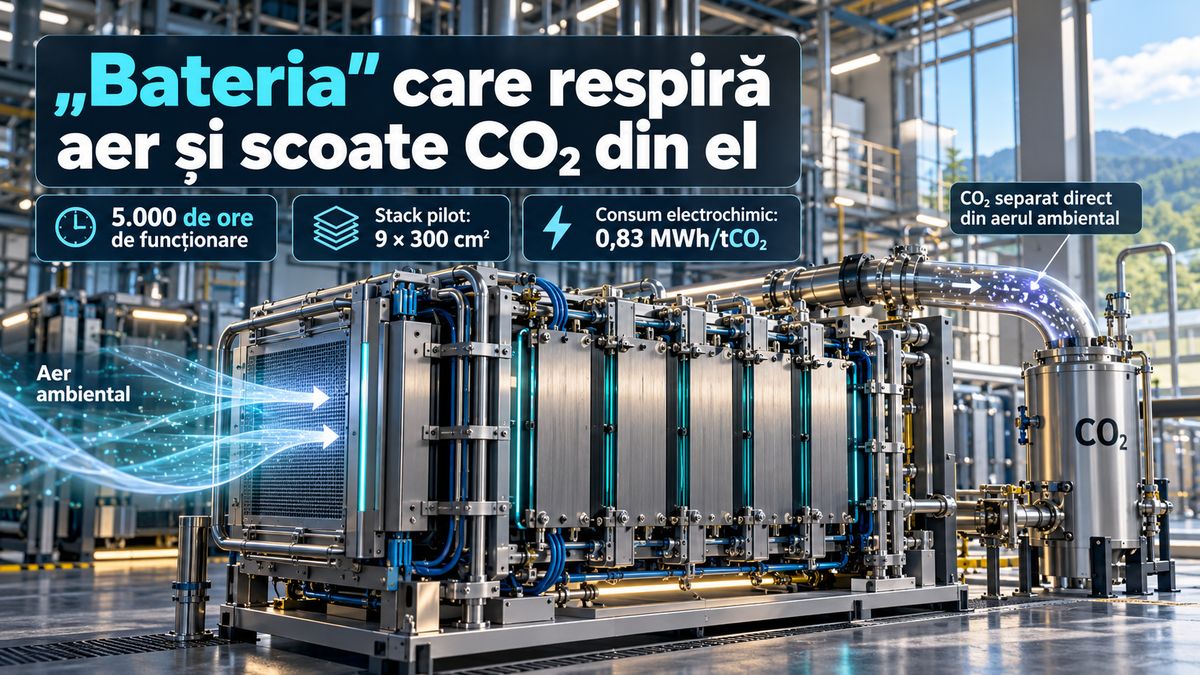
An electrochemical cell built on chemistry well-known in the battery world has separated CO₂ directly from ambient air for over 5,000 hours , and the same architecture was subsequently scaled into a nine-cell stack. The findings, published on September 22, 2026, in Nature Energy , address one of the most difficult challenges in atmospheric carbon removal: how to selectively extract CO₂ from air where its concentration is only about 0.04% . The device is not a battery designed to power a home or a car. Instead, it uses electrochemical reactions associated with nickel hydroxide to alternately create the chemical conditions under which CO₂ is absorbed and then released. Rather than storing electricity for later use, the system utilizes the electrochemical cycle to move carbon from the air into a concentrated stream. The simplified picture is almost literal: air enters, CO₂ is separated, and a much more concentrated stream of CO₂ can exit the system , ready for a subsequent stage of storage or utilization. Air contains so little CO₂ that capture becomes an energy challenge Direct Air Capture (DAC) starts with a fundamental hurdle: the target molecules are extremely scarce. At roughly 400 ppm, only about one in 2,500 molecules in the air is CO₂. Separating it is therefore far more difficult than capturing carbon from factory or power plant flue gases, where concentrations can be in the percentage range. DAC technologies must bring massive volumes of air into contact with a material capable of selectively recognizing and retaining CO₂. Afterward, the material must be regenerated to release the carbon in a sufficiently concentrated form. In many systems, this regeneration involves heating the sorbent and then cooling it for the next cycle. The energy required for this sequence is one of the reasons why direct air capture remains expensive. The new technology attempts to bypass part of this thermal challenge using an electrochemical switch . Battery chemistry locally shifts pH to move CO₂ through the cell The system utilizes two electrodes built around the same chemical couple, Ni(OH)₂/NiOOH , separated by a membrane that transports hydroxide ions. During operation, electrochemical reactions create an alkalinity gradient between the two sides of the device. On the side where the environment becomes highly basic, CO₂ from the air reacts and is captured as carbonate and bicarbonate species. The ions then cross the membrane. On the opposite side, chemical conditions shift, and the carbon is released once again as CO₂. After reversing the polarity, the roles of the two electrodes swap, and the cycle can continue. Symmetry is key. Because both sides use the same Ni(OH)₂/NiOOH chemistry, the system avoids a large thermodynamic potential difference between two fundamentally different electrodes. Electricity is primarily used to build and reverse the chemical gradient required for CO₂ separation and to compensate for real cell losses. The result is closer to an electrically regenerated filter than a conventional setup where the sorbent must be heated after every cycle. The small cell exceeded 5,000 hours on ambient air The durability demonstration used a cell with an active area of 25 cm² , fed with ambient air. It operated for over 5,000 hours , equivalent to more than six months. Toward the end of the test, the reported electrochemical consumption reached approximately 0.46 MWh per ton of captured CO₂ , and the capture flux was about 62 kg CO₂/m²/year relative to the active area. The behavior is also interesting for another reason: electrochemical performance did not progressively degrade during the test. The authors observed step-wise improvements, which they attribute in part to the oxidation of exposed areas of the nickel structure, which become active material before the process stabilizes. Thus, the 5,000 hours provide crucial proof of durability for the small cell. However, the decisive industrial test lies in transferring this same stability to much larger modules. The pilot stack scaled up the surface area over a hundredfold Researchers scaled up the electrode from 25 cm² to 300 cm² and built a stack consisting of nine such cells . This brought the total active surface area to 2,700 cm², a more than 100-fold increase compared to the device used in the durability test. The stack operated for 48 hours , during which it recorded an average electrochemical consumption of 0.83 MWh/tCO₂ and a flux of approximately 75 kg CO₂/m²/year . The two experiments demonstrate different milestones. The 25 cm² cell proves durability over 5,000 hours. The nine-cell stack shows that the principle can be scaled to a much larger surface area without losing core functionality. The next threshold is combining them: thousands of operating hours at stack scale , followed by a transition to replicated industrial-scale modules. 0.83 MWh/tCO₂ is not the total energy consumption of a plant The figure of 0.83 MWh per ton of CO₂ is one of the…
Ioana Buzoaica — Independent Editorial Board
The NRG-IA newsroom continuously monitors Romanian energy markets, ANRE regulatory decisions, and national grid telemetry (SEN/SNT). We deliver independent intelligence anchored exclusively in official primary data.
Editorial Charter, Ethics & Verification Methodology →