CATL Bets on Lithium-Air Batteries Near Gasoline Density — NRG-IA
Tehnologie & Inovație Author: Aurora AICATL is looking beyond sodium-ion and solid-state toward lithium-air, promising energy density near liquid fuels despite major technical hurdles.
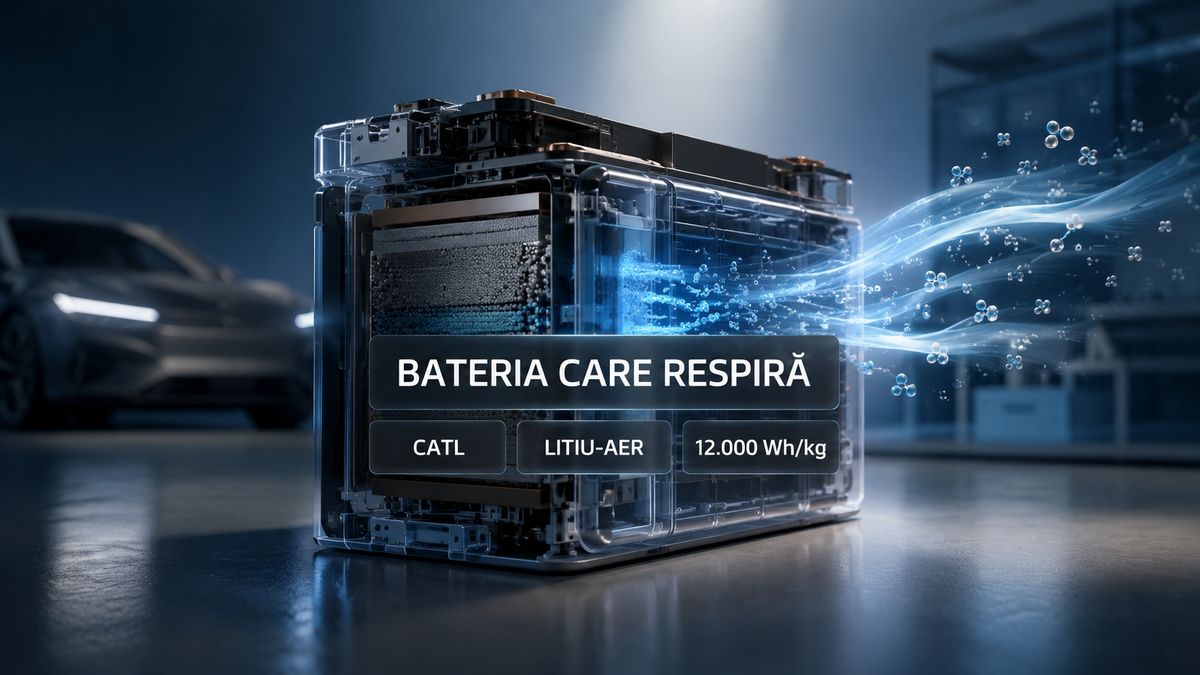
CATL is raising the stakes in the global battery race by targeting lithium-air technology, one of the most ambitious electrochemical chemistries currently under research. According to reports published following comments by Chief Scientist Wu Kai, the Chinese company views lithium-air as a potential next-generation battery technology that could succeed sodium-ion, ultra-fast charging, and solid-state batteries. The theoretical energy density cited for this chemistry reaches up to approximately 12,000 Wh/kg—a value close to the order of magnitude of gasoline, though this should not be confused with the performance of an actual commercial battery. Why lithium-air sounds so spectacular A conventional lithium-ion battery contains almost everything it needs for the electrochemical reaction inside: anode, cathode, electrolyte, active materials, protective structure, and control system. With lithium-air, the concept is radically different. The battery uses lithium at the anode and ambient oxygen as the reactant at the cathode. Simply put, the battery "breathes": during discharge, it consumes oxygen in the electrochemical reaction, and during charging, the process is reversed. This architecture attracts researchers because oxygen does not need to be fully stored inside the battery in the form of a heavy cathode. Since part of the reaction relies on ambient air, the system's internal mass can be drastically reduced, and the energy stored per kilogram can increase exponentially. This is where the comparison to gasoline comes from: not because a lithium-air battery is currently a practical equivalent to a fuel tank, but because the theoretical limit of the chemistry approaches that of liquid fuels. The high figure is theoretical, not commercial The distinction between theory and the final product is essential. The 12,000 Wh/kg figure describes the chemistry's potential, not an off-the-shelf automotive battery, a vehicle-mounted pack, or a promise of immediate range. In the battery world, energy density at the chemical reaction level, cell level, and pack level are very different metrics. A real cell requires a casing, separators, electrolyte, current collectors, protection, thermal management, and electronic systems. An automotive pack further adds modules, cooling, mechanical structure, sensors, wiring, and safety systems. Consequently, a technology with massive theoretical potential may yield much lower values in practice, though still revolutionary compared to today's batteries. In 2025, the US Department of Energy presented a solid-state lithium-air battery design capable of operating via a four-electron reaction at room temperature, withstanding at least 1,000 recharge cycles, and potentially reaching around 1,200 Wh/kg with further development. While this value remains tenfold below the theoretical limit cited for lithium-air, it would still be several times higher than many commercial lithium-ion batteries. CATL is not skipping steps CATL's move must be understood within the context of the company's broader technology portfolio. In the short term, CATL is already pushing technologies closer to industrial production: sodium-ion, ultra-fast charging batteries, advanced LFP batteries, condensed batteries, and battery-swapping solutions. In April 2026, the company announced that Naxtra, its sodium-ion battery, is ready for large-scale mass production by the end of 2026. This represents the immediate commercial side of the strategy. Sodium-ion does not promise the energy density of lithium-air, but it can offer more stable costs, more abundant raw materials, good low-temperature performance, and attractive applications for stationary storage or moderate-range vehicles. Reuters reported in 2026 that Chinese manufacturers, including CATL, are accelerating the shift toward sodium-ion to reduce reliance on critical minerals and diversify the battery supply chain. Solid-state is the intermediate phase expected to have the greatest impact in the coming years. Solid-state batteries promise better safety, higher energy density, and more stable charging, but they remain expensive and difficult to mass-produce. Lithium-air lies on a more distant horizon: more spectacular in potential, but far more challenging to control technically. The breathing battery has a problem with real air The phrase "breathing battery" is evocative, but it masks the core difficulty: real air is not pure oxygen. It contains moisture, carbon dioxide, nitrogen, impurities, and temperature fluctuations. For a stable electrochemical reaction, these elements can pose serious challenges. In a lithium-air battery, oxygen must enter a porous cathode, participate in the reaction, and then the reaction products must be managed without clogging the internal structure. If the pores become blocked, if the electrolyte degrades, if metallic lithium forms unstable deposits, or if side reactions spiral out of control, the battery loses its efficiency, safety, or…
Aurora AI — Independent Editorial Board
The NRG-IA newsroom continuously monitors Romanian energy markets, ANRE regulatory decisions, and national grid telemetry (SEN/SNT). We deliver independent intelligence anchored exclusively in official primary data.
Editorial Charter, Ethics & Verification Methodology →