60,000-Cycle Zinc-Iodine Battery: Lithium-Free Storage — NRG-IA
Tehnologie & Inovație Author: Ioana BuzoaicaA new zinc-iodine battery exceeds 60,000 lab cycles using a polymer to block degradation. If scaled, grid storage could run intensively for decades.
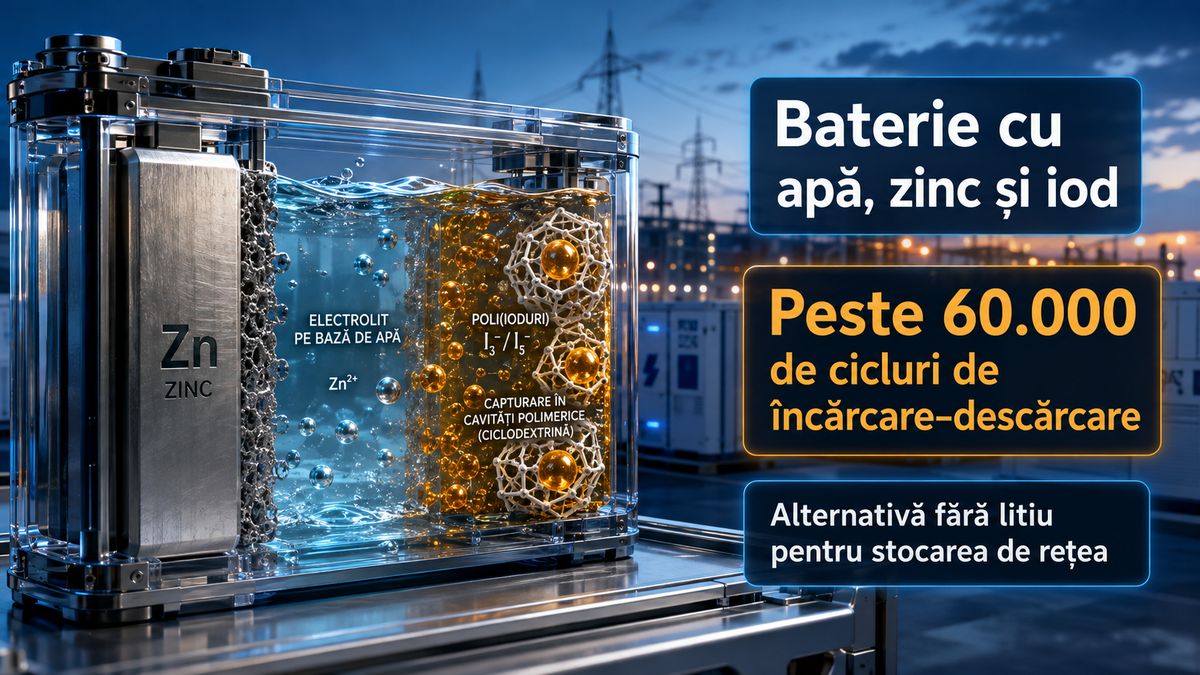
A battery built from zinc, iodine, and a water-based electrolyte has surpassed 60,000 charge-discharge cycles in an experiment published in Angewandte Chemie International Edition . Under the most durable operating regime, the specific capacity started at approximately 149 mAh/g and remained around 148 mAh/g after 60,000 cycles —a result that highlights an alternative pathway for energy storage: lithium-free batteries designed for extremely intensive use. The research was conducted by a team from Flinders University and its collaborators. The technology addresses a core issue of zinc-iodine batteries: during operation, iodine forms mobile chemical species that can cross the electrolyte, reach the zinc anode, and accelerate degradation. The researchers' solution is conceptually simple. They developed a polymer based on β-cyclodextrin , whose molecular cavities trap iodine species and prevent them from migrating freely through the battery. Instead of fundamentally altering zinc chemistry or introducing exotic materials, the team created a network of "molecular cages" for the iodine. The result combines three crucial properties for stationary storage batteries: ultra-long cycle life, rapid charging, and the use of an aqueous electrolyte . How 60,000 Cycles Change Battery Utilization The cycle count is a key metric determining the real-world economics of any storage system. Simply put, a cycle represents one full charge and discharge. In commercial operations, the concept of an equivalent full cycle is frequently used, meaning successive partial charges and discharges are aggregated to equal one full cycle. The difference between 5,000, 15,000, and 60,000 cycles becomes massive when a battery is cycled daily. A system capable of delivering 60,000 full cycles would, mathematically, have enough cycling headroom to last approximately 164 years at one cycle per day, 82 years at two cycles, 41 years at four cycles, or just over 20 years at eight cycles per day. The physical lifespan of a commercial battery is also limited by calendar aging, corrosion, the separator, electrolyte degradation, connections, and other system components. The true significance of 60,000 cycles lies elsewhere: in a 20-year energy project, cycling limits could become far less restrictive than they are for most of today's batteries . A system operating once a day accumulates about 7,300 cycles over 20 years. Two daily cycles total around 14,600, while four cycles per day push the total toward 29,200. Only by running close to eight full cycles every single day for two decades does one approach the 60,000-cycle mark. For a grid-scale battery, this can matter more than the promise of a spectacular calendar lifespan: the battery can simply be utilized much more intensively. Commercial Batteries Already Reach Tens of Thousands of Cycles A comparison with currently available technologies puts this result into perspective. Modern LFP (lithium iron phosphate) systems for stationary storage have advanced significantly. For instance, CATL specifies a design life of approximately 15,000 cycles and over 20 years of operation for its current TENER storage solutions. At 60,000 cycles, the Flinders result is roughly four times higher than this commercial LFP benchmark , comparing strictly on declared cycle counts. There are also specialized commercial batteries designed for much higher durability. Toshiba claims over 20,000 cycles for its SCiB range featuring a lithium titanate anode, and reports over 80% of initial capacity after 40,000 cycles for a high-power 2.9 Ah cell under highly demanding test conditions. Vanadium redox flow batteries operate on a different architecture and are marketed for over 20,000 deep cycles with lifespans in the range of 25 years. Therefore, 60,000 cycles do not emerge in a market where current batteries only survive a few hundred or thousand uses. Commercial performance has already grown enormously. However, the Flinders breakthrough remains remarkable due to its combination of durability and a chemistry based on zinc, iodine, and water , entirely free of lithium. Molecular "Cages" Prevent Iodine from Degrading the Battery One of the challenges of zinc-iodine batteries stems from the solubility of the iodine species involved in the electrochemical reactions. During charging and discharging, polyiodides are formed and can migrate through the electrolyte. If they reach the anode, they react with the zinc, consuming active material and triggering parasitic side reactions. This phenomenon, known as the polyiodide shuttle , reduces both efficiency and cycle life. The Flinders team utilized β-cyclodextrin, a cyclic oligosaccharide molecule. Its defining feature is a central cavity capable of hosting specific molecules or ions. By linking these molecules into a three-dimensional polymer, the researchers created a structure packed with these cavities. Polyiodides are trapped inside them, remaining close to the cathode instead of…
Ioana Buzoaica — Independent Editorial Board
The NRG-IA newsroom continuously monitors Romanian energy markets, ANRE regulatory decisions, and national grid telemetry (SEN/SNT). We deliver independent intelligence anchored exclusively in official primary data.
Editorial Charter, Ethics & Verification Methodology →