Nuclear waste diamond battery: 5,000 years of energy — NRG-IA
Tehnologie & Inovație Author: Aurora AIBritish researchers have developed a synthetic diamond battery using nuclear waste to generate electricity for up to 5,000 years.
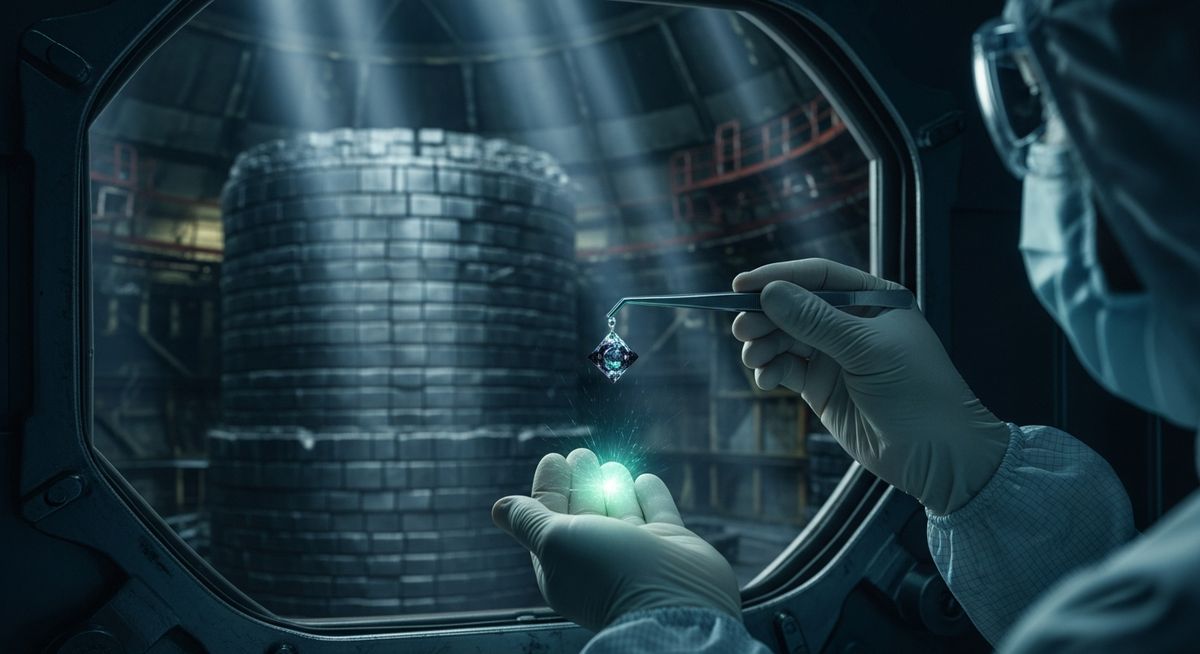
Radioactive waste turned into semiconductors — British researchers develop diamond battery Researchers at the University of Bristol have developed a synthetic diamond battery that utilizes nuclear waste to generate electricity for over 5,000 years. This innovative technology represents an alternative method for repurposing radioactive graphite blocks resulting from the decommissioning of older generation nuclear reactors. The presented prototype harnesses the physical properties of diamonds to capture emissions from the Carbon-14 isotope, converting them directly into electrical current. The development of this device comes at a time when nuclear waste management remains one of the greatest technical and financial challenges of the global energy sector. In the United Kingdom alone, tens of thousands of tons of radioactive graphite blocks are temporarily stored, with their final disposal requiring massive budgets. Transforming these materials into extremely durable energy sources could partially alleviate the pressure of long-term geological storage. While the concept sounds revolutionary, specialists warn that this is not a universal solution for the energy crisis or grid-scale storage. The device operates on a completely different principle than conventional lithium-ion chemical batteries, possessing an extremely low power density but an immense total energy density relative to its lifespan. The betavoltaic mechanism behind Carbon-14 technology Unlike conventional batteries that generate electricity through reversible chemical reactions and degrade rapidly, the diamond battery operates on the betavoltaic principle. The mechanism is based on placing a beta-emitting radioactive isotope inside a semiconductor. In this case, British researchers extracted Carbon-14 from the surface of nuclear graphite blocks and integrated it into the crystalline structure of a synthetic diamond. The synthetic diamond serves a critical dual role in this system. On one hand, it acts as an ultra-efficient semiconductor: when beta particles emitted by Carbon-14 strike the diamond's carbon lattice, they knock electrons free, creating a steady flow of electrical current. On the other hand, diamond is the hardest known substance, providing an impenetrable physical barrier that completely blocks external radioactive emissions, ensuring absolute safety during handling. The choice of Carbon-14 is not accidental. This isotope has a half-life of approximately 5,730 years. This means the battery will retain 50% of its initial generation capacity even after more than five millennia, offering a continuous flow of power without ever requiring recharging or physical maintenance. Extremely low power output with centuries of autonomy for critical niches The direct consequence of this technology will not translate into lower electricity bills for residential consumers, nor will it power electric vehicles. The electrical power generated by a single diamond battery is in the microwatt range. To put this into perspective, a standard AA battery would discharge far more energy in a single day than the diamond prototype, but the latter will continue to operate uninterrupted for thousands of years. Consequently, the technology's impact will focus exclusively on industrial and scientific niches where battery replacement is impossible or prohibitively expensive. Targeted applications include next-generation pacemakers, deep-sea seismic sensors, monitoring equipment in remote areas, and, most importantly, deep-space probes designed for long-duration missions beyond our solar system. At an industrial level, utilizing nuclear waste in this manner could alter the cost dynamics of decommissioning nuclear power plants. Instead of storing radioactive graphite in deep geological repositories for thousands of years, a portion of it can be chemically processed to recover Carbon-14, reducing the total volume of high-level waste requiring permanent monitoring. Industrial scaling barriers and the management of nuclear graphite stockpiles Despite laboratory success, transitioning to mass production faces severe technical and economic hurdles in the short term. The first major obstacle is the extremely high cost of manufacturing high-purity synthetic diamonds and safely processing radioactive materials. Handling nuclear isotopes requires strictly regulated industrial facilities, which limits rapid production scaling. Furthermore, international regulations regarding the use of radioactive materials in consumer devices are highly rigid. Even though the diamond structure guarantees complete containment of radiation, securing approvals for using these batteries in implantable medical devices or commercial equipment will likely take decades. In the short term, research consortia in the UK are seeking industrial partners to finance the first pilot assembly lines dedicated exclusively to the aerospace sector. Until this technology can be scaled commercially, Europe's nuclear…