Water-Iodine Batteries: Chemistry Doubles Iodine Capacity — NRG-IA
Tehnologie & Inovație Author: Ioana BuzoaicaA Nature study presents a method to harness iodine in aqueous batteries, doubling theoretical active material capacity and testing a 1.1 Ah cell.
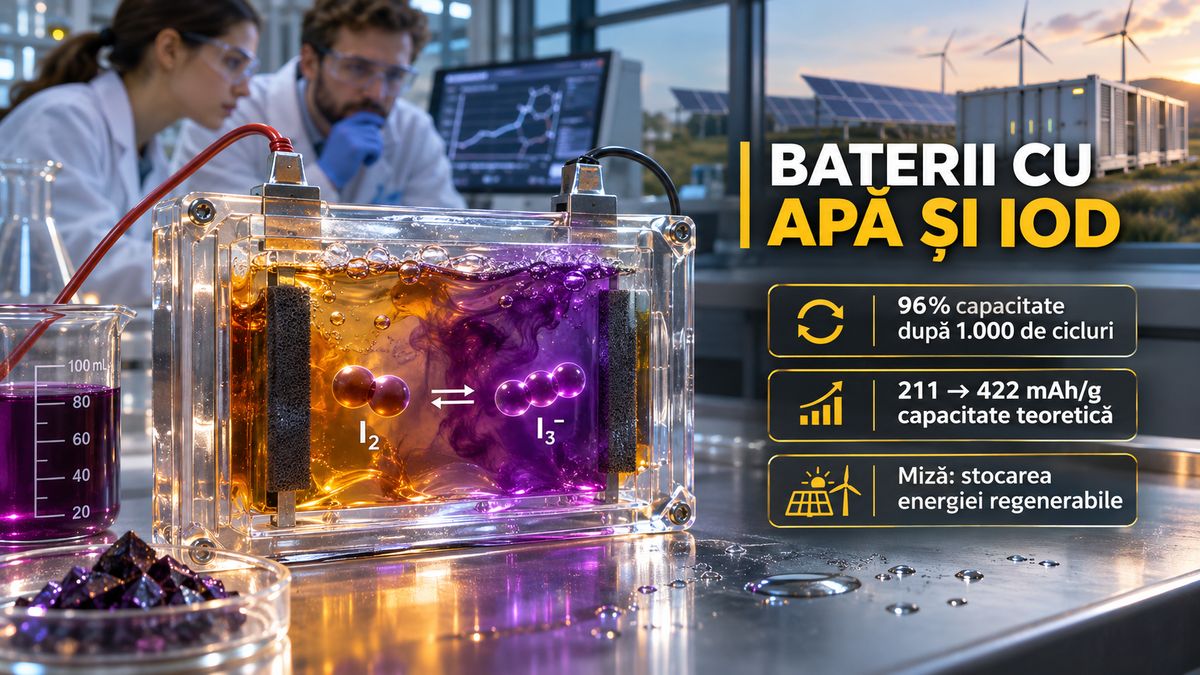
A team of researchers from University College London (UCL) and the University of Oxford has demonstrated a new water- and iodine-based electrochemical energy storage method that unlocks a reaction capable of doubling the theoretical capacity of iodine used in batteries. The discovery, published on November 11, 2026, in the prestigious scientific journal Nature , proposes a solution to one of the technology's most challenging hurdles: stabilizing the chemical reactions that enable higher energy storage density. Experimental results are promising. In the tested zinc–iodine cells, researchers achieved 96% capacity retention after 1,000 charge-discharge cycles at a specific current of 1 A/g. In another test at 2 A/g, capacity retention reached 94% after 2,000 cycles. The team also demonstrated the mechanism's operation in a larger-capacity experimental pouch cell of 1.1 Ah, as well as its applicability in systems utilizing aluminum. The implications extend far beyond laboratory performance. As global solar and wind energy production scales up, power grids require storage technologies capable of absorbing surplus electricity and dispatching it when needed. A battery that efficiently utilizes accessible materials, a water-based electrolyte, and high-capacity electrochemical reactions could help pave the way for alternative stationary storage solutions in a market currently dominated by lithium-ion technologies. Twice the Theoretical Capacity from the Same Amount of Iodine The underlying principle stems from how iodine participates in electrochemical reactions. In conventional zinc–iodine batteries, energy is stored via reversible transformations between negatively charged iodide and molecular iodine. This process involves the transfer of two electrons per iodine molecule, yielding a theoretical specific capacity of 211 milliamp-hours per gram of active iodine. The researchers sought to harness an additional reaction step in which iodine reaches a higher oxidation state. By incorporating this transformation, the complete electrochemical process can involve four electrons, doubling the theoretical specific capacity to 422 mAh/g. In practical terms, the same mass of iodine can undergo twice as much electrical charge transfer compared to the conventional two-electron reaction. This advantage is significant because electroactive materials directly dictate the amount of energy a battery can store. Harnessing more electrons boosts the material's specific capacity, offering the potential for batteries with superior energy performance. However, the actual energy stored by a cell also depends on operating voltage, electrolyte volume, the anode (negative electrode), and other structural components. The four-electron reaction itself is not a new discovery. In January 2021, a research team led by Xiao Liang published a study in Nature Communications demonstrating a zinc–iodine system capable of utilizing this conversion, achieving notable electrochemical stability. However, the bottleneck of previously developed methods was their frequent reliance on highly concentrated halogenated salt electrolytes needed to stabilize highly reactive iodine species. These electrolytes can introduce challenges regarding corrosion, cost, and material compatibility. The breakthrough by the UCL–Oxford team lies in developing a distinct stabilization mechanism that allows the reaction to occur reversibly in an aqueous electrolyte without relying on these halogenated salts. Thus, the research shifts focus from merely achieving the four-electron reaction to controlling the chemical microenvironment that enables stable, repeatable operation. The New Formulation Simultaneously Controls Water and Reactive Iodine Species The most challenging stage of the four-electron conversion involves iodine in the +1 oxidation state. This species is highly reactive and easily destabilized by water in the electrolyte, triggering side reactions that degrade battery capacity. Consequently, stabilizing iodine requires precise control over the chemical microenvironment near the electrode surface, where electron transfer occurs. The team, led by Professor Guanjie He, formulated an electrolyte design framework designated as KA–PA–Nuc. It combines three complementary component categories: anions that alter interactions between water molecules and stabilizing agents, polar anions that foster a water-depleted interphase at the electrode surface, and organic molecules capable of stabilizing reactive iodine species. Through this combination, researchers successfully created the necessary conditions for iodine to transition reversibly across its oxidation states. Stabilizing molecules interact with iodine in the +1 state, while the localized water-depleted environment suppresses unwanted side reactions. As a result, the process can be repeated across charge and discharge cycles without relying on the ultra-high concentrations of chlorides or bromides characteristic of earlier…
Ioana Buzoaica — Independent Editorial Board
The NRG-IA newsroom continuously monitors Romanian energy markets, ANRE regulatory decisions, and national grid telemetry (SEN/SNT). We deliver independent intelligence anchored exclusively in official primary data.
Editorial Charter, Ethics & Verification Methodology →