4-minute battery charging: New graphite by US researchers — NRG-IA
Tehnologie & Inovație Author: Ioana BuzoaicaUS researchers developed an anode material enabling 4-minute EV battery charging while cutting synthetic graphite production emissions by over 80%.
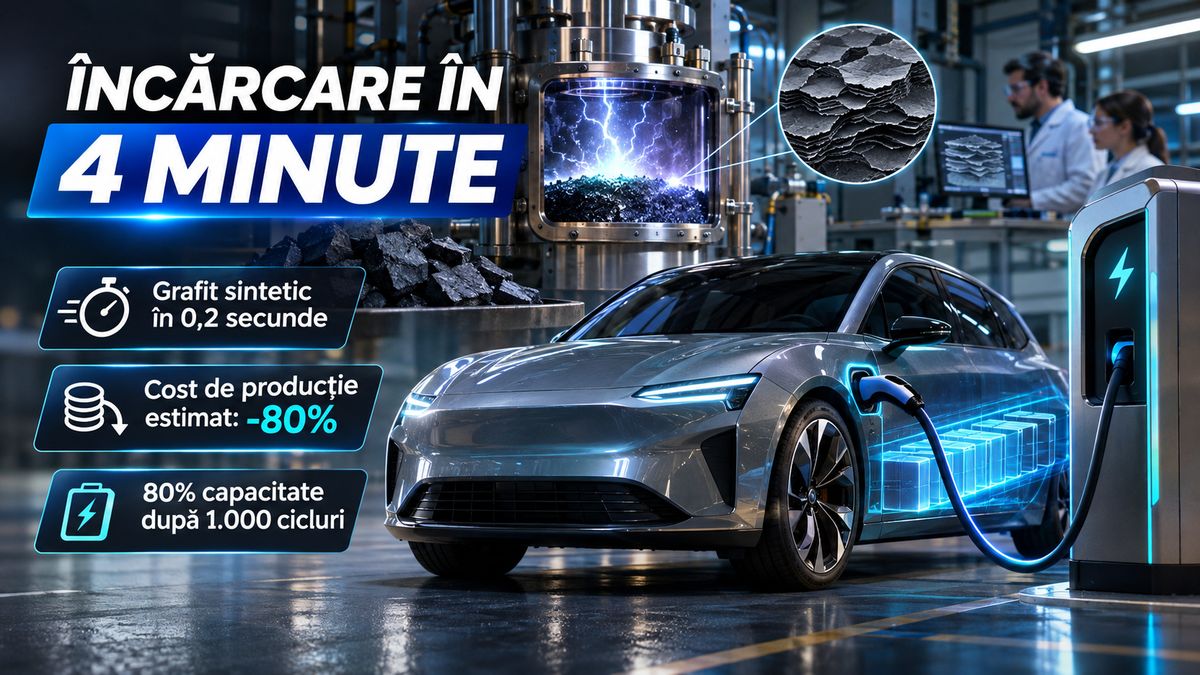
Researchers at Rice University in Houston, United States, announced on November 23, 2026, the development of a new type of synthetic graphite that could radically reduce electric vehicle charging times. In laboratory testing, the material demonstrated the capacity to operate at a nominal charging rate equivalent to four minutes while retaining 80% of its capacity after 1,000 cycles. The research findings, published in the scientific journal Advanced Materials, carry significance well beyond the electrochemical performance of the new material. The team led by Professor James M. Tour also developed a manufacturing process that transforms petroleum coke into high-performance synthetic graphite using an electrical pulse lasting just 0.2 seconds. The researchers estimate the technology could reduce production costs for the material by approximately 80%. The combination of charging speed, durability, and low manufacturing costs makes the discovery particularly relevant for the electric vehicle industry. These three characteristics represent decisive factors for battery competitiveness and the global expansion of electric mobility. Graphite represents a major bottleneck for fast charging In most lithium-ion batteries used in electric vehicles today, graphite serves as the primary active anode material. During charging, lithium ions migrate from the cathode to the anode, inserting themselves between the atomic layers of graphite. During discharge, the process is reversed, enabling electrical energy to be delivered to the motor. The rate at which lithium ions can penetrate the graphite structure limits the charging power the battery can accept. At very high currents, lithium can deposit as metallic lithium on the anode surface—a phenomenon that accelerates battery degradation and can compromise safety. The US researchers aimed to optimize the graphite structure to facilitate lithium-ion transport. The resulting material recorded a reversible specific capacity of 347.4 mAh/g at a rate of 0.25C and 158.8 mAh/g at 15C, the latter being nominally equivalent to a four-minute charge. At the maximum speed tested, the material delivers approximately 46% of the specific capacity measured under slow charging conditions. This performance demonstrates the feasibility of using graphite at extreme charging rates, with the development of commercial cells exploiting these properties representing the next technological milestone. An electrical pulse transforms petroleum coke into high-quality graphite Conventional manufacturing of synthetic graphite involves treating carbon materials at very high temperatures maintained over long periods. The process entails substantial energy consumption and specialized industrial facilities—factors that directly drive up anode material costs. The method developed at Rice University relies on a different principle. Researchers introduce small amounts of nickel into the carbon feedstock and apply an electrical pulse that raises the material's temperature to approximately 2,500°C for just 0.2 seconds. The nickel acts as a catalyst, accelerating the rearrangement of carbon atoms into an ordered crystalline structure. The resulting graphite exhibits structural characteristics favorable for battery use, and its electrochemical properties are retained even after removing more than 99% of the residual nickel. The feedstock used is petroleum coke, a carbon byproduct of oil refining. Concentrating energy input into an extremely brief interval minimizes thermal losses associated with conventional processes. According to researcher estimates, the new method could reduce both energy consumption and greenhouse gas emissions associated with synthetic graphite production by over 80%. Graphite production cost could fall to $840 per tonne Economic analysis conducted by the US team indicates a potential production cost of around $0.84 per kilogram of high-performance synthetic graphite—equivalent to $840 per tonne. This represents an estimated cost reduction of roughly 80% compared to conventional methods. At industrial scale, this difference becomes significant. For a hypothetical plant with an annual capacity of 10,000 tonnes, production cost savings could exceed $30 million per year, provided the researchers' economic projections are confirmed through commercial scaling. Reducing anode material costs could lower overall battery prices and improve the competitiveness of electric vehicle manufacturers. Concurrently, reducing the energy footprint required for graphitization could facilitate production deployment in the United States and Europe, including regions with high industrial electricity costs. This outlook carries a significant geopolitical dimension. According to the International Energy Agency, China accounts for over 90% of global synthetic graphite refining capacity. Developing alternative, economically competitive production technologies based on locally available raw materials could help diversify…
Ioana Buzoaica — Independent Editorial Board
The NRG-IA newsroom continuously monitors Romanian energy markets, ANRE regulatory decisions, and national grid telemetry (SEN/SNT). We deliver independent intelligence anchored exclusively in official primary data.
Editorial Charter, Ethics & Verification Methodology →