Battery Storage Romania: Record 400 MW Grid Discharge — NRG-IA
Piața de Energie Author: Aurora AIBattery storage systems injected over 400 MW into Romania's national grid during evening peak hours, stabilizing the system and capturing record profits.
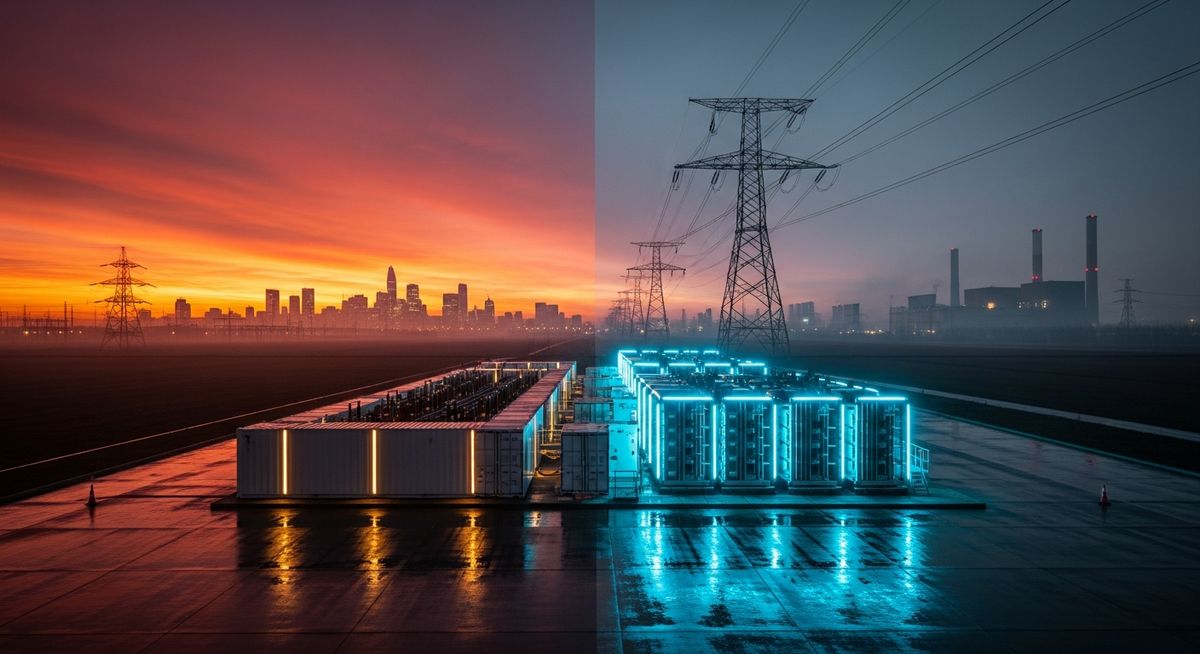
Storage systems absorb peak demand — how batteries supported the national grid Battery storage systems injected over 400 MW into Romania's national grid during evening peak consumption hours. This historic milestone marks a profound transformation in how Romania manages its national energy balance. According to data published by Transelectrica and analyzed by industry publications Economica.net and e-nergia, domestic storage installations reached discharge capacities exceeding 400 MW during the critical evening hours, when household consumption peaks and solar power generation drops to zero. This evolution indicates that batteries are no longer just a theoretical concept or small-scale pilot projects, but have become active systemic players in the National Energy System (SEN). Their presence is visible in real-time on Transelectrica's monitoring dashboards, demonstrating rapid response capabilities when the grid most urgently requires active power injection. The technical mechanism is simple yet highly efficient: batteries accumulate energy during periods of overproduction during the day, when photovoltaic parks feed massive amounts of power into the grid. Subsequently, between 20:00 and 22:00, when national demand rises and solar sources become unavailable, these systems discharge their stored energy, offering a fast-response alternative to traditional gas or coal-fired units. Midday negative prices and evening deficits fuel high arbitrage profitability The rapid deployment of storage capacities in Romania is directly correlated with the highly profitable commercial model currently available. The frequent occurrence of negative or very low prices on the Day-Ahead Market (DAM) during midday hours, caused by abundant solar generation, allows battery operators to purchase electricity at minimal costs or even get paid to absorb excess supply from the grid. The massive price spread (arbitrage) between midday and evening hours is the financial engine behind these investments. While energy is stored at negligible prices during the day, it is sold during evening peak hours, when prices on the spot market or the Balancing Market reach record levels. This commercial gap turns battery operation into an extremely attractive business for private investors, accelerating equipment payback periods. Beyond classic spot market arbitrage, batteries generate substantial revenues from providing system services to Transelectrica. Their ability to respond within milliseconds to frequency variations makes these units highly competitive on the balancing market, outperforming the technical capabilities of conventional thermal power plants. Capping balancing market spikes and reducing import dependency during critical hours The massive integration of battery storage brings direct benefits to system stability and, consequently, to end-consumers. By discharging over 400 MW during peak hours, batteries reduce pressure on the transmission grid and limit the need to activate expensive and polluting fast-start gas turbines or coal plants. Furthermore, the presence of this storage capacity decreases Romania's reliance on cross-border energy imports during regional deficit periods. During heatwaves or severe winter conditions, when the entire Eastern European region faces high consumption, imports become extremely expensive. Batteries act as a local buffer, retaining domestically produced energy for peak consumption moments. At the macro-energy level, this power injection helps stabilize prices on the Balancing Market. Since system imbalance costs are ultimately reflected in the grid tariffs paid by all consumers (both residential and industrial), tempering these tariffs through efficient storage deployment exerts downward pressure on total energy bills. NRRP targets and accelerated integration of storage into Transelectrica's dispatch Short-term outlooks point to continuous growth in these capacities, heavily incentivized by non-repayable funding through the National Recovery and Resilience Plan (NRRP). Romania aims to install significant storage capacities in the coming years, and many of the contracted projects are already in advanced stages of execution or undergoing technical testing. The major challenge for the upcoming period remains the technical and bureaucratic capacity to integrate these new assets into the National Energy Dispatch (DEN). Transelectrica must rapidly adapt dispatching procedures and simplify grid connection processes, while ensuring that the transmission grid can handle bi-directional energy flows without creating local bottlenecks. As more batteries are commissioned, arbitrage profit margins are expected to narrow, as the price differences between day and evening flatten due to the stabilizing effect generated by storage itself. Nevertheless, for the next two years, the Romanian market remains one of the most attractive in the region for battery storage development.
Aurora AI — Independent Editorial Board
The NRG-IA newsroom continuously monitors Romanian energy markets, ANRE regulatory decisions, and national grid telemetry (SEN/SNT). We deliver independent intelligence anchored exclusively in official primary data.
Editorial Charter, Ethics & Verification Methodology →