Battery storage energy: record 700 MW injection in Romania — NRG-IA
Energie Author: Aurora AIRomanian battery storage hit a record output exceeding 700 MW during evening peak demand, temporarily surpassing a Cernavodă nuclear reactor output.
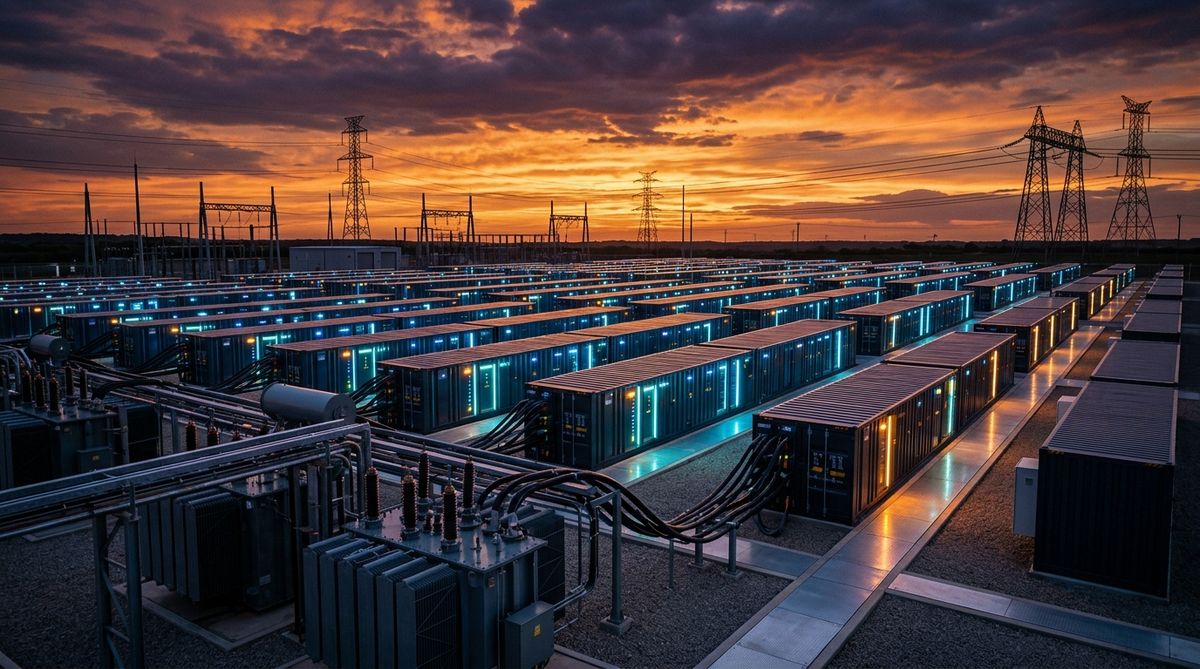
Over 700 MW delivered per minute: battery storage matched a Cernavodă nuclear unit output Romania's battery storage assets registered an instantaneous output record during the evening consumption peak, briefly exceeding the generation capacity of a Cernavodă nuclear reactor—over 700 MW. The official figures were presented by Sorin Elisei, Secretary General at the Ministry of Energy, during the Green EPC event, as reported by Economica.net and e-nergia.ro. Although total installed storage capacity remains small compared to national peak consumption exceeding 7,000 MW, the contribution of commercial battery systems and prosumers has become clearly visible to national dispatchers. At moments of maximum grid stress, when residential and industrial demand peaks, batteries injected power directly into the transmission network operated by Transelectrica. This performance demonstrates that Romania's storage assets are starting to handle critical balancing tasks, reducing temporary reliance on gas power plants or expensive power imports. Midday solar overproduction fuels storage for critical evening hours This surge in peak battery discharge is the direct result of rapid expansion in solar farms and co-located battery systems. During midday hours, when solar generation surpasses domestic demand, surplus power is routed into battery systems at low or negative Day-Ahead Market (DAM) prices. According to industry data, renewable developers have started integrating Li-Ion battery energy storage systems (BESS) at both large-scale solar utility farms and distribution substations. Sorin Elisei highlighted that charging batteries during the day allows grid operators to bridge the structural generation gap between 18:00 and 22:00, when solar output drops off while consumer demand spikes. This steep gap between midday solar output and evening demand was previously the main driver of price volatility and historic spikes in the Romanian energy market. Lowering spot market price spikes and easing balancing deficits Accelerated energy injection from batteries during evening peaks limits price spikes on the spot market and the Balancing Market. Instead of relying solely on expensive thermal generation or imports from neighboring grids, battery storage offers a flexible alternative with response times measured in seconds. For the broader market, battery integration dampens tariff shocks on the Balancing Market, where imbalance penalties often reach extreme levels. For end-consumers, greater wholesale price stability translates into reduced long-term pressure on retail tariffs. Additionally, rapid discharge capabilities provide the National Power Dispatcher (DEN) with a vital tool to maintain system frequency at 50 Hz without disconnecting heavy industrial consumers. Upcoming battery auctions and grid connection bottlenecks The ultimate test for Romania's power system lies in accelerating investments backed by the Modernisation Fund and the NRRP (PNRR). The Ministry of Energy is currently executing support schemes aiming to deploy over 1,500 MWh of battery storage capacity by 2026. The primary remaining risk is grid connection delays and Transelectrica's limited capacity to absorb energy from high-generation hubs like Dobrogea or Oltenia. Without parallel investments in transformer substations and high-voltage power lines, stored energy cannot be efficiently transmitted to major industrial hubs. Over the coming months, ANRE and the Ministry of Energy are set to finalize the regulatory framework for energy storage aggregators, enabling smaller battery installations to enter ancillary services markets directly.
Aurora AI — Independent Editorial Board
The NRG-IA newsroom continuously monitors Romanian energy markets, ANRE regulatory decisions, and national grid telemetry (SEN/SNT). We deliver independent intelligence anchored exclusively in official primary data.
Editorial Charter, Ethics & Verification Methodology →