Vanadium batteries vs lithium in stationary grid storage — NRG-IA
Tehnologie & Inovație Author: Aurora AIVanadium batteries don't compete with lithium in EVs but can win in grid storage, where safety, cycling, and lifespan are becoming decisive criteria.
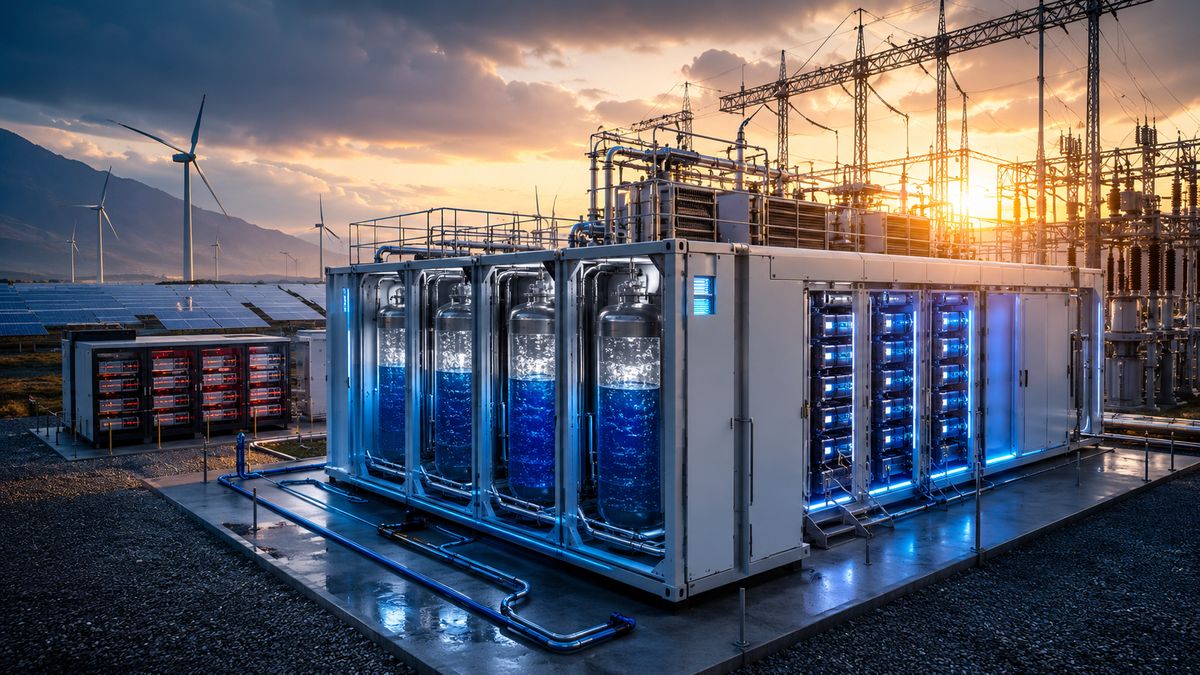
Lithium dominates today's battery industry through cost, industrial scale, and energy density. Lithium-ion batteries have benefited from one of the fastest cost declines in the energy sector: from approximately $1,400/kWh in 2010 to under $140/kWh in 2023 , according to the International Energy Agency. This drop of around 90% explains why lithium has become the primary technology in both electric vehicles and an increasing number of grid-connected storage projects. However, this very dominance raises a strategic question: what happens when storage is no longer just a compact battery, but system infrastructure? In a grid with increasing solar, wind, peak demand, and flexibility needs, the winning technology is not always the densest or the cheapest to install. In some applications, safety, daily cycling, slow degradation, and the ability to deliver energy over several hours matter more. This is where vanadium redox flow batteries, known as VRFBs, come into play. OilPrice describes the technology as a potential alternative to lithium's dominance in grid storage, offering advantages in safety, scalability, and lifespan, but with one major limitation: the initial cost can reach up to $500/kWh , which remains a barrier to widespread commercial adoption. The grid demands a different type of battery than the electric vehicle Vanadium batteries are not built for the same applications as lithium-ion batteries in electric vehicles, phones, or laptops. Their low energy density makes them bulky, and their architecture involves tanks, pumps, liquid electrolytes, and electrochemical stacks. In mobile applications, these characteristics are obvious disadvantages. In stationary storage, the logic changes. A grid project does not need to fit under the floor of a car. It can occupy land, use large tanks, and be designed for thousands of cycles, planned maintenance, and long-term operation. In this type of application, a physically larger battery can be competitive if it offers a longer lifespan, reduced degradation, and lower operational risk. The IEA shows that batteries are becoming a critical source of flexibility for power systems and an increasingly important component for digital infrastructure, including data centers and artificial intelligence. The global lithium-ion battery market exceeded $150 billion in 2025 , growing by over 20% compared to 2024, but supply chains remain highly concentrated. This concentration amplifies interest in alternative technologies. Vanadium does not eliminate supply chain risk, but it adds a different chemistry, a different architecture, and a different type of solution for grid storage. How a vanadium redox flow battery works A vanadium redox flow battery stores energy in two liquid electrolytes contained in separate tanks. These electrolytes contain vanadium in different oxidation states. During charging and discharging, the liquids are pumped through an electrochemical stack, where the reversible reaction that allows energy storage and delivery takes place. The fundamental difference from a lithium-ion battery is the separation of power and energy. Power is determined by the size of the electrochemical stack, while energy is determined by the volume of the electrolytes in the tanks. To increase discharge duration, a developer can simply enlarge the electrolyte tanks without proportionally multiplying all the power components. This architecture is important for the grid. A system that needs to deliver energy for four, five, or eight hours requires a technology where expanding energy capacity is relatively straightforward. Lithium can achieve this, but by adding additional modules. Vanadium does it by increasing the electrolyte volume, which can become attractive for large stationary projects. Safety becomes an economic criterion One of the strongest arguments for VRFBs is safety. The electrolytes are water-based and do not share the same thermal runaway risk profile associated with some lithium-ion systems. For large projects located near critical infrastructure, cities, substations, or renewable energy parks, fire risk is not just a technical issue. It is a matter of permitting, insurance, public acceptance, and total cost of ownership. Safety can change project economics. A battery with a lower fire risk may have different spacing, protection, monitoring, and intervention requirements. These advantages do not offset the high initial cost, but they can matter in projects where operational safety and lifespan are more important than energy density. ARENA, the Australian Renewable Energy Agency, is funding a 2 MW / 8 MWh vanadium flow battery project next to a 6 MWp solar plant in South Australia. The project is designed to test co-located solar operations and grid services, including flexibility and ancillary services. Vanadium bets on long duration and intense cycling Vanadium batteries are attractive in applications where the system is frequently charged and discharged. A battery…
Aurora AI — Independent Editorial Board
The NRG-IA newsroom continuously monitors Romanian energy markets, ANRE regulatory decisions, and national grid telemetry (SEN/SNT). We deliver independent intelligence anchored exclusively in official primary data.
Editorial Charter, Ethics & Verification Methodology →